UNNES Strengthens Disposable Item Reduction through Institutional Policies and Sustainable Campus Practices
SEMARANG – Universitas Negeri Semarang (UNNES) continues to strengthen its commitment to environmental sustainability by implementing institutional policies and practical initiatives to reduce disposable items across campus. As a Conservation University, UNNES promotes responsible consumption by limiting single-use plastics, styrofoam packaging, and unnecessary paper consumption while encouraging reusable and environmentally friendly alternatives in academic, administrative, and ceremonial activities.
The university implements two complementary policies: Rector’s Regulation No. 125 of 2024 concerning the Prohibition of Single-Use Plastics at UNNES and Rector’s Circular Letter No. B/28525/UN37/PA.00.00/2024 concerning the Reduction of Single-Use Plastic at UNNES. These policies establish an institutional framework for reducing disposable plastic products and promoting sustainable practices across faculties, administrative offices, canteens, and campus activities.
Rector’s Regulation No. 125 of 2024 prohibits the use of single-use plastic products, including plastic bags, disposable bottles, straws, food containers, and plastic cutlery. The regulation replaces Rector’s Regulation No. 21 of 2019, demonstrating the university’s continued commitment to plastic waste reduction.
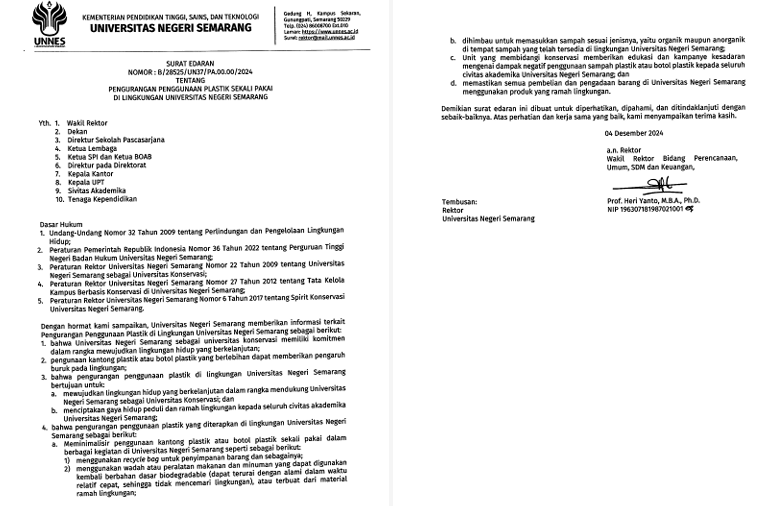
Meanwhile, Circular Letter No. B/28525/UN37/PA.00.00/2024 provides operational guidance for minimizing single-use plastic consumption, promoting waste segregation and recycling, and encouraging environmentally responsible procurement practices.
Promoting Reusable Alternatives and Environmentally Responsible Procurement
UNNES requires its academic and administrative units, campus canteens, and vendors to support the reduction of single-use plastic products in their daily operations. Disposable food packaging, plastic bottles, and plastic shopping bags are replaced with more sustainable alternatives, including reusable tumblers, environmentally friendly food containers, sustainable tableware, and cloth bags.
Each university work unit is responsible for encouraging environmentally responsible purchasing practices and ensuring that vendors operating within its facilities comply with the university’s applicable environmental and procurement requirements.
These measures are complemented by waste segregation and recycling initiatives designed to reduce the amount of disposable material generated across campus. By promoting reusable products and responsible waste management, UNNES integrates sustainability considerations into its operational activities and procurement practices.
Providing Drinking Water Refill Facilities to Reduce Plastic Bottle Consumption
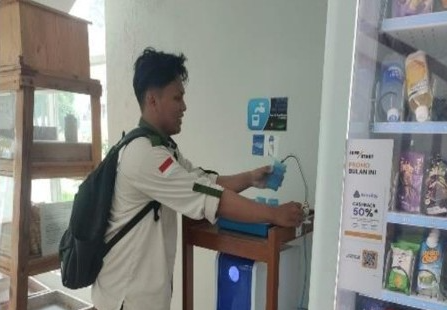
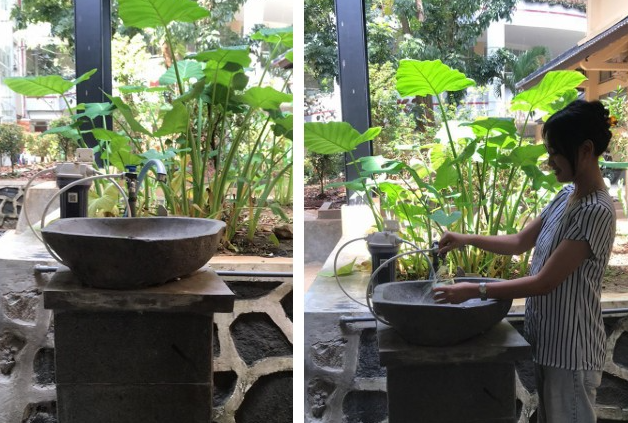
To reduce dependence on packaged drinking water, UNNES provides 21 drinking water refill stations across university facilities. These stations enable students, lecturers, staff, and visitors to refill reusable drinking bottles instead of purchasing single-use plastic bottles.
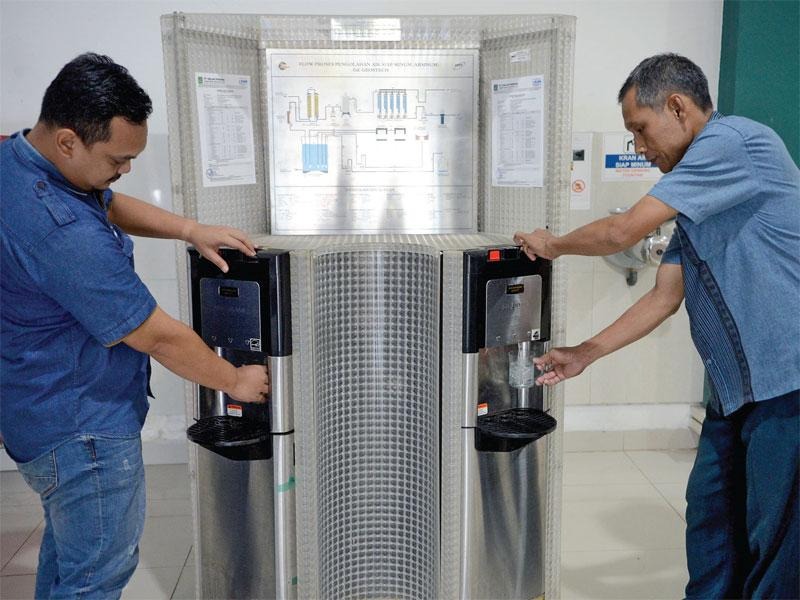
The facilities include drinking water dispensers and filtration systems utilizing Reverse Osmosis (RO) technology. At the Faculty of Medicine (FK UNNES), RO-based water filtration facilities have been introduced to support the university’s Green Campus initiative and improve access to refillable drinking water.
Other faculties, including the Faculty of Mathematics and Natural Sciences (FMIPA), also provide free drinking water stations to encourage reusable bottle consumption and minimize disposable packaging.
These facilities demonstrate the practical implementation of UNNES’s plastic reduction policies by making sustainable alternatives accessible during lectures, administrative activities, meetings, and campus events.
Reducing Paper Consumption through Digital Academic Services
Beyond plastic waste reduction, UNNES promotes paper-saving practices through the use of digital academic services and environmentally responsible documentation.
The university encourages online academic consultation systems, allowing students and lecturers to conduct consultations, exchange documents, and review academic work electronically. This approach reduces the need for repeated printing during academic supervision and administrative processes.
UNNES also promotes the use of recycled paper for final project drafts, supporting more responsible paper consumption during academic activities.
By integrating digital consultation processes with paper-saving practices, the university seeks to minimize unnecessary printing, reduce disposable paper use, and encourage the academic community to adopt more sustainable working habits.
These initiatives extend the university’s waste reduction efforts beyond plastic products by addressing disposable materials commonly used in teaching, research, and administration.
Eliminating Styrofoam and Promoting Sustainable Campus Events
UNNES also implements measures to reduce disposable materials during official university activities, including graduation ceremonies, university anniversaries, meetings, seminars, and other institutional events.
The university prohibits the use of styrofoam in campus activities and encourages organizers, vendors, and participants to adopt reusable or environmentally preferable materials for food packaging, decorations, and ceremonial purposes.
Since 2025, the university has also promoted the replacement of plastic- and styrofoam-based congratulatory displays and souvenirs with environmentally friendly alternatives. Live plants accompanied by small paper greeting cards are encouraged as substitutes for conventional congratulatory displays.
This initiative demonstrates the integration of sustainability principles into university traditions and ceremonial activities while reducing the use of disposable decorative materials. Through these practices, UNNES encourages its academic community and external partners to consider environmental impacts when selecting products, packaging, gifts, and event materials.
Strengthening Policy Implementation and Waste Reduction Practices
Implementation of the university’s disposable item reduction policies is supported by coordination among work units, environmental awareness initiatives, and institutional waste management activities.
Faculties, administrative offices, canteens, and vendors are expected to comply with the applicable regulations by minimizing disposable products, providing reusable alternatives, supporting waste segregation, and encouraging recycling.
The university also promotes environmental education and awareness to strengthen the adoption of sustainable consumption practices among students, lecturers, staff, and visitors.
Together, these initiatives demonstrate how UNNES translates its environmental policies into practical actions, including reduced reliance on plastic bottles, alternatives to styrofoam packaging, paper-saving academic services, and environmentally responsible campus events.
Through the implementation of Rector’s Regulation No. 125 of 2024 and Rector’s Circular Letter No. B/28525/UN37/PA.00.00/2024, UNNES continues to strengthen its institutional approach to reducing disposable items and promoting sustainable consumption particularly efforts to prevent and reduce waste generation through sustainable purchasing, reuse, recycling, and responsible resource management. By integrating these practices into campus operations and academic activities, UNNES reinforces its commitment to building a more environmentally responsible university community.