UNNES Strengthens Environmental Compliance among Vendors and External Partners through Single-Use Plastic Reduction Policies
SEMARANG – Universitas Negeri Semarang (UNNES) continues to strengthen its commitment to environmental sustainability by extending its single-use plastic reduction policies to external parties, including vendors, outsourced service providers, contractors, event organizers, and partners utilizing university facilities. As a Conservation University, UNNES promotes shared environmental responsibility by requiring campus activities and service arrangements to support waste reduction, sustainable procurement, and environmentally friendly practices.
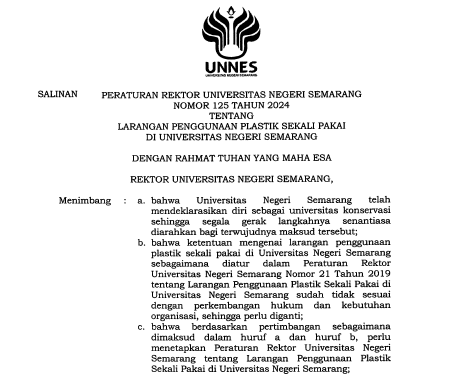
The university’s approach is supported by three institutional regulations: Rector’s Regulation No. 125 of 2024 concerning the Prohibition of Single-Use Plastics, Rector’s Circular Letter No. B/28525/UN37/PA.00.00/2024 concerning the Reduction of Single-Use Plastic, and Rector’s Regulation No. 79 of 2024 concerning the Guidelines for the Procurement of Goods and Services.
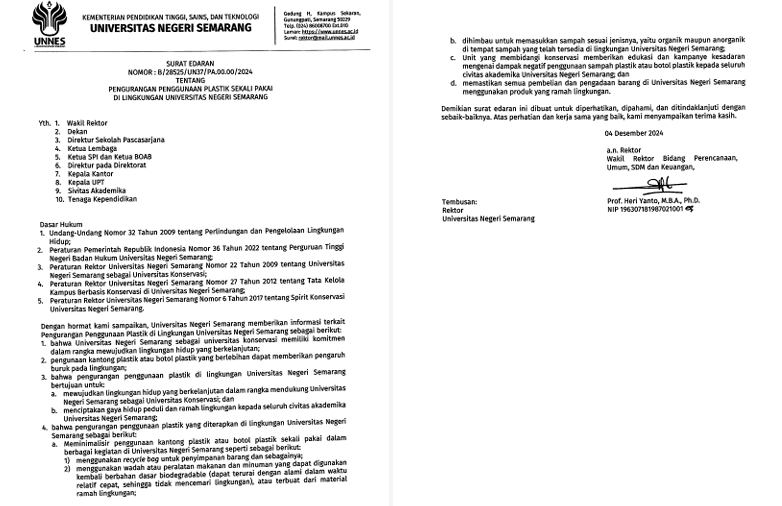
These policies establish a framework for reducing disposable plastic consumption, encouraging responsible purchasing, and integrating environmental considerations into university operations and cooperation with external service providers.
Rector’s Regulation No. 125 of 2024 explicitly extends the prohibition of single-use plastics to UNNES community members and visitors, while the accompanying circular promotes reusable alternatives, proper waste segregation, and environmentally responsible purchasing practices.
Extending Environmental Standards to Vendors and Outsourced Services
UNNES integrates environmental considerations into its relationships with external vendors and service providers, including catering businesses, cleaning services, suppliers, and other contractors operating within university facilities.
In line with its plastic reduction policies, the university expects service providers to minimize single-use plastic products, including disposable bottles, plastic bags, styrofoam containers, and plastic food packaging. Vendors are encouraged to replace these materials with reusable or appropriate biodegradable alternatives, such as refillable drinking containers, sustainable tableware, cloth bags, and environmentally preferable food packaging.
The university also promotes responsible sourcing practices by encouraging suppliers to prioritize sustainable local products where feasible. This approach supports waste prevention while creating opportunities for environmentally responsible local businesses.
Each university work unit is responsible for communicating applicable environmental requirements to its vendors and coordinating compliance within its area of responsibility. Through these measures, UNNES seeks to ensure that environmental considerations are reflected not only in internal campus operations but also throughout its external service and supply arrangements.
Applying Plastic Reduction Requirements to External Events and Facility Rentals
UNNES also extends its sustainability expectations to external organizations and individuals using university facilities, including those renting buildings, meeting rooms, auditoriums, and other event spaces.
External event organizers, catering providers, and facility users are expected to respect the university’s plastic reduction policies by minimizing disposable products, using reusable or environmentally friendly alternatives, and ensuring responsible waste management during their activities.
Environmental requirements communicated through facility-use arrangements may include avoiding single-use plastic bottles and styrofoam food containers, providing appropriate waste segregation facilities, and maintaining cleanliness after events.

These practices are particularly relevant to conferences, seminars, exhibitions, meetings, and other activities involving external partners. By encouraging organizers to adopt sustainable practices, UNNES seeks to maintain consistent environmental standards regardless of whether activities are organized internally or externally.
One example of environmentally responsible food provision can be seen in activities at the Faculty of Mathematics and Natural Sciences (FMIPA), where traditional boiled foods have been presented using tampah, a traditional woven bamboo tray. This practice illustrates how locally available, reusable serving materials can support more sustainable event practices.
Strengthening Environmental Responsibility through Procurement Policies
UNNES further reinforces responsible supplier management through Rector’s Regulation No. 79 of 2024 concerning the Guidelines for the Procurement of Goods and Services.
The regulation provides institutional guidance for procurement procedures, supplier selection, and accountability in purchasing goods and services. Combined with the university’s plastic reduction policies, this framework supports the integration of environmental considerations into procurement and cooperation with external service providers.
University work units are encouraged to consider the environmental implications of goods and services, particularly the use of disposable packaging, reusable products, and sustainable materials.
For outsourced services and supply arrangements, these considerations help promote responsible resource use and encourage vendors to participate in the university’s broader waste reduction initiatives.
By connecting procurement procedures with environmental policies, UNNES aims to strengthen responsible supply chain management and ensure that its sustainability commitments are communicated to external business partners.
Monitoring Compliance and Strengthening Accountability
Effective implementation of the university’s environmental policies requires coordination between work units responsible for campus facilities, procurement, event management, and external service arrangements.
Rector’s Regulation No. 125 of 2024 requires university units to support, facilitate, and coordinate the implementation of the single-use plastic prohibition. The regulation also provides for administrative sanctions, including verbal or written warnings, in cases of non-compliance.
For external partners, compliance responsibilities can be reinforced through applicable procurement documents, service agreements, and facility-use arrangements. Where environmental requirements are expressly included in contractual terms, non-compliance may lead to corrective measures or other contractual consequences in accordance with the relevant agreement.
UNNES also recognizes the importance of strengthening compliance monitoring through documented assessments of vendor practices, environmental requirements, and waste management performance. Such monitoring can support consistent implementation and provide evidence for evaluating the effectiveness of the university’s sustainability policies.
Through regulatory enforcement, institutional coordination, and responsible partnership management, UNNES seeks to ensure that environmental commitments are consistently reflected in activities conducted by both university units and external parties.
Promoting Shared Environmental Responsibility for a Sustainable Campus
UNNES’s approach demonstrates that environmental sustainability extends beyond internal campus activities to include external service providers, business partners, and organizations utilizing university facilities.
By integrating single-use plastic restrictions with responsible procurement practices, vendor expectations, facility-use requirements, and institutional oversight, the university promotes a shared commitment to reducing disposable waste and encouraging environmentally responsible consumption. Through continued policy implementation and cooperation with external stakeholders, UNNES strengthens its identity as a Conservation University while promoting a more sustainable campus environment and responsible supply chain.