UNNES Strengthens Hazardous Waste Management through Certified Partnerships and Sustainable Treatment Systems
SEMARANG – Universitas Negeri Semarang (UNNES) continues to strengthen its commitment to environmental sustainability through the implementation of institutional policies, certified third-party partnerships, and sustainable treatment technologies for hazardous and toxic waste, known in Indonesia as Bahan Berbahaya dan Beracun (B3). These initiatives aim to ensure that hazardous waste generated across university facilities is properly identified, stored, transported, and managed in accordance with environmental regulations.
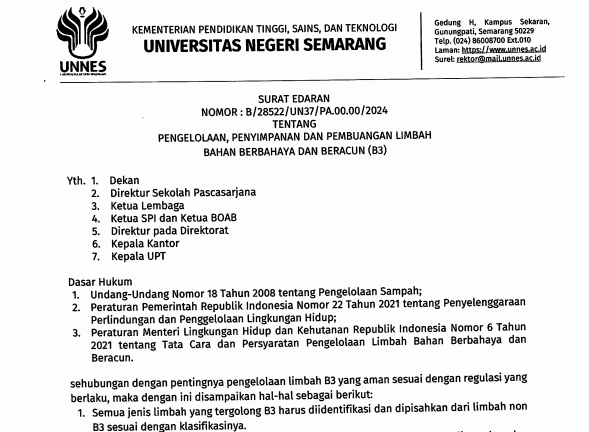
The university’s hazardous waste management system is governed by Rector’s Circular Letter No. B/28522/UN37/PA.00.00/2024 concerning the Management, Storage, and Disposal of Hazardous and Toxic Waste. The policy requires every waste-generating unit, including laboratories, academic facilities, and healthcare services, to identify, classify, and store hazardous waste appropriately before collection and further treatment or disposal.
Strengthening Hazardous Waste Disposal through Certified Third-Party Partnerships
To ensure responsible hazardous waste disposal, UNNES collaborates with PT Bendi Nasha Niaga Industri, a certified waste management service provider responsible for transporting hazardous waste from the university to an authorized hazardous waste management facility in Banten Province.
The partnership is documented through Memorandum of Understanding (MoU) No. B/2453/UN/37.5.2.2/TU/2021, establishing a formal cooperation framework for hazardous waste collection, transportation, and management.
Hazardous waste is collected and transported periodically, approximately every four months, to ensure that waste generated across university units is managed safely and systematically. UNNES generates approximately two tons of hazardous waste annually, including electronic waste, healthcare-related hazardous waste, and hazardous materials from laboratories and other campus facilities.
Since 2025, UNNES has fully implemented the requirement to transfer hazardous waste to licensed third-party waste management providers. This measure strengthens institutional compliance with hazardous waste management regulations and helps ensure that hazardous materials are handled through authorized treatment and disposal processes.
PT Bendi Nasha Niaga Industri provides services covering hazardous waste collection, transportation, delivery to authorized processing or recovery facilities, monitoring, and waste management documentation. Through this collaboration, UNNES strengthens accountability and traceability throughout the hazardous waste management process.
Implementing Bioremediation Technology for Laboratory Liquid Waste
In addition to managing solid hazardous waste, UNNES implements treatment measures for liquid waste generated by laboratory activities. The university operates four liquid waste treatment units utilizing bioremediation technology, which uses biological processes to reduce contaminants and support environmentally responsible wastewater management.
These treatment units form part of the university’s efforts to minimize environmental risks associated with laboratory operations and strengthen sustainable waste management practices.
By integrating laboratory liquid waste treatment with institutional hazardous waste management procedures, UNNES promotes a more comprehensive approach to environmental protection across its academic and research facilities.
Developing an Integrated Hazardous Waste Storage Facility by 2027
As part of its continuous improvement strategy, UNNES plans to establish an integrated hazardous waste storage facility by 2027. The proposed facility is intended to serve all hazardous waste-generating units across the university, providing a centralized system for temporary storage before collection and transportation by licensed third-party service providers.
The planned development is expected to strengthen coordination among university units, improve waste storage management, and support more systematic monitoring of hazardous waste generated throughout the campus.
Through its institutional regulations, cooperation with certified waste management providers, bioremediation-based liquid waste treatment, and planned infrastructure development, UNNES continues to strengthen its hazardous waste management system. These efforts demonstrate the university’s commitment to preventing environmental contamination, promoting responsible waste disposal, and supporting the Sustainable Development Goals (SDGs).