UNNES Strengthens Sustainable Procurement for Suppliers and Construction Services through Institutional Policies and Oversight
SEMARANG – Universitas Negeri Semarang (UNNES) continues to strengthen its commitment to environmental sustainability by integrating responsible procurement principles into the purchasing of goods, services, equipment, and construction-related work. As a Conservation University, UNNES promotes environmentally conscious purchasing practices, ethical sourcing, and supplier accountability to ensure that procurement activities support institutional sustainability objectives.
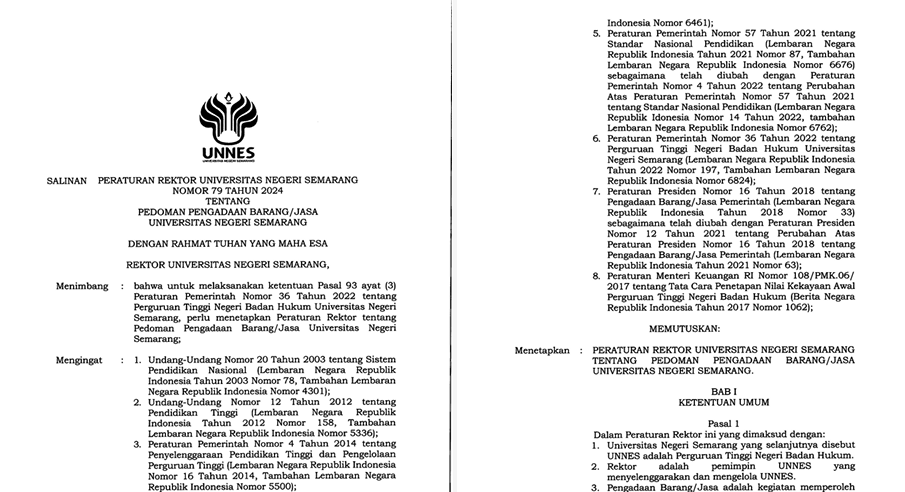
The university’s procurement system is governed by Rector’s Regulation No. 79 of 2024 concerning the Guidelines for the Procurement of Goods and Services. The regulation establishes the institutional framework for procurement planning, supplier qualifications, contract management, performance evaluation, and oversight, covering purchases ranging from office supplies and laboratory equipment to construction and infrastructure development.
The regulation emphasizes efficiency, economic considerations, sound business practices, integrity, and compliance with applicable requirements. These principles provide the foundation for transparent and accountable procurement while supporting the university’s broader commitment to environmental sustainability.
Integrating Environmental Sustainability into Supplier and Contractor Requirements
UNNES promotes sustainable procurement by encouraging suppliers and construction partners to adopt environmentally responsible practices throughout the procurement process. Article 5 of Rector’s Regulation No. 79 of 2024 establishes the principles of efficiency, economy, and sound business practices. Meanwhile, Article 16 requires suppliers to demonstrate legal compliance, professional competence, technical and managerial capabilities, relevant experience, and adequate resources to fulfill procurement contracts.
Building on these requirements, UNNES integrates its conservation-oriented priorities into procurement practices by promoting environmentally friendly materials, ethical sourcing, resource efficiency, and responsible construction methods.
For goods and supplies, the university prioritizes environmentally preferable products and sustainable local sourcing where appropriate. These considerations encourage reduced packaging waste, responsible material selection, and support for local suppliers adopting sustainable business practices.
In construction and infrastructure projects, UNNES promotes environmentally conscious approaches, including responsible material use, construction waste management, and efficient resource utilization. These priorities support the university’s efforts to reduce the environmental impacts associated with campus development and maintenance.
By incorporating sustainability considerations into purchasing decisions and technical requirements, UNNES seeks to encourage suppliers and contractors to contribute to its long-term conservation objectives.
Strengthening Supplier Evaluation and Procurement Accountability
UNNES manages procurement activities through its Procurement Services Office (Kantor Pelayanan Pengadaan or KPP UNNES) in coordination with university work units and personnel responsible for asset management.
Supplier selection is supported by administrative and technical qualification requirements, including legal status, professional competence, relevant experience, financial capability, and the ability to fulfill contractual obligations.
In applying its sustainability priorities, UNNES also encourages environmental considerations to be incorporated into supplier assessments and technical specifications where relevant to the procurement package. These considerations may include the environmental characteristics of supplied materials, resource efficiency, waste management practices, and compliance with applicable environmental requirements.
Furthermore, Article 17 of Rector’s Regulation No. 79 of 2024 requires registered suppliers in the university’s Selected Supplier List (Daftar Penyedia Terpilih, DPT) to undergo annual performance evaluations. These evaluations provide a formal mechanism for reviewing supplier performance, including contract fulfillment, quality, delivery timeliness, and other applicable requirements.
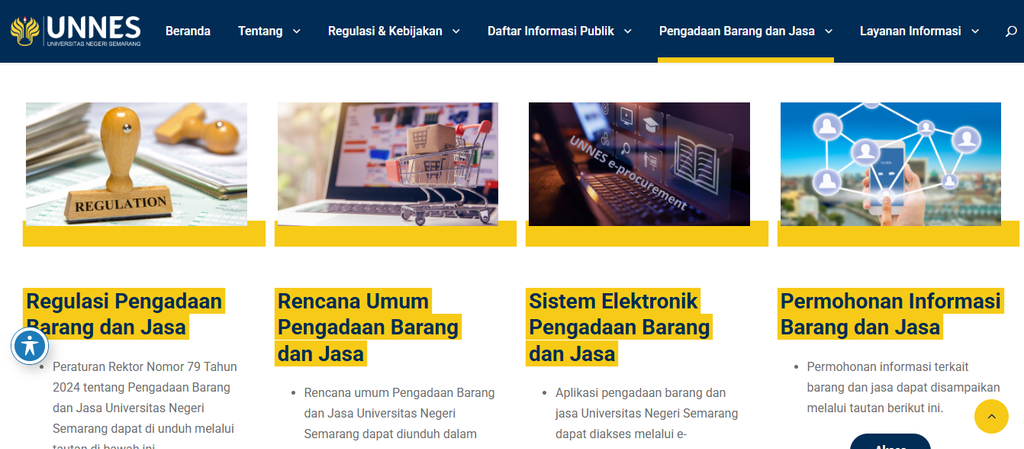
The university also supports procurement transparency through its Public Information and Documentation Management Office (PPID), which provides access to procurement regulations, procurement plans, and electronic procurement services.
These mechanisms strengthen institutional accountability and encourage suppliers to maintain professional and responsible business practices throughout their cooperation with UNNES.
Strengthening Institutional Oversight through 2025 Audit Activities
UNNES reinforces procurement accountability through institutional oversight and internal auditing mechanisms.
Article 58 of Rector’s Regulation No. 79 of 2024 requires the university’s Internal Audit Unit (Satuan Pengawas Internal, SPI) to conduct oversight through audits, reviews, or evaluations of officials involved in procurement planning, supplier selection, and quality control, in accordance with their respective responsibilities.
In 2025, UNNES also underwent examinations of strategic educational programmes by Indonesia’s Financial and Development Supervisory Agency (Badan Pengawasan Keuangan dan Pembangunan, BPKP). Conducted from 26 May to 20 June 2025, the examination covered three major areas: improving educational accessibility through facilities and infrastructure, strengthening teaching and administrative personnel, and optimizing educational assistance funding.
SPI supported the examination by coordinating with university work units and preparing relevant documentation and information for the auditors. The examination included infrastructure-related programme management, providing an example of institutional oversight relevant to university facilities and resource allocation.
UNNES also conducted internal compliance audits during 2025. For example, on 17 October 2025, SPI carried out a compliance audit at the Faculty of Economics and Business (FEB), covering financial management, assets, human resources, and information technology.
The university’s 2025 internal audit activities were further documented in the 2025 Internal Audit Report, officially submitted by SPI Chair Prof. Dr. Muhammad Khafid, M.Si., QIA, to the Rector on 19 January 2026. According to the official SPI publication, the audits evaluated regulatory compliance, internal control effectiveness, and the efficiency and effectiveness of university programmes and activities.
These documented oversight activities demonstrate UNNES’s continuing efforts to strengthen governance, accountability, and compliance across its operations. While the published reports confirm institutional auditing activities, they do not separately identify environmental audit findings for suppliers or construction contractors.
Source: UNNES Internal Audit Unit (SPI).
Enforcing Supplier Compliance and Responsible Procurement Practices
UNNES further strengthens supplier accountability through procurement regulations governing contractual performance and sanctions.
Article 59 of Rector’s Regulation No. 79 of 2024 establishes consequences for supplier misconduct, including collusion, misrepresentation, failure to fulfill procurement requirements, and non-performance of contractual obligations.
Depending on the violation, sanctions may include administrative measures, removal from the Selected Supplier List, civil legal action, or referral to the relevant authorities.
These provisions help ensure that suppliers and contractors fulfill their contractual responsibilities and maintain professional integrity throughout procurement activities.
In addition to these regulatory controls, UNNES continues to promote sustainability considerations in procurement specifications and supplier relationships, encouraging environmentally responsible materials, sustainable sourcing, and resource-efficient construction practices.
Through coordination among procurement personnel, asset management functions, and internal oversight mechanisms, the university seeks to strengthen responsible supply chain management and ensure that purchasing decisions remain aligned with its conservation-oriented institutional vision.
Advancing Sustainable Procurement and Institutional Accountability
Through Rector’s Regulation No. 79 of 2024, UNNES has established a procurement framework covering suppliers, service providers, and construction contractors. The regulation combines qualification requirements, contractual accountability, supplier performance evaluation, and institutional oversight.
Supported by its conservation commitments, procurement transparency mechanisms, and documented audit activities during 2025, UNNES continues to promote environmentally responsible purchasing and infrastructure development. By connecting institutional procurement procedures with environmental sustainability priorities, UNNES seeks to build a more responsible supply chain and ensure that its development activities contribute to long-term environmental conservation and sustainable institutional growth.