UNNES Strengthens Waste Measurement and Monitoring through Integrated Waste Management Policies and Facilities
SEMARANG – Universitas Negeri Semarang (UNNES) continues to strengthen its commitment to sustainable waste management through institutional policies, systematic waste measurement, and integrated recycling facilities. The university actively monitors waste generation, recycling, and landfill diversion through its Integrated Waste Processing Facility (Tempat Pengolahan Sampah Terpadu, TPST), which began operating in 2019 and supported the achievement of its zero-waste-to-landfill target by 2020.
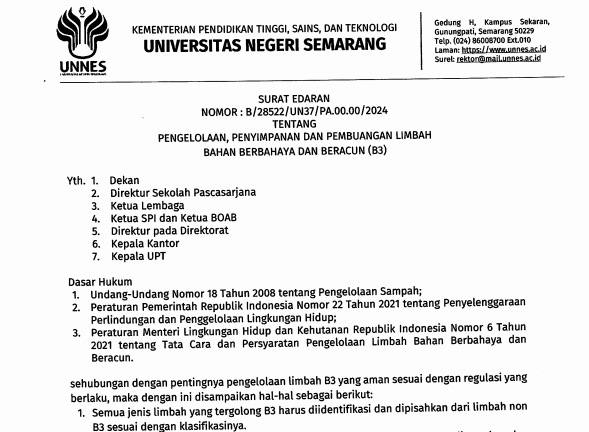
The university’s waste monitoring system is guided by Rector’s Circular Letter No. B/28401/UN37/RT.02/2024 on the Obligation of Waste Recycling within UNNES. This policy requires academic faculties and administrative units to separate waste into organic, inorganic, and hazardous and toxic waste (B3) categories and report their waste management activities.
The policy establishes an institutional framework for measuring waste generation and recycling performance through daily waste segregation, weighing, recording, and periodic reporting. These procedures enable UNNES to monitor the amount of waste generated, identify the quantities processed or recycled, and evaluate waste diversion from municipal landfills.
Implementing Daily Waste Measurement and Reporting
UNNES implements a systematic waste monitoring mechanism involving university work units and the Conservation Development Unit. Each faculty and administrative unit is responsible for separating waste at its source into organic, inorganic, and hazardous categories before collection and further processing.
Waste collected from university facilities is transported to the TPST, where it is weighed, classified, and recorded according to its type and subsequent treatment method. These records provide quantitative information on waste generation and support the measurement of recycling and landfill diversion performance.
The waste monitoring process includes recording the quantities of organic waste processed into compost or maggot feed, inorganic waste transferred for recycling, and residual waste requiring alternative treatment. Periodic reporting enables the university to evaluate waste management performance, identify changes in waste generation, and monitor compliance with institutional waste management policies.
Through this integrated recording system, UNNES measures not only the total amount of waste generated but also the proportion managed through recycling, resource recovery, and other treatment methods, providing an institutional basis for monitoring waste diverted from landfills.
Tracking Waste Generation and Recycling Performance
UNNES manages waste through its integrated processing facility, where different waste streams are processed according to their characteristics and potential for recycling or resource recovery.
In 2025, UNNES recorded approximately 4,275 tons of organic waste, consisting of 4,217 tons of leaf waste, 36 tons of food scraps, and 22 tons of other organic materials.
Of the total leaf waste generated, approximately 4,165.81 tons were processed into compost, while 51.19 tons could not be composted and required alternative treatment through the university’s incineration system. Meanwhile, food scraps were utilized as feed for black soldier fly (BSF) larvae, commonly known as maggots, supporting organic waste recovery and sustainable feed production. The remaining 22 tons of other organic waste were also managed through alternative treatment.
Inorganic waste is managed through recycling and cooperation with external recycling partners. In 2025, UNNES recorded 1.73 tons of hard plastic and 26.89 tons of soft plastic, totaling 28.62 tons of plastic waste. The collected plastic was shredded and sold as raw material for further recycling.
Additionally, 7.83 tons of paper waste were transferred to PT Pura Nusapersada in Kudus, Central Java, for recycling into paper products.
These waste management practices demonstrate how UNNES integrates waste measurement with practical recycling activities, enabling the university to track the quantities of materials recovered and processed while reducing the volume of waste requiring final disposal.
UNNES Conservation Website – Integrated Waste Management Site.
Source: https://unnes.ac.id/konservasi/integrated-waste-management-site/
Measuring Waste Diversion from Municipal Landfills
UNNES has implemented an integrated waste management approach since the establishment of its TPST in 2019. Through waste segregation, composting, recycling, and alternative treatment methods, the university achieved its zero-waste-to-landfill target in 2020.
Since 2020, UNNES has reported that no campus waste has been sent to city-managed landfills. Instead, organic materials are processed through composting and maggot cultivation, recyclable plastics and paper are transferred to recycling channels, and non-recyclable residues are managed through alternative treatment methods.
To monitor this achievement, the university records waste generation and processing activities, including the quantities recovered through recycling, treated on campus, and transferred to external recycling partners.
By comparing recorded waste generation with the quantities processed through each management pathway, UNNES can assess landfill diversion performance and monitor the effectiveness of its waste reduction initiatives.
This measurement approach supports institutional accountability by linking waste management policies with quantifiable operational data and periodic evaluation.
Expanding Waste Management Infrastructure and Digital Monitoring
To strengthen its waste management capacity, UNNES constructed a new and larger Integrated Waste Processing Facility (TPST) in 2025, with an investment of approximately IDR 5.8 billion. The facility was developed to improve waste processing capacity and support more systematic waste collection, segregation, and resource recovery across the university.
As part of its continuing improvements, UNNES also planned the development of a waste monitoring dashboard in 2026 to enhance data recording, consolidation, and reporting. The proposed digital system is intended to improve the monitoring of waste quantities, recycling activities, and landfill diversion performance across academic and administrative units.
These infrastructure and monitoring initiatives are expected to strengthen the university’s ability to maintain consistent waste records, assess recycling outcomes, and support evidence-based waste management decisions.
Through Rector’s Circular Letter No. B/28401/UN37/RT.02/2024, daily waste measurement, integrated processing facilities, and planned digital monitoring improvements, UNNES continues to implement a comprehensive institutional approach to waste management.
By systematically tracking waste generation, recycling, and landfill diversion, the university reinforces its commitment to sustainable campus operations and supports Sustainable Development Goal 12 (Responsible Consumption and Production), particularly efforts to reduce waste generation through prevention, reduction, recycling, and reuse.