Semarang — Universitas Negeri Semarang (UNNES) recorded total energy consumption of 37,194 gigajoules (GJ) in 2025, covering grid electricity, on-campus solar energy, fuel for official vehicles, and fuel for backup generators. This consolidated inventory provides a baseline for assessing energy use across university operations and identifying opportunities to improve efficiency.
The university’s total energy use includes both electricity consumption and direct fuel consumption. Electricity supplied by the national grid (PLN) accounted for 32,016.996 GJ, equivalent to 8,893,610 kWh. On-campus solar photovoltaic systems across 20 monitored locations contributed a further 2,538.8496 GJ, equivalent to 705,236 kWh.
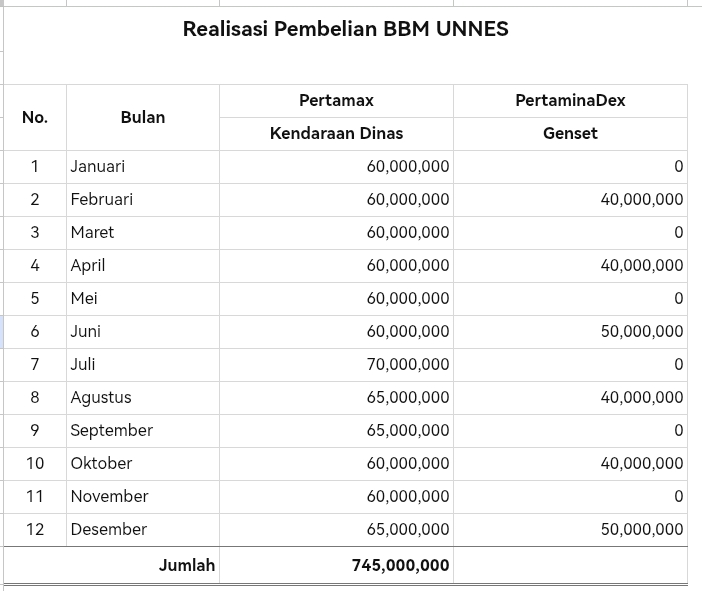
Beyond electricity, UNNES recorded an estimated 1,976.36 GJ from Pertamax fuel used by official university vehicles and 661.88 GJ from Pertamina Dex fuel used for backup generators. Together, these four categories amounted to 37,194.0856 GJ, reported as 37,194 GJ after rounding.
| Energy source | Operational use | Energy used in 2025 (GJ) |
|---|---|---|
| PLN grid electricity | Electricity for campus facilities | 32,016.996 |
| On-campus solar photovoltaics | Renewable electricity across 20 monitored locations | 2,538.8496 |
| Pertamax | Fuel for official university vehicles | 1,976.36 |
| Pertamina Dex | Fuel for backup generators | 661.88 |
| Total energy used | Combined electricity and fuel consumption | 37,194.0856 |
The inventory draws on electricity records maintained through the myUNNES-Office system and annual fuel purchase records. Electricity consumption is converted into gigajoules using a conversion factor of 0.0036 GJ per kWh, allowing electricity and fuel use to be consolidated into a common reporting unit. Generator fuel is included in the total, while the electricity produced from that fuel is not added separately, avoiding double counting.
By documenting its total annual energy consumption, UNNES establishes a measurable foundation for energy management. These records support targeted efficiency measures, planning for renewable energy infrastructure, and monitoring progress toward lower-carbon campus operations, reflecting the university’s commitment to responsible energy use and climate action.