SEMARANG — Universitas Negeri Semarang (UNNES) expanded access to higher education for international students from low- and lower-middle-income countries in 2025 by providing scholarships, tuition fee waivers, accommodation assistance, and living allowances. Through various international scholarship schemes, UNNES seeks to reduce the financial barriers that international students face in accessing higher education and pursuing their studies in Indonesia.
This commitment is reflected in UNNES Rector’s Decree No. B/948/UN37/HK.02/2025, dated 5 September 2025. Of the 22 international students awarded International Undergraduate Program (IUP) and NEXTShip scholarships for the 2025/2026 academic year, 15 students, or 68.2%, came from low- and lower-middle-income countries, based on the World Bank’s country income classifications applicable in 2025.
This assistance forms part of UNNES’s broader international scholarship provision. In September 2025, the university welcomed 48 new international students, 39 of whom received support through the IUP, NEXTShip, Developing Countries Partnership Scholarship (KNB), and The Indonesian AID Scholarship (TIAS) schemes.
110 Active International Students from Diverse Countries
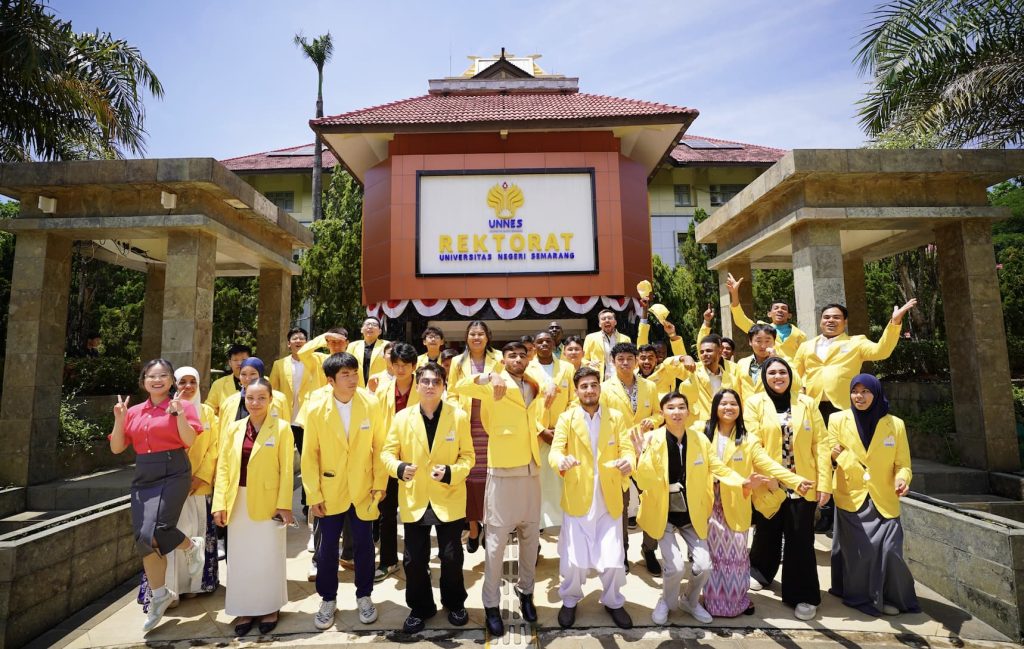
In 2025, UNNES had 110 active international students from various countries. They were enrolled in undergraduate, master’s, and doctoral programmes in fields including management, accounting, law, public health, civil engineering, informatics engineering, language education, development economics, and other disciplines.
These international students came from countries across Asia, Africa, Europe, and the Pacific region, including Timor-Leste, Kyrgyzstan, Thailand, Myanmar, Tajikistan, Kazakhstan, Nigeria, China, Pakistan, South Sudan, and Bangladesh.
The diversity of students’ countries of origin and academic disciplines reflects UNNES’s international reach. Financial assistance through various scholarship schemes is one of the university’s efforts to expand educational opportunities for students from diverse national and economic backgrounds.
Fifteen Scholarship Recipients from Low- and Lower-Middle-Income Countries
According to the appendix to Rector’s Decree No. B/948/UN37/HK.02/2025, 22 students received IUP and NEXTShip scholarships. Of these, 15 students came from nine countries classified as low-income or lower-middle-income economies.
They comprised one student from South Sudan, one from Sudan, one from Yemen, two from Myanmar, five from Kyrgyzstan, one from Bangladesh, one from Nigeria, two from Pakistan, and one from the Philippines.
The remaining seven recipients came from Kazakhstan and Thailand. This categorisation refers to the World Bank’s income classification for fiscal year 2026, which took effect on 1 July 2025.
Consequently, 68.2% of the IUP and NEXTShip scholarship recipients appointed by UNNES in September 2025 came from countries within these income groups.
The recipients pursued studies across various disciplines, including public health, management, chemical engineering, law, development economics, language education, information technology education, natural science education, curriculum development, and sports education.
Tuition Fee Waivers and Living Allowances
UNNES established the funding components for its international scholarships through Rector’s Decree No. T/725/UN37/HK.02/2025, dated 25 June 2025, concerning the IUP and NEXTShip scholarship components.
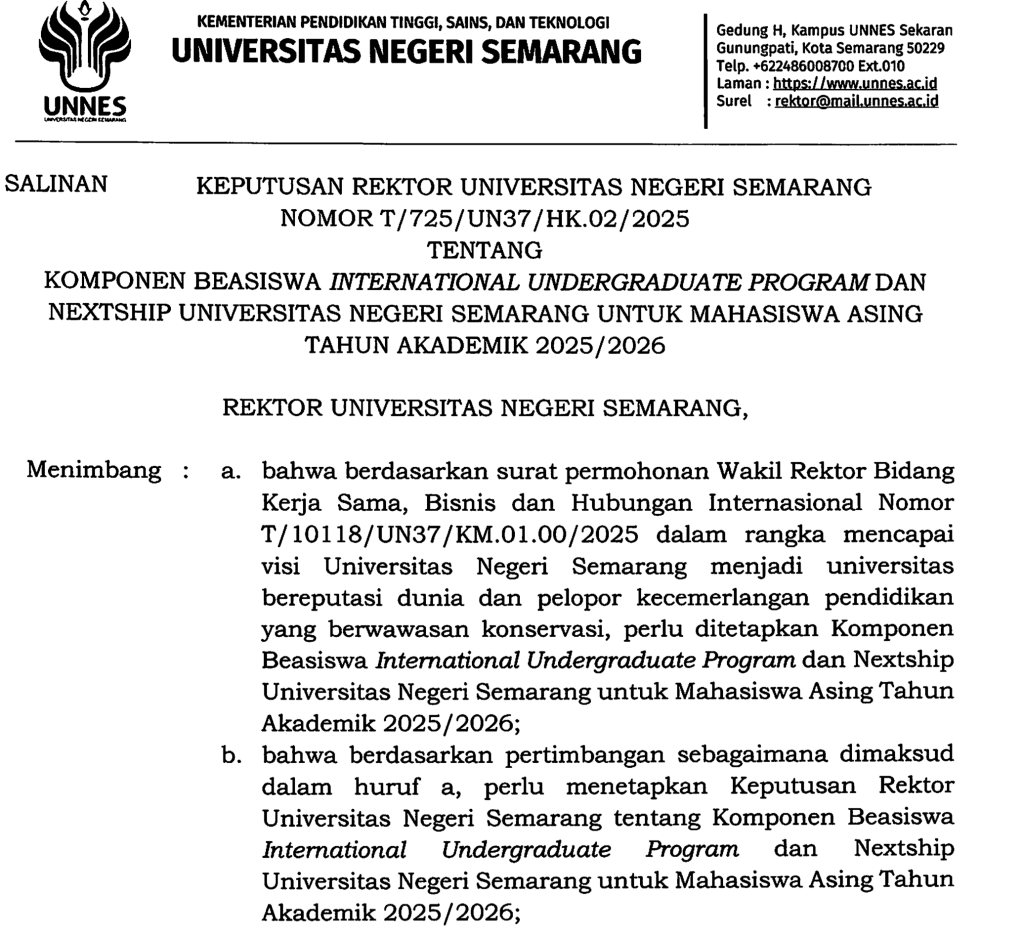
The support includes waivers for registration fees and tuition fees, known as Uang Kuliah Tunggal (UKT). Accommodation assistance, living allowances, visa support, and domestic arrival travel assistance are also available, subject to the applicable provisions and each recipient’s entitlements.
Rector Regulation Strengthens International Scholarship Governance
The implementation of international scholarships is also supported by UNNES Rector Regulation No. 20 of 2025, issued on 15 May 2025.
The regulation establishes guidelines for awarding scholarships to international students enrolled in undergraduate, master’s, doctoral, and non-degree programmes. It covers recipient eligibility requirements, scholarship management mechanisms, funding periods, evaluation, and scholarship termination.
The regulation provides an institutional framework for managing international scholarship programmes in a structured and sustainable manner.
It also specifies the duration of scholarship assistance and the evaluation procedures for recipients throughout their study period, in accordance with the requirements of each scholarship scheme.
Four Scholarship Schemes Support 39 New International Students at UNNES
The expansion of access to international education was reflected in the welcoming ceremony for new international students held on Friday, 12 September 2025, at Room 405 of the UNNES Rectorate Building.
In the 2025/2026 academic year, UNNES welcomed 48 new international students. Of these, 35 enrolled in degree programmes at the undergraduate, master’s, and doctoral levels, while the remaining 13 joined the Indonesian Language for Foreign Speakers (BIPA) non-degree programme.
Among the degree programme students, 15 received IUP scholarships, seven received NEXTShip scholarships, and four received Developing Countries Partnership (KNB) scholarships. Meanwhile, five BIPA participants received KNB scholarships, while eight others joined the programme through The Indonesian AID Scholarship (TIAS).
In total, 39 of the 48 new international students, or 81.25%, received scholarships through these four schemes. The remaining nine students pursued their studies through self-funding.
The scholarship recipients were enrolled in degree and non-degree programmes across different academic levels and scholarship categories at UNNES.
KNB and TIAS Scholarships Support Human Resource Development in Partner Countries
In addition to IUP and NEXTShip, UNNES provides access to higher education through the Developing Countries Partnership (KNB) Scholarship.
In 2025, the funding components of the KNB Scholarship were regulated through Rector’s Decree No. T/318/UN37/HK.02/2025 and its amendment. The assistance may cover tuition fees, Indonesian Language for Foreign Speakers (BIPA) learning, living allowances, books, research, scientific publications, and insurance, in accordance with the applicable provisions.
The KNB Scholarship is one of Indonesia’s educational cooperation programmes with developing countries, providing international students with opportunities to pursue higher education.
UNNES also participated in the implementation of The Indonesian AID Scholarship (TIAS) in 2025. Preparations for the programme were discussed with the Indonesian Agency for International Development (LDKPI) of the Ministry of Finance on 12 August 2025.
The TIAS programme aims to enhance the human resource capacity of Indonesia’s development partner countries. During the September 2025 international student intake, eight TIAS participants joined the BIPA programme at UNNES.
The scholarship recipients come from 17 countries, namely Egypt (3 students), Kyrgyzstan (2), Uganda (1), Thailand (3), Timor-Leste (3), South Sudan (1), Pakistan (2), Papua New Guinea (2), Ghana (1), Mozambique (1), Vietnam (1), Nigeria (2), Solomon Islands (1), Zimbabwe (1), Kenya (1), Tanzania (1), and Vanuatu (1).
The KNB and TIAS scholarship schemes are among the funding programmes available to international students enrolled at UNNES, alongside IUP and NEXTShip.
International Academic Environment and Cross-Cultural Learning Support Students
In addition to financial assistance, UNNES provides opportunities for international students to participate in academic and socio-cultural activities.
On 7-9 May 2025, UNNES organised an International Summer Course under the theme Living the Local Way: Nature, Art, and Culture, involving 60 participants from 32 countries.
Of these participants, 23 were international students currently studying at UNNES through the KNB, Darmasiswa, and regular international scholarship schemes. The programme brought international students together with participants from partner universities through learning activities focusing on culture, the environment, and local community life.
The programme included learning activities related to local culture, environmental conservation, and community life, involving participants from various countries and partner universities.
These activities formed part of the academic and cultural programmes organised by UNNES for international participants.
Expanding Educational Access as a Contribution to SDG 1
Through scholarship regulations, recipient appointments, and financial assistance in 2025, UNNES expanded access to higher education for international students, including those from low- and lower-middle-income countries.
The appointment of 15 IUP and NEXTShip scholarship recipients from nine low- and lower-middle-income countries provides measurable evidence of the geographical reach of UNNES’s educational assistance in the 2025/2026 academic year.
The financial assistance covers tuition fees, accommodation, living expenses, and study-related administrative needs, subject to the provisions and entitlements of each scholarship programme.
The IUP, NEXTShip, KNB, and TIAS scholarship programmes are part of UNNES’s initiatives related to Sustainable Development Goal (SDG) 1: No Poverty, particularly in expanding higher education opportunities and supporting human resource development in partner countries.