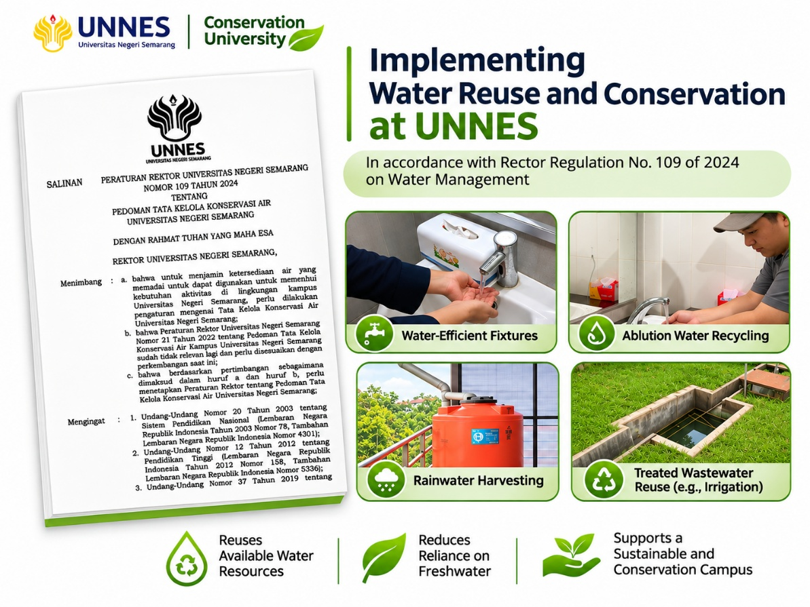
Universitas Negeri Semarang (UNNES) has an institutional policy to maximise water reuse across the university. Through Rector’s Regulation No. 109 of 2024 on Guidelines for Water Conservation Governance, UNNES establishes a framework for water conservation and reuse across faculties and administrative units, supporting reduced freshwater demand and more efficient campus operations.
Establishing an Institutional Framework
Adopted on 29 October 2024, the regulation places water conservation within the university’s institutional governance. It replaces Rector’s Regulation No. 21 of 2022 and provides the policy foundation for managing campus water resources.
UNNES’s official explanation of the policy identifies three implementation priorities: rainwater harvesting, ablution water recycling, and treated wastewater reuse. These programmes connect university policy with practical measures in faculties, work units, and campus mosques.
Collecting Rainwater for Campus Needs
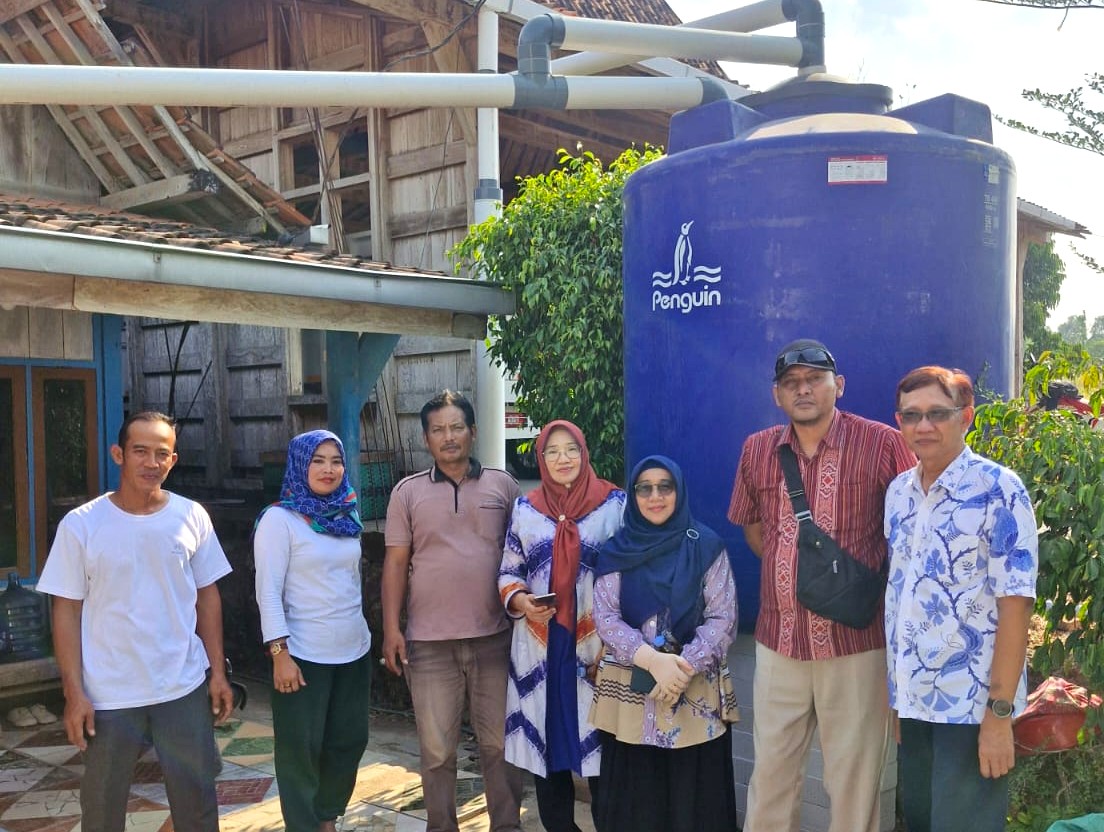
Rainwater harvesting complements water reuse by providing an alternative supply for activities that do not require drinking water. Collection and storage systems allow rainfall to be retained for appropriate campus uses.
At FMIPA, a report published on 6 November 2025 documents gutters connected to rainwater storage tanks for non-potable applications. The faculty also reuses water collected from air-conditioning systems to irrigate plants, providing another source for landscape maintenance.
Recycling Ablution Water for Irrigation
UNNES promotes the collection and treatment of water from ablution facilities at campus mosques. Through filtration, this water can be reused for non-potable purposes, particularly watering surrounding gardens.
The university reports implementation at Asshidiqi, Ulul Albab, and Salman Al-Farisi mosques. These systems connect daily campus activities with water conservation by recovering water for a further use.
Reusing Treated Wastewater
The policy’s implementation also includes using recycled wastewater for garden irrigation and pond maintenance at faculties equipped with treatment facilities. Reuse must be appropriate to the treated water’s quality and intended application.
By linking an institution-wide policy with water collection, treatment, and reuse infrastructure, UNNES incorporates water conservation into campus management. These measures support SDG 6: Clean Water and Sanitation, particularly water recycling and resource efficiency.