Universitas Negeri Semarang (UNNES) recognizes academic freedom as a fundamental principle that enables lecturers, researchers, and students to independently develop knowledge, conduct research, exchange academic ideas, and communicate scientific findings. Through its institutional regulations, UNNES provides a formal framework that protects the academic community’s freedom to determine research interests, develop teaching approaches, and express scholarly perspectives within their respective areas of expertise.
As a Legal Entity State University (Perguruan Tinggi Negeri Badan Hukum/PTN-BH), UNNES is committed to maintaining an academic environment that encourages independent inquiry, open scientific discussion, and responsible knowledge development. This commitment is reflected in its regulations on academic freedom, academic expression, and scientific autonomy, supporting the principles of Sustainable Development Goal 16.
Establishing Academic Freedom through Institutional Regulations
UNNES formally guarantees academic freedom through Rector’s Regulation No. 136 of 2024 concerning Academic Freedom, Academic Expression, and Scientific Autonomy at Universitas Negeri Semarang, as amended by Rector’s Regulation No. 138 of 2024.
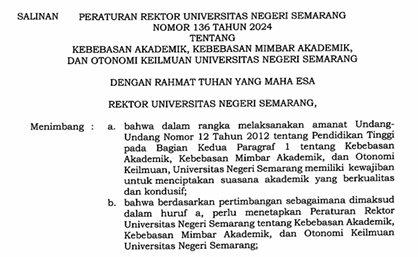
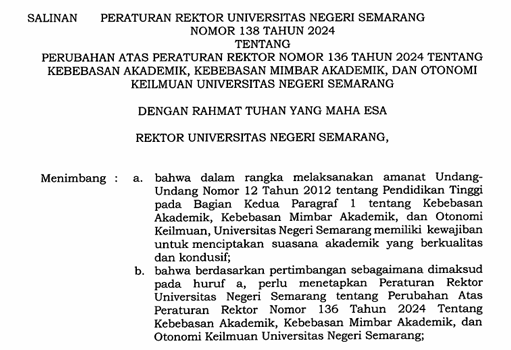
These regulations establish the institutional framework governing the exercise of academic freedom, academic expression, and scientific autonomy across the university.
The framework recognizes the right of academic community members to develop knowledge and technology independently through education, research, and community service. It also recognizes the authority of qualified professors and lecturers to communicate academic opinions and disseminate scientific findings publicly through appropriate academic forums.
The regulations emphasize that academic freedom must be exercised independently and responsibly, in accordance with scientific principles, academic ethics, and applicable laws. They also establish the responsibility of university leadership to protect and facilitate the exercise of these academic rights.
By incorporating these provisions into its institutional regulations, UNNES provides a formal basis for lecturers and researchers to determine their academic interests, pursue independent research, and communicate scientific perspectives without compromising academic integrity.
Translating Academic Freedom Policies into Practice through the 2025 Academic Guide
The implementation of UNNES’s academic freedom policy was further reinforced through the publication of the UNNES Academic Guide 2024 – First Revision, officially issued in May 2025.
Chapter VI, entitled Academic Atmosphere, specifically addresses policies and the implementation of academic freedom, academic expression, and scientific autonomy.
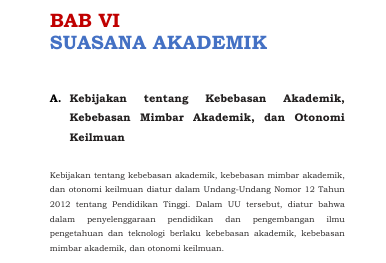
The guide explains that lecturers have the freedom to develop learning models, strategies, methods, and instructional media. It also recognizes their opportunities to conduct independent research and community service, participate in academic conferences and workshops, deliver scientific orations, and disseminate research findings through university, faculty, and postgraduate academic forums.
Furthermore, the guide describes how UNNES facilitates academic freedom through research collaboration with international universities, visiting professor programmes, and opportunities for lecturers and students to present their work at national and international seminars and conferences.
The guide also explicitly recognizes the autonomy of lecturers to teach scientific knowledge according to their respective areas of expertise, while providing opportunities for students to participate in research, present academic ideas, and develop independent scientific work.
These provisions demonstrate how UNNES translates its academic freedom regulations into practical guidance for teaching, research, and scholarly communication across the university.
Demonstrating Academic Freedom through Scholarly Activities
The implementation of academic freedom at UNNES is also reflected in the academic activities undertaken by its lecturers and researchers in 2025. One example was the participation of four lecturers from the Faculty of Economics and Business (FEB) in an international seminar at Kasetsart University, Thailand, on July 9, 2025. The lecturers presented their academic perspectives on Gen Z: Trends in Financial Literacy and Behavior and Its Implications, contributing to scholarly discussions on contemporary financial literacy and generational behaviour.
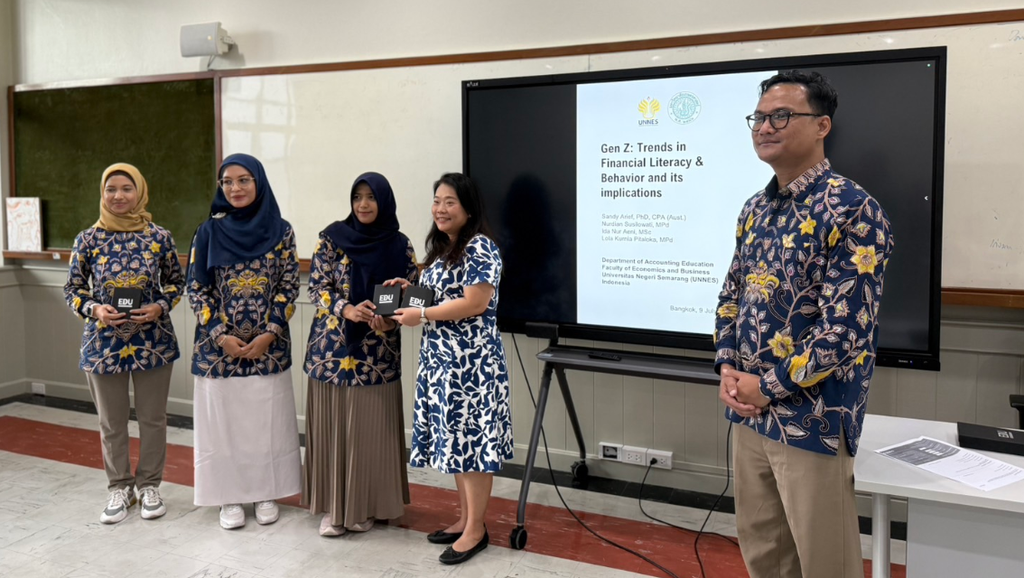
The activity demonstrates how UNNES lecturers communicate academic knowledge and research-related perspectives through international scholarly forums, consistent with the principles of academic expression and freedom of the academic podium established in the university’s regulations.
UNNES also supported the development of independent teaching practices through the Applied Approach Training programme held on January 21–24, 2025. Attended by 40 lecturers from nine faculties, the programme provided opportunities to develop pedagogical competencies and improve teaching methods.
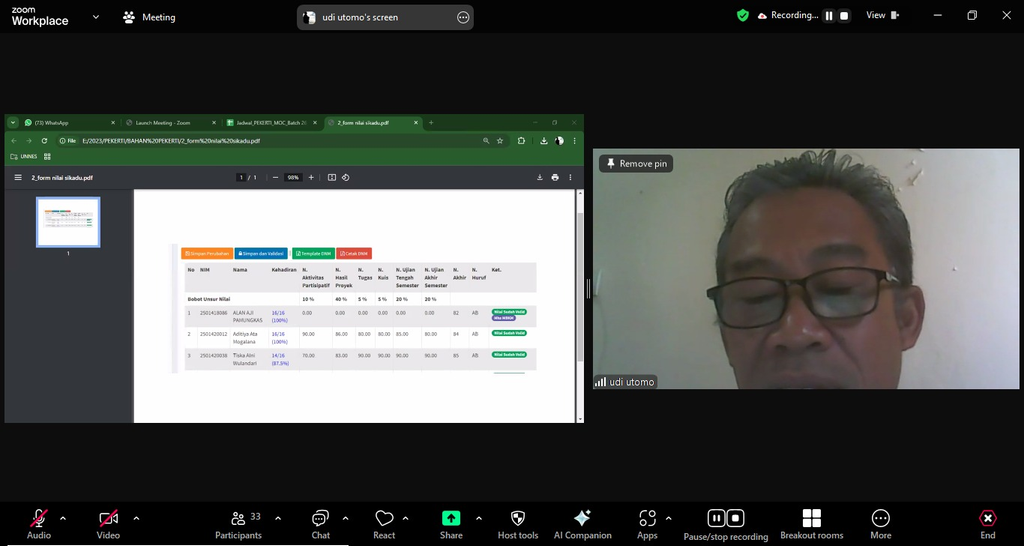
Together, these activities illustrate the practical expression of academic freedom through scholarly communication, teaching development, and awareness of academic responsibilities.
Advancing Academic Autonomy through Policies and Activities
Through Rector’s Regulation No. 136 of 2024, as amended by Rector’s Regulation No. 138 of 2024, UNNES establishes its institutional commitment to academic freedom, academic expression, and scientific autonomy. This commitment is further supported by the revised UNNES Academic Guide published in May 2025, which provides practical guidance for lecturers, researchers, and students in exercising academic freedom through teaching, research, and scholarly communication.
The implementation of academic practices consistent with these principles is reflected in several activities during 2025. On July 9, four FEB lecturers participated as speakers at an international seminar at Kasetsart University, Thailand, presenting academic perspectives on financial literacy and generational behaviour. This activity illustrates lecturers’ opportunities to communicate scientific knowledge and exchange scholarly perspectives in international forums.
Furthermore, the Applied Approach Training programme, held on January 21–24, 2025, involved 40 lecturers from nine faculties in developing their pedagogical competencies and teaching methods. Together, these activities illustrate UNNES’s support for scholarly expression, academic exchange, and teaching development, complementing its institutional commitment to academic autonomy.