Universitas Negeri Semarang (UNNES) continues to uphold its commitment to fair and sustainable employment practices through the issuance of Rector’s Regulation No. 122 of 2024 on Leave for Non-Civil Servant Employees. The policy ensures that non-civil servant educational staff (tendik non-ASN) receive equal access to leave rights, promoting well-being, fairness, and decent working conditions.
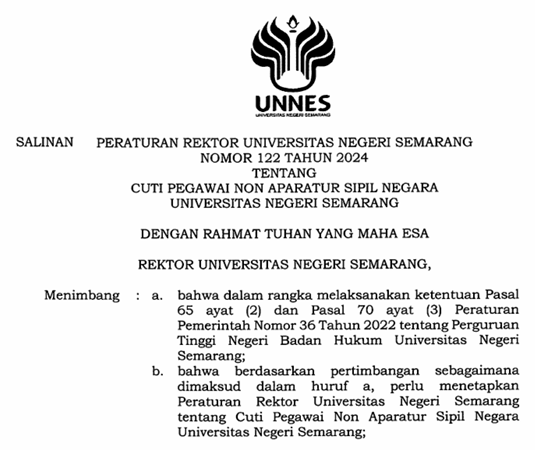
This regulation aligns with Sustainable Development Goal (SDG) 8: Decent Work and Economic Growth, which emphasizes inclusive and productive employment opportunities for all. By guaranteeing leave rights and workplace protection, UNNES demonstrates its dedication to decent work standards, employee motivation, and institutional productivity.
Furthermore, this policy also supports SDG 5: Gender Equality, as it provides equal leave entitlements for male and female staff, including maternity, paternity, and family-related leave. The inclusion of paternity leave ensures that non-gestational parents can actively participate in childcare duties, promoting shared responsibility within families.
The implementation of paternity leave has had a positive impact on work-life balance. Fathers are given the opportunity to shift their focus temporarily from professional duties to childcare, enabling them to be more involved during the early stages of their child’s life. This approach fosters a culture of equality and empathy within the workplace, ensuring that both men and women receive institutional support in fulfilling their parental roles.
Leave applications for employees at Universitas Negeri Semarang (UNNES) are processed via the integrated online Personnel Management Information System (SIMPEG). The process begins with preparing supporting documents relevant to the requested leave type, such as a doctor’s certificate for sick leave or an estimated due date letter for maternity leave. Employees then log into the SIMPEG portal using their Single Sign-On (SSO) account, select the leave application menu, and complete a digital form detailing the leave type, duration, reason, and contact address during the leave period before uploading all required files.
Once submitted, the application undergoes a multi-tiered verification process within the system. Immediate supervisors—such as Department Chairs, Deans, or Bureau Heads—review the eligibility of the request. For specific leave types such as maternity leave, extended leave, or leave for important reasons, the application is forwarded to the Rectorate’s Personnel Division for final approval from the Rector or Vice Rector for General Affairs and Finance. After full approval, the official digital Leave Permit (SIC) featuring an electronic signature can be downloaded directly from the employee’s SIMPEG account for record-keeping or submission to the department’s administrative office.
Through this integrated policy, UNNES reinforces its position as a conservation and sustainability-oriented university that values human rights, equality, and decent work for all members of its academic community.