

SEMARANG — Universitas Negeri Semarang (UNNES) continues to expand access to higher education and promote inclusive employment through scholarships, affirmative admission programmes, recognition of prior learning, and disability-inclusive recruitment measures. These initiatives are designed to reduce financial, geographical, and accessibility barriers that can limit opportunities for underrepresented groups.
- Scholarships Help Students Overcome Financial Barriers
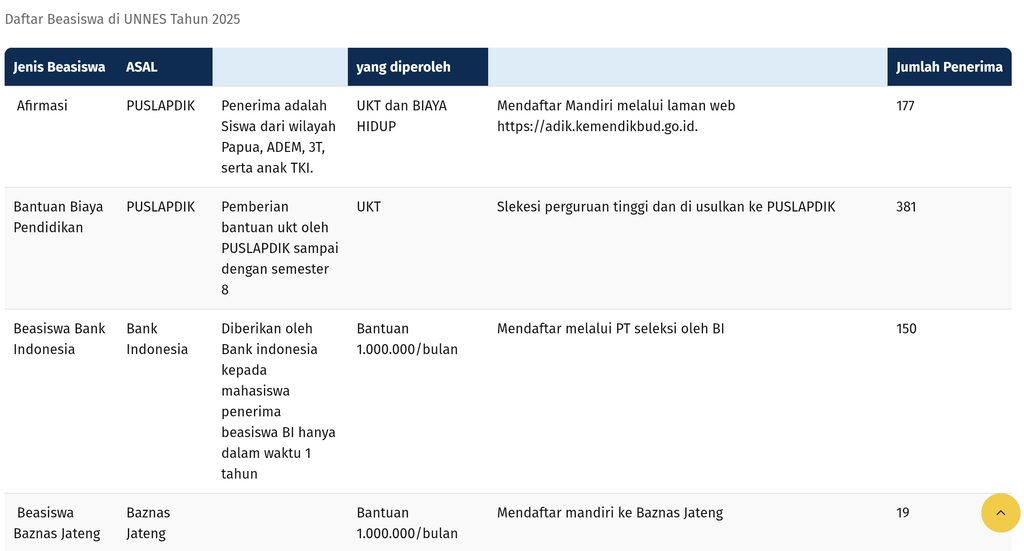
Financial assistance is one of the main ways UNNES supports prospective students from economically disadvantaged backgrounds. Through the Kartu Indonesia Pintar Kuliah (KIP-K) programme, eligible students can receive assistance with tuition fees and living expenses, helping them pursue higher education without facing the full financial burden of university study.
UNNES recorded 7,595 scholarship recipients in the first quarter of 2024, including 6,301 recipients under the Bidikmisi/KIP programme. The university’s subsequent report stated that 8,708 students benefited from scholarships during 2024, with 6,428 supported through KIP-Kuliah. These figures demonstrate the scale of financial assistance available to students at the university.
The programme is particularly relevant to applicants whose families are experiencing financial hardship. By providing financial support, UNNES helps reduce economic barriers that might otherwise prevent students from entering or continuing higher education.
UNNES also participates in the Afirmasi Pendidikan Tinggi (ADik) programme, which provides educational opportunities for eligible students from disadvantaged backgrounds and designated regions, including Papua and other underserved areas. This initiative complements general admission pathways by addressing geographical and socioeconomic barriers to participation in higher education.
Affirmative Admission Supports Wider Participation
UNNES combines its general admission system with targeted assistance for applicants who face additional barriers. The university has publicly documented the admission of students through the ADik programme and KIP-Kuliah, demonstrating that these initiatives form part of its efforts to broaden educational access.
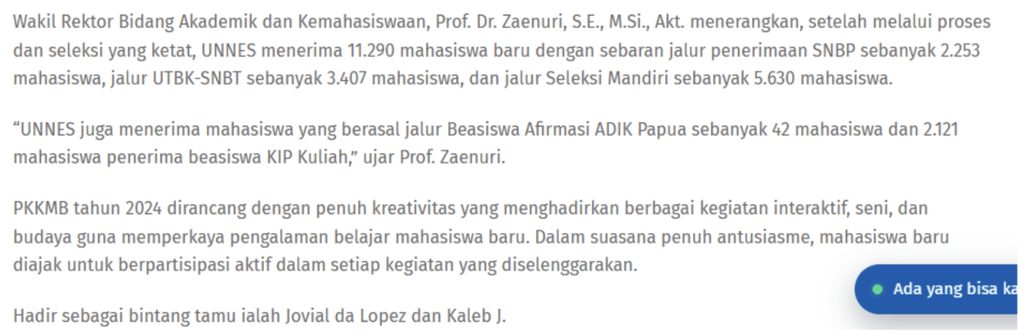
For example, UNNES reported that 42 students enrolled through the ADik Papua pathway and 2,121 students received KIP-Kuliah scholarships among its new students in 2024. Earlier, in 2021, the university announced that 1,416 candidates admitted through the SBMPTN selection pathway had qualified for KIP-Kuliah assistance, subject to verification.
These examples illustrate how financial aid and affirmative programmes can support participation by students who might otherwise face difficulties accessing higher education. The initiatives do not replace the university’s general admission process; instead, they provide additional support to eligible groups whose circumstances may create unequal opportunities.
Recognition of Prior Learning Opens Additional Routes to Higher Education
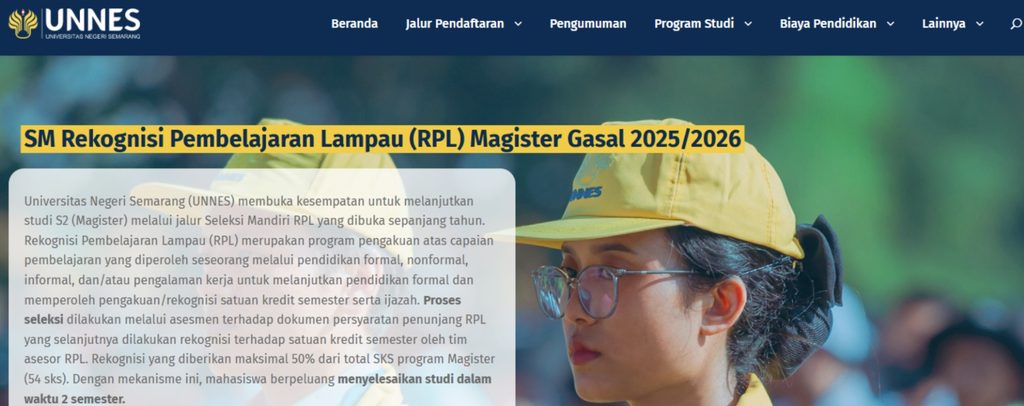
In addition to scholarships and affirmative admissions, UNNES offers Recognition of Prior Learning (Rekognisi Pembelajaran Lampau, or RPL). This pathway recognizes relevant learning acquired through formal, non-formal, or informal education and work experience, allowing eligible applicants to pursue further qualifications through an assessment of their previous learning.
The assessment process and the opportunity for eligible applicants to receive academic credit for previously acquired learning outcomes. This can help qualified applicants continue their education without repeating all previously achieved learning.
RPL broadens access through a different mechanism from financial aid. While scholarships address economic barriers and affirmative admission programmes target designated groups, RPL recognizes prior learning and relevant experience as part of an applicant’s educational pathway.
The university’s 2025 Rector’s Annual Report also documents RPL implementation and partnerships with local governments, including programmes involving participants from Blora and Semarang regencies. Such partnerships illustrate how cooperation with local institutions can provide additional routes to higher education.
- Disability-Inclusive Recruitment Supports Equal Employment Opportunities
UNNES’s inclusion efforts also extend beyond student admissions to recruitment and participation in the university workforce. The university identifies disability inclusion as part of its wider commitment to creating an accessible educational environment.

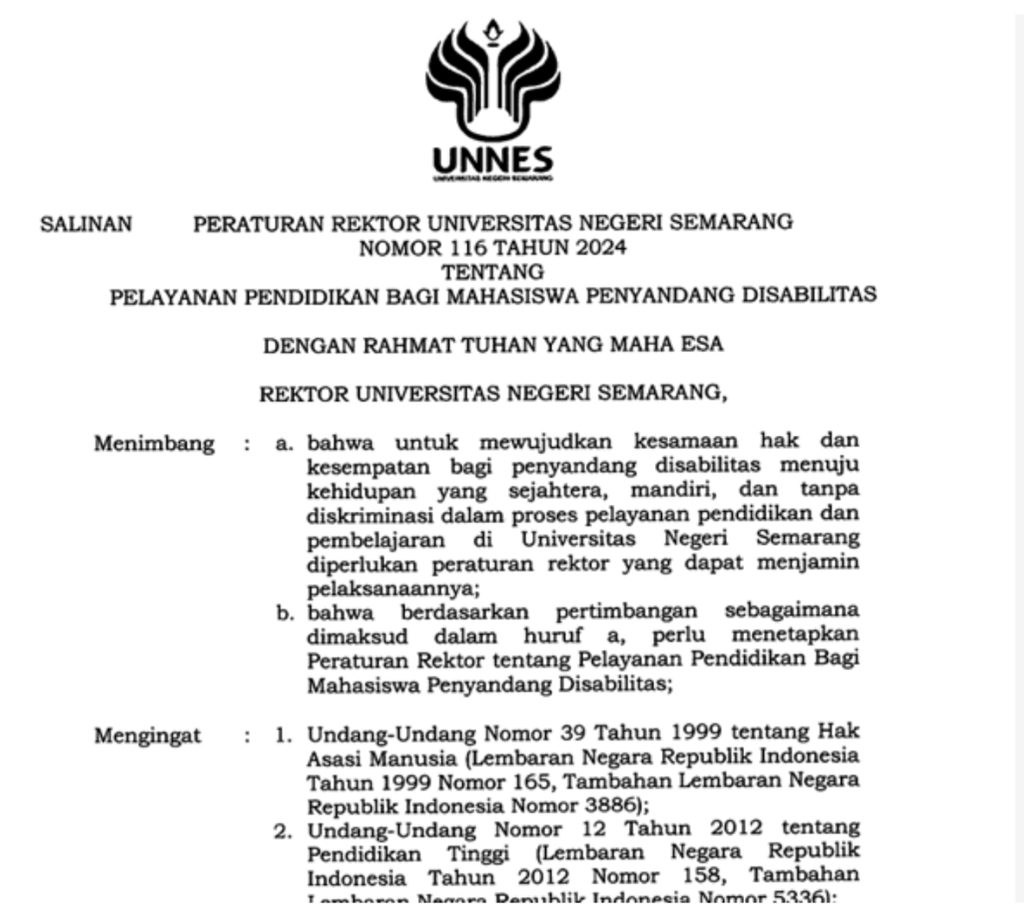
For staff and faculty recruitment, Regulation No. 32816/A.A.3/KP.01.01/2023 on Civil Servant Recruitment encourages women and people with disabilities to apply.
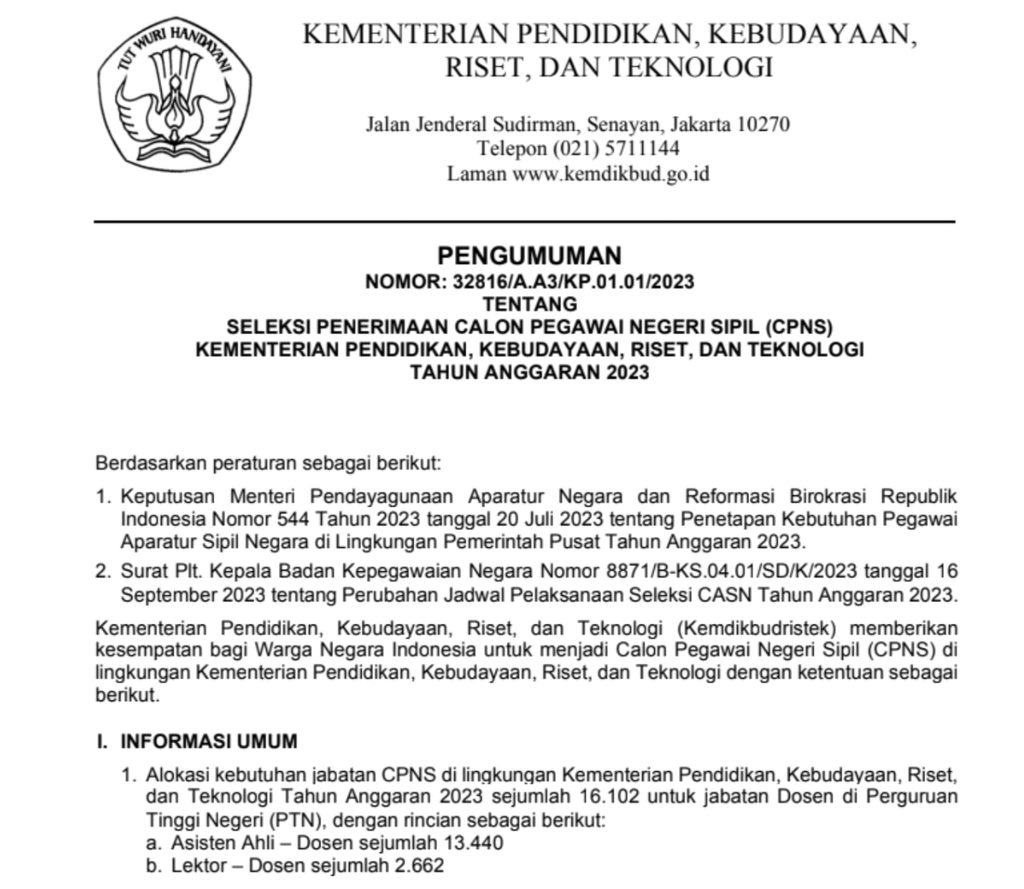
The regulation specifically highlights the criteria for people with disabilities in point 2. The detailed criteria are as follows:
APPLICANT CRITERIA
- The positions available under each recruitment category are intended for applicants meeting the following criteria:
a. Applicants in the special category for outstanding graduates with “with honours” (cum laude) distinction must meet the following criteria:
- Graduates of domestic higher education institutions who earned a “with honours” (cum laude) distinction and whose institution and study programme were accredited A/Excellent at the time of graduation. This must be evidenced by a statement that the applicant graduated “with honours” (cum laude) on the diploma or academic transcript.
- Graduates of overseas higher education institutions who have obtained diploma equivalency recognition and an official statement confirming that their graduation distinction is equivalent to cum laude, issued by the ministry responsible for higher education.
- Applicants in the special category for persons with disabilities must have a disability and be able to use information and communication technology (be tech-savvy) to perform the job. The type and degree of disability must be evidenced by a medical certificate issued by a government hospital or community health centre (Puskesmas).
- Applicants in the special category for sons or daughters of Papua and West Papua must be of Papuan or West Papuan descent through either or both parents. This must be evidenced by the applicant’s birth certificate or birth statement and a certificate from the village head or tribal chief confirming that the applicant’s father and/or mother is Indigenous Papuan or West Papuan.
- General applicants are applicants who do not meet the criteria set out in points a, b, or c.