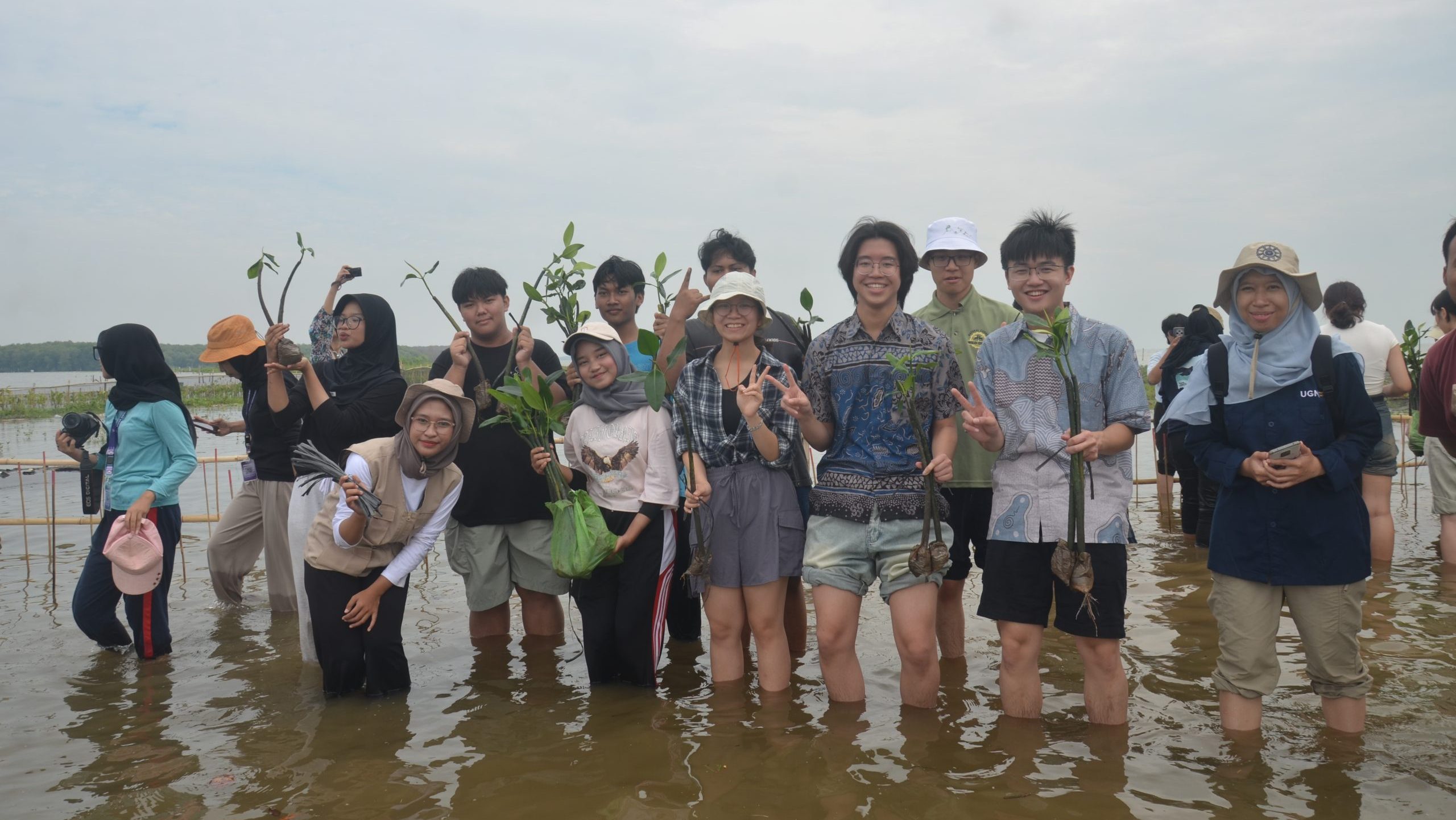


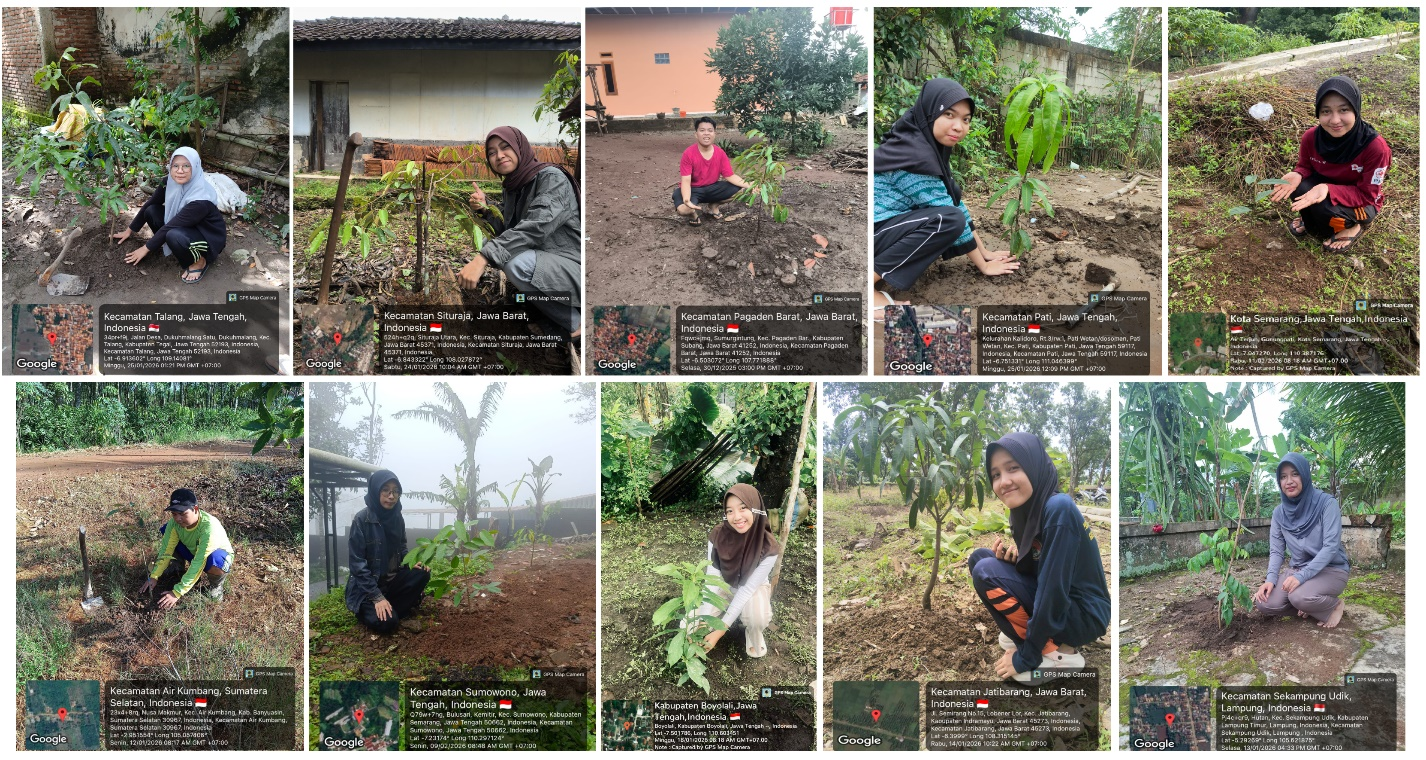
Students of the Faculty of Mathematics and Natural Sciences (FMIPA), Universitas Negeri Semarang (UNNES), have independently carried out tree-planting activities across Java, parts of Sumatra, and one location in East Kalimantan.
This initiative forms part of UNNES’ commitment as a Conservation Campus and implements the institutional policy requiring every UNNES student to plant one tree. The program was conducted from late December 2025 through early February 2026.
At the faculty level, the activity was coordinated by Mr. Trida Ridho Fariz, M.Sc., a member of the FMIPA Conservation Task Force. Guidance was provided through socialization sessions on recommended plant species, proper planting techniques, and reporting procedures via the SiOmon application, which is integrated into the UNNES academic information system.
Students carried out the tree planting independently in their respective residential environments, either at home or at their boarding houses. The planted species included both fruit trees and hardwood species.
The majority of trees planted were fruit-bearing varieties. The most common species was avocado (Persea americana), which holds considerable economic value at the household level.
Among hardwood species, sengon (Albizia chinensis) was the most widely planted. Each student planted one tree as a form of environmental responsibility.
The program involved students from the 2024 and 2025 cohorts. Based on compiled data, approximately 481 planting entries were recorded in the reporting system.
Planting locations were distributed across DKI Jakarta, Banten, West Java, Central Java, the Special Region of Yogyakarta, East Java, Lampung, South Sumatra, Riau, Jambi, Bengkulu, and East Kalimantan. The majority of planting sites were located in Central Java Province.
Several planting points were situated within hydrologically significant areas classified as nationally prioritized watershed rehabilitation zones, including the Ciliwung and Serayu Watersheds. This reflects students’ tangible contributions to environmental rehabilitation efforts.
In general, many regions in Indonesia face challenges related to the conversion of vegetated land into built environments. While this independent tree-planting program is not intended as a structural solution to such issues, it serves as an effort to enhance environmental awareness among students, particularly those of Generation Z.
Through hands-on experience in planting and caring for trees, students not only gain theoretical understanding of conservation principles but also apply them in their daily lives. The initiative fosters the development of ecological awareness and responsibility among students.
Program sustainability is supported by a documentation and reporting system through the SiOmon application, integrated with the UNNES academic system. This system includes periodic reporting on both planting and tree maintenance.
As the trees are planted within students’ residential environments, monitoring and maintenance can be carried out more easily by students and their families. The mandatory tree-planting requirement for every student also ensures the continuity of the program for future cohorts.
The independent tree-planting initiative by FMIPA UNNES students aligns with SDG 15 (Life on Land), SDG 6 (Clean Water and Sanitation), and SDG 13 (Climate Action). Its primary focus is the development of a young generation that is environmentally conscious and responsible.
This initiative represents a concrete realization of UNNES’ vision as a Conservation Campus and supports Key Performance Indicator 7 related to higher education institutions’ engagement in achieving the Sustainable Development Goals.