
Tim Peneliti FMIPA UNNES Kembangkan Nanomaterial Berbasis Bahan Alam untuk Perlindungan UV dan Antioksidan

Universitas Negeri Semarang/Faculty of Mathematics and Natural Sciences/Berita/Tim Peneliti FMIPA UNNES Kembangkan Nanomaterial Berbasis Bahan Alam untuk Perlindungan UV dan Antioksidan
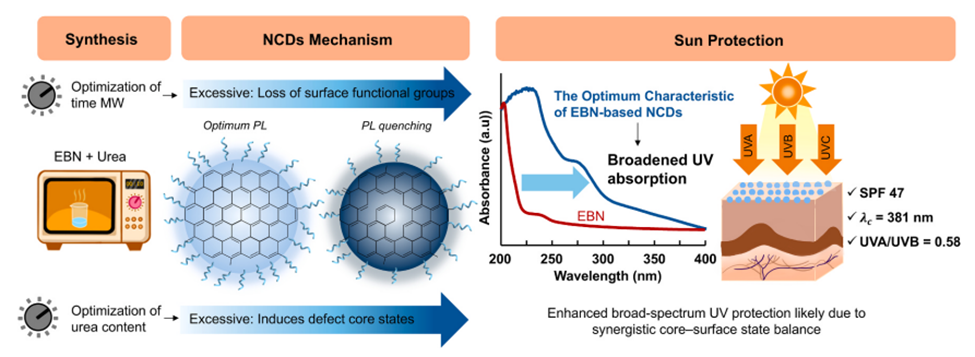
Diagram abstrak grafis berlatar putih yang terbagi dalam tiga bagian yaitu Synthesis, NCDs Mechanism, dan Sun Protection, menampilkan ilustrasi microwave, struktur partikel karbon, grafik serapan UV 200 hingga 400 nm, serta ilustrasi lapisan kulit yang terlindungi dari sinar UVA, UVB, dan UVC.

SEMARANG – Pemanfaatan bahan alam sebagai sumber material berteknologi tinggi terus dikembangkan untuk mendukung inovasi yang berkelanjutan. Prof. Mahardika Prasetya Aji bersama tim peneliti Fakultas Matematika dan Ilmu Pengetahuan Alam Universitas Negeri Semarang (FMIPA UNNES) mengembangkan nanopartikel karbon (carbon dots) berbahan dasar buah parijoto dan sarang burung walet yang berpotensi dimanfaatkan sebagai material antioksidan dan pelindung radiasi ultraviolet (UV).

Penelitian tersebut menghasilkan dua publikasi pada jurnal internasional terindeks Scopus tahun 2026, yaitu “Carbon Dots Nanoparticles Derived from Showy Asian Grapes (Medinilla speciosa) for Free Radical Scavenger” dalam jurnal Materials Science and Technology serta “Facile Approach to Broaden UV-Absorbing Sun Protection via Structural Transformation of Edible Bird Nest into Nitrogen-Doped Carbon Dots” dalam jurnal Next Materials.

Kedua penelitian memanfaatkan teknologi nanomaterial untuk mengubah bahan alam menjadi partikel karbon berukuran sangat kecil dengan sifat fungsional tertentu. Melalui proses berbantuan gelombang mikro, tim peneliti berhasil menghasilkan material yang memiliki potensi aplikasi di bidang kesehatan dan perlindungan tubuh.

Pada penelitian pertama, kulit buah parijoto (Medinilla speciosa) diolah menjadi nanopartikel karbon yang memiliki aktivitas antioksidan sebesar 73,82% pada konsentrasi pengujian 5 mg/mL. Hasil ini menunjukkan potensi material dalam menangkal radikal bebas, sehingga dapat menjadi dasar pengembangan bahan fungsional untuk aplikasi biomedis maupun produk kesehatan.

Sementara itu, penelitian kedua memanfaatkan sarang burung walet sebagai bahan dasar pembuatan nitrogen-doped carbon dots. Hasil pengujian menunjukkan kemampuan penyerapan radiasi UV dengan nilai Sun Protection Factor (SPF) sebesar 46,46 serta cakupan perlindungan UV berspektrum luas. Temuan ini membuka peluang pengembangan material pelindung UV berbasis bahan alam, meskipun masih memerlukan pengujian keamanan dan efektivitas lebih lanjut sebelum diaplikasikan pada produk tabir surya.

Dampak positif kedua penelitian ini adalah terbukanya peluang pemanfaatan sumber daya hayati menjadi nanomaterial bernilai tambah untuk teknologi perlindungan kesehatan. Pengembangan material berbasis parijoto dan sarang burung walet juga memperluas alternatif bahan baku dalam inovasi material fungsional, sekaligus mendorong penelitian yang memanfaatkan potensi sumber daya alam.

Penelitian ini mendukung Sustainable Development Goals (SDGs), khususnya SDG 9 (Industri, Inovasi, dan Infrastruktur) melalui pengembangan teknologi nanomaterial, serta berpotensi mendukung SDG 3 (Kehidupan Sehat dan Sejahtera) melalui pengembangan kandidat material antioksidan dan pelindung radiasi UV. Selain itu, penelitian ini relevan dengan SDG 12 (Konsumsi dan Produksi yang Bertanggung Jawab) melalui eksplorasi bahan alam sebagai sumber material fungsional, meskipun manfaat keberlanjutannya masih perlu dievaluasi lebih lanjut.

Melalui kedua publikasi tersebut, Prof. Mahardika Prasetya Aji bersama tim FMIPA UNNES menunjukkan kontribusi dalam pengembangan nanoteknologi berbasis sumber daya hayati. Hasil penelitian ini diharapkan menjadi landasan bagi inovasi material fungsional yang bermanfaat bagi kesehatan dan pengembangan teknologi berkelanjutan.
Related Posts

Leave a Reply

* Kode Akses Komentar:

* Tuliskan kode akses komentar diatas:

GDPR

  • Privacy Policy

Privacy Policy

At unnes.ac.id, the privacy of our visitors is of extreme importance to us. This privacy policy document outlines the types of personal information that is received and collected by unnes.ac.id and how it is used.

Log Files

Like many other Web sites, unnes.ac.id makes use of log files. The information inside the log files includes internet protocol (IP) addresses, type of browser, Internet Service Provider (ISP), date/time stamp, referring/exit pages, and number of clicks to analyze trends, administer the site, track user’s movement around the site, and gather demographic information. IP addresses and other such information are not linked to any information that is personally identifiable.

Cookies

unnes.ac.id uses cookies to store information about visitors’ preferences, to record user-specific information on which pages the site visitor accesses or visits, and to personalize or customize our web page content based upon visitors’ browser type or other information that the visitor sends via their browser.

Third-party ad servers or ad networks use technology in their respective advertisements and links that appear on unnes.ac.id and which are sent directly to your browser. They automatically receive your IP address when this occurs. Other technologies (such as cookies, JavaScript, or Web Beacons) may also be used by our site’s third-party ad networks to measure the effectiveness of their advertising campaigns and/or to personalize the advertising content that you see on the site.

unnes.ac.id has no access to or control over these cookies that are used by third-party advertisers.

You should consult the respective privacy policies of these third-party ad servers for more detailed information on their practices as well as for instructions about how to opt-out of certain practices. unnes.ac.id’s privacy policy does not apply to, and we cannot control the activities of, such other advertisers or web sites.

If you wish to disable cookies, you may do so through your individual browser options. More detailed information about cookie management with specific web browsers can be found at the browsers’ respective websites.

Consent

By using our website, you hereby consent to our privacy policy and agree to its terms.

Update

This Privacy Policy was last updated on: 2023-02-14. Should we update, amend or make any changes to our privacy policy, those changes will be posted here.

Contact Us

If you have any questions, comments, or concerns about our Privacy Policy or our practices with regards to your personal information, please feel free to contact us through the contact form on our website or by emailing us at humas[at]mail.unnes.ac.id.

This Privacy Policy is intended as a general guide to our practices in collecting and using information. If there is any inconsistency between this Privacy Policy and the terms of the Service Agreement or any other terms that may apply to specific services you use, then those specific service terms shall apply.

Terms of Use

By using our website, you agree to abide by this Privacy Policy. If you do not agree with this Privacy Policy, please do not use our website. We reserve the right to update this Privacy Policy from time to time without prior notice. Please review our Privacy Policy periodically to check for changes. Your continued use of our website following the posting of changes to this Privacy Policy means that you accept the changes.

Thank you for reading our Privacy Policy. We are committed to protecting the privacy of our website visitors and will continue to update our Privacy Policy to ensure optimal protection.