



FMIPA UNNES Professor Prof. Dr. Ir. Amin Retnoningsih, M.Si., participated as a speaker at the Durian Discussion Forum and as one of the judges of the Durian Contest during the 2026 Equatorial Flora and Fauna Exhibition.
Pontianak, July 19, 2026 — Professor of the Faculty of Mathematics and Natural Sciences, Universitas Negeri Semarang (FMIPA UNNES), Prof. Dr. Ir. Amin Retnoningsih, M.Si., participated in the Durian Discussion Forum and Durian Contest held as part of the 2026 Equatorial Flora and Fauna Exhibition in Pontianak, West Kalimantan.
The 2026 Equatorial Flora and Fauna Exhibition, initiated by the GERAM community, was held from July 15 to 19, 2026, as a platform for education, promotion, and appreciation of West Kalimantan’s biodiversity. The event not only showcased the region’s diverse flora and fauna but also highlighted the potential of local West Kalimantan durian as a leading commodity with economic, cultural, and conservation value.
On Sunday, July 19, 2026, the durian-related activities were held through a discussion forum and durian contest. The forum brought together several speakers and durian observers, including Prof. Dr. Ir. Syaiful Anwar, M.Si. from Universitas Diponegoro, Dietmar Frick from Germany, Prof. Dr. Ir. Amin Retnoningsih, M.Si. from UNNES, Thomas Harryanto, Vice Chair of the Indonesian Durian Growers Association, and Dr. Tatang Abdurrahman, S.P., M.P. from Universitas Tanjungpura and Chair of Perhorti West Kalimantan. The forum provided a platform for sharing knowledge on cultivation, fruit quality, the identification of superior durian varieties, and opportunities to improve the competitiveness of West Kalimantan durian.
An important feature of this year’s durian contest was the integration of festival judging with durian characterization. Each fruit sample was not only assessed to determine the best durian but was also scientifically documented. The observed aspects included the characteristics of the fruit, aril or flesh, seeds, rind, aroma, taste, texture, and other quality indicators required to identify promising superior durian varieties more objectively.
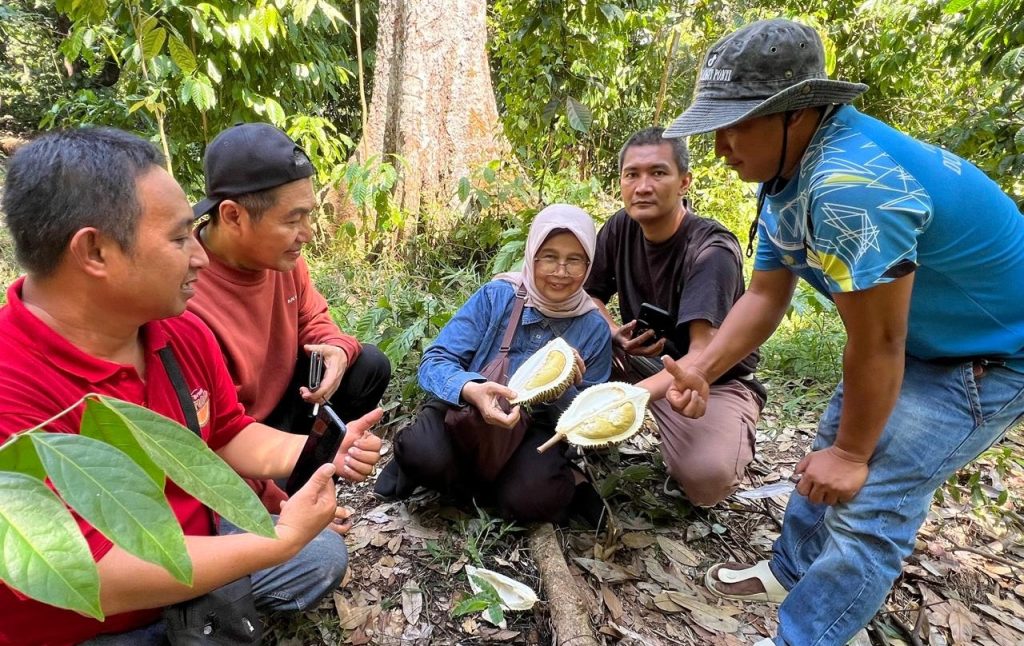
The judges and speakers directly examine the characteristics of the fruit and durian flesh as part of the characterization process for superior West Kalimantan durian.
The judges and speakers directly examined the characteristics of the fruit and durian flesh as part of the characterization process for superior West Kalimantan durian.
This approach represents an initial step toward developing a durian database, particularly for durian varieties from West Kalimantan. By recording fruit identity, origin, morphological characteristics, photographic documentation, and quality data, local superior durian varieties are expected to be recognized not only through their names and stories but also through traceable scientific evidence. Such a database is important for supporting the designation of mother trees, the provision of scion sources, the development of superior seedlings, the protection of genetic resources, quality standardization, and the downstream development of durian-based products.
The characterization activities were supported by several young lecturers from the Faculty of Agriculture at Universitas Tanjungpura, as well as students from the faculties of agriculture, economics and business, social and political sciences, and law. This cross-faculty involvement demonstrates that durian development requires not only an agronomic approach but also support in economics, entrepreneurship, social affairs, law, variety protection, and value-chain governance.
This activity also contributes to the achievement of the Sustainable Development Goals (SDGs), particularly SDG 2: Zero Hunger, through the development of sustainable agriculture and the conservation of plant genetic resources; SDG 8: Decent Work and Economic Growth, through increasing the economic value of local durian and strengthening farmers’ business chains; and SDG 15: Life on Land, through the protection of genetic resources and West Kalimantan’s durian biodiversity. Collaboration among universities, communities, farmers, government institutions, and other stakeholders is also aligned with SDG 17: Partnerships for the Goals.
Prof. Amin emphasized that durian festivals should not end merely with the announcement of winners. Such festivals should become an entry point for identifying superior candidates, recognizing tree owners, verifying the source trees, conducting repeated observations in subsequent seasons, and developing a traceability system that benefits both farmers and the region.
Through this activity, FMIPA UNNES helped strengthen academic and research networks for Indonesian durian in collaboration with Universitas Tanjungpura, the organizing committee of the 2026 Equatorial Flora and Fauna Exhibition, durian communities, farmers, and stakeholders in West Kalimantan. This collaboration is expected to contribute to joint efforts to ensure that West Kalimantan durian becomes increasingly well documented, protected, widely recognized, and competitive.