


The Physics Education Study Program, Faculty of Mathematics and Natural Sciences (FMIPA), Universitas Negeri Semarang (UNNES), held two practitioner lectures for the Environmental Physics course on November 19 and 26, 2025. Conducted online via Zoom, the sessions featured distinguished practitioners—both proud alumni of UNNES—who shared real-world perspectives on environmental physics, science education, ethics, and conservation.
On 19 November 2025, the practitioner lecture featured Siti Handayani, M.Pd., a senior Physics teacher at SMAN 1 Semarang and an alumna of the Physics Education Study Program at UNNES. With 25 years of teaching experience, she discussed the challenges commonly faced in Physics learning, particularly the perception that it is a complex subject due to its strong linkage to mathematics and the complexity of problem-solving. To address these issues, she introduced the Environment-Based Learning Approach, which integrates natural, social, and cultural environments as learning resources, media, and objects of observation in Physics lessons.
Her approach aims to reduce dependence on mathematical calculations, cultivate scientific thinking, and spark curiosity about real-world phenomena. She shared classroom practices involving contextual stimuli, exploratory learning processes, and authentic student products. She emphasized that a teacher’s creativity is more crucial than complete laboratory facilities. “What truly matters is motivating students to want to learn and explore,” she stated.
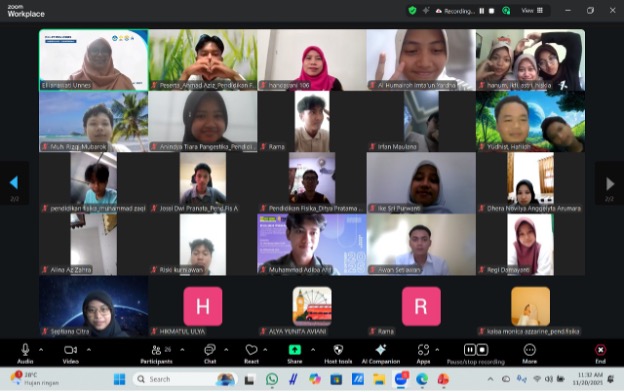
During this session, one of the student creative work groups also presented their innovative project, showcasing how waste materials can be repurposed into instructional tools for Physics learning. The product demonstrated how unused materials can be transformed into engaging and environmentally friendly teaching aids. Mrs. Siti gave high appreciation for the students’ creativity, noting that such innovations align perfectly with the principles of environment-based learning.
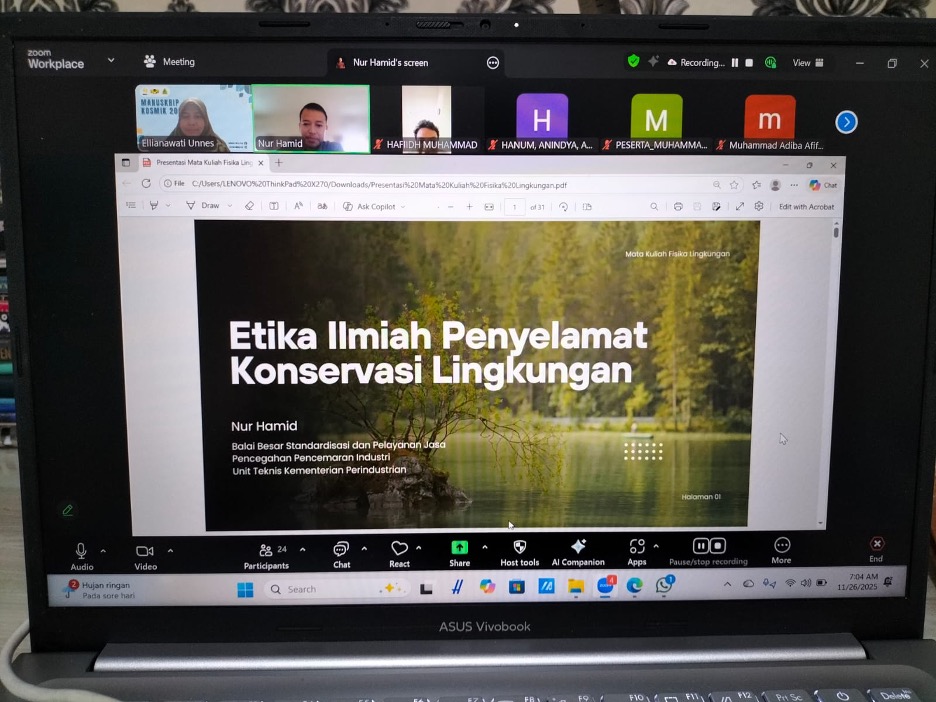
The second practitioner lecture, held on 26 November 2025, welcomed Nur Hamid, S.Si., a conservation practitioner and civil servant at the Ministry of Industry, as well as an alumnus of the Physics Study Program at UNNES. He currently works at the Center for Standardization and Industrial Pollution Prevention Services (BBSPJPPI) in Semarang. Having served in the institution for three years, he has held the roles of Junior Engineer (2023–2024) and currently Junior Industrial Supervisor (2024–present).
In his presentation titled “Scientific Ethics and Conservation,” he highlighted the importance of ethical principles in all scientific activities, from research and data collection to professional practice. He emphasized that scientific ethics provide the foundation for integrity, safety, and societal benefit. In addition, he stressed the vital role of environmental conservation in physics education, reminding students that scientists and educators bear a moral responsibility to protect environmental sustainability and promote responsible ecological actions.
These practitioner lectures offered meaningful learning experiences for students of the Physics Education Study Program at FMIPA UNNES. Beyond enriching their theoretical understanding of environmental physics, the sessions provided practical insights into school-based environmental learning and the ethical dimensions of conservation. This initiative aligns with UNNES’s commitment to cultivating conservation-minded educators and strengthening the bridge between academic knowledge and real-world applications.
Recordings of the practitioner lectures have been made available through the internal Zoom link for documentation and reflective learning.