


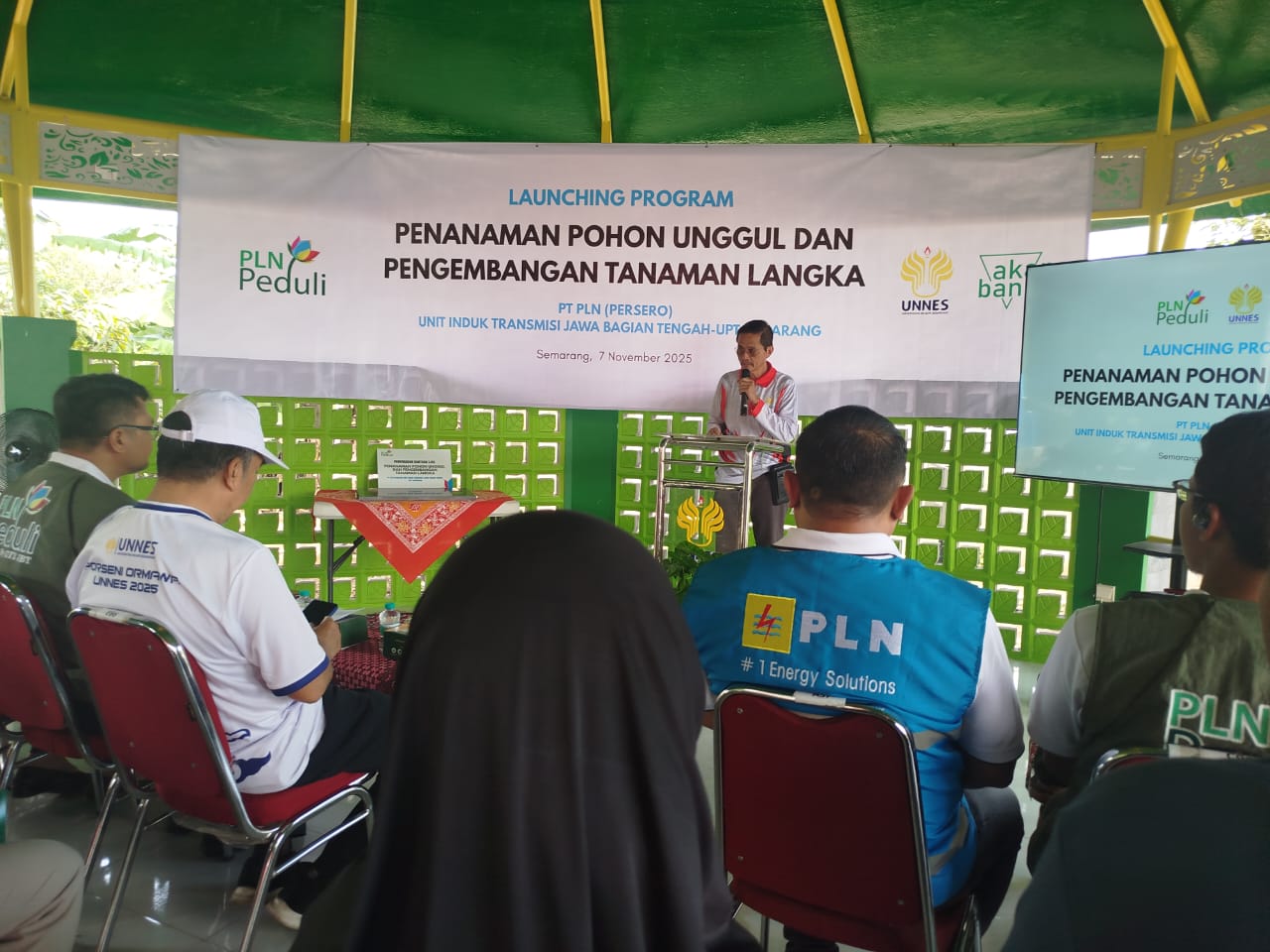
Semarang—The social and environmental responsibility (TJSL) program of PT PLN (Persero)’s Central Java Transmission Main Unit, in collaboration with the Semarang Technical Implementation Unit (UPT Semarang), once again presented an inspiring community empowerment activity in the Right of Way (ROW) 416–418 Wonolopo area, Semarang. The launch event was held at the Ecofarm Unit of Semarang State University (UNNES) on Friday, November 7, 2025. This program involved a strategic collaboration with UNNES through a cross-faculty academic team consisting of Prof. Juhadi (FISIPOL), Prof. Amin Retnoningaih (FMIPA), Prof. Nana Karida (FMIPA), Prof. Eva Banowati (FISIPOL), Prof. Masturi (FMIPA), and Wahid Akhsin Budi Nur Sidiq, S.Pd., M.Sc. (FISIPOL). This activity demonstrated the synergy between industry, academia, and the community in creating sustainable development under the high-voltage electricity transmission network (SUTET).
This community empowerment social activity focused on two main aspects: providing goat farming assistance to farmers under the ROW and planting superior trees and rare plants in the surrounding land. The plants planted include durian, avocado, and calliandra, species considered to have high ecological and economic value and are safer for electricity grid infrastructure than fast-growing plants like sengon. Through this activity, PLN, together with UNNES, strives to build a productive, environmentally friendly economic ecosystem while maintaining the reliability of the national electricity system.
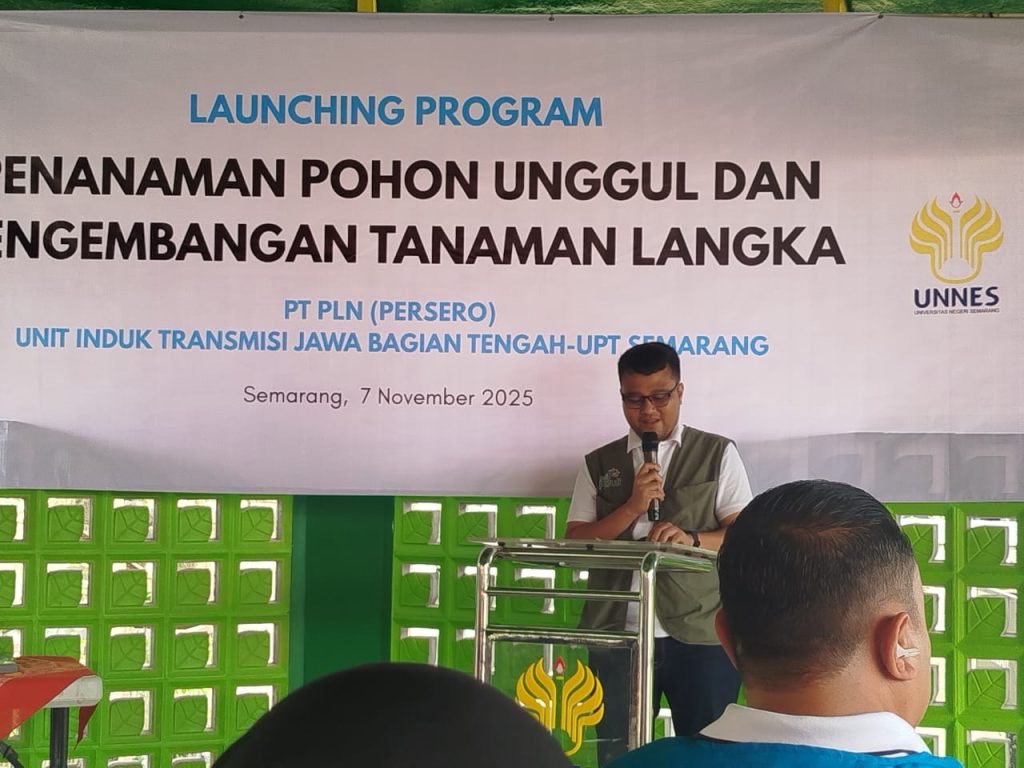
In his remarks, Ahmad Firdaus, Senior Manager of Finance, Communications, and General Affairs at PT PLN (Persero) Central Java Transmission Unit, stated that this program offers at least three strategic benefits. First, ecological benefits, as the environment under the high-voltage transmission line network becomes more organized and safer thanks to the presence of superior plants with conservation value. Second, economic benefits, as agricultural and livestock products can improve the welfare of surrounding communities. Third, operational benefits, as the reliability of the PLN transmission network will be strengthened by vegetation management that meets network safety standards. Firdaus emphasized that collaboration with UNNES academics is a crucial step in ensuring this CSR program is scientifically oriented and sustainable.
Meanwhile, Prof. Zaenuri, Vice Rector for Academic and Student Affairs at UNNES, expressed his appreciation and full support for this collaborative program. He considered the collaboration between UNNES and PLN not only a manifestation of corporate social responsibility but also a concrete implementation of UNNES’s vision as a Conservation-Oriented University. The involvement of professors from various fields demonstrates UNNES’s commitment to providing research- and conservation-based solutions to meet community needs, including supporting energy security and environmental sustainability. “Activities like this emphasize that academic and industrial collaboration can have a direct impact on society and the environment,” said Prof. Zaenuri.
The Head of the Semarang City Cooperatives Office, Shoti’ah, S.P., expressed her appreciation for this initiative in her remarks. She stated that the social program under the SUTET network is highly relevant to the city government’s policy of strengthening urban farming entrepreneurship and the productive economy of urban communities. Given the limited land area in Semarang, activities such as goat farming and planting productive trees are innovative solutions to improve community welfare while preserving the environment. She hopes similar programs can be replicated in other areas of Semarang and become a model of triple helix synergy between the government, universities, and state-owned enterprises.