August 21, 2025

Day

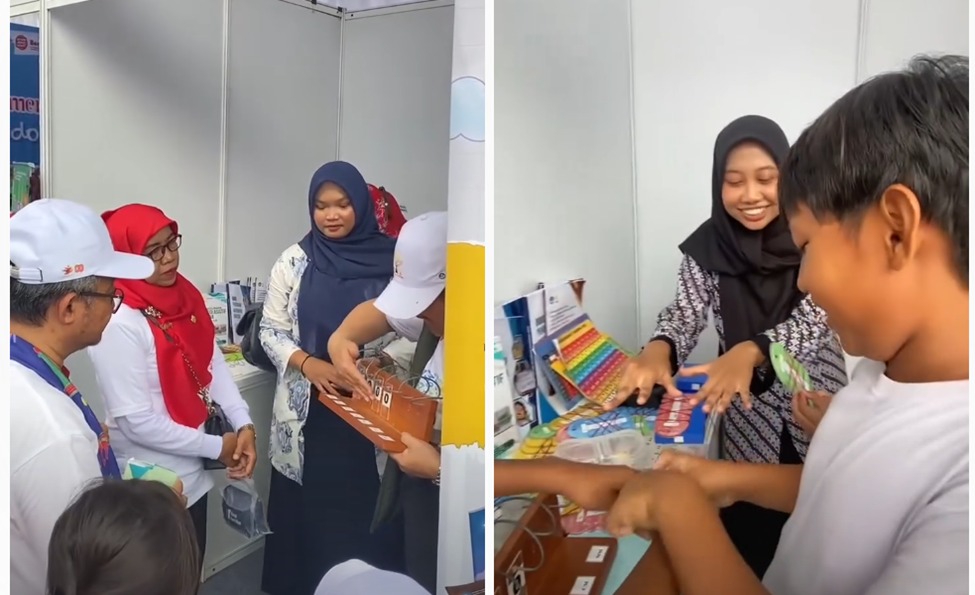
UNNES Supports the National Numeracy Movement through Inclusive Mathematics Innovation for Children with Special Needs Universitas Negeri Semarang (UNNES) once again demonstrated its commitment to advancing Indonesia's educational transformation by participating in the 2025 National Numeracy Movement (Gerakan Numerasi Nasional/GNN) Launch, organized by the Ministry of Primary and Secondary Education of the Republic of Indonesia on 19 August 2025 at SDN Meruya 04, West Jakarta. Through its participation, UNNES showcased inclusive mathematics learning innovations aimed at expanding access to quality education for all learners, including children with special educational needs. During the event, Dr. Sugiman, a lecturer from the Department of Mathematics at Universitas Negeri Semarang, served as a keynote speaker in the Interactive Dialogue on Inclusive Numeracy. On this occasion, he introduced several Assistive Mathematics Technologies (AMT) designed to support mathematics learning for students with disabilities. Among the innovations presented was Abanetra Pecahan, a fraction abacus specifically designed to help students with visual impairments understand fraction concepts more concretely. Another innovation, Sapa Disabilitas, was also introduced as an assistive learning solution that enhances the accessibility of mathematics education for students with special needs. These innovations demonstrate that sensory limitations should never be a barrier to learning mathematics through engaging, interactive, and meaningful educational experiences. UNNES's participation in the 2025 National Numeracy Movement reflects the university's tangible contribution to strengthening literacy and numeracy across Indonesia. The introduction of inclusive mathematics learning innovations is expected to promote a broader perspective that mathematics education should be accessible to every learner, regardless of physical condition or ability. Consequently, efforts to improve numeracy extend beyond enhancing academic performance to fostering an equitable education system that provides equal learning opportunities for all Indonesian children. Participation in this national initiative has generated significant positive impacts, including increased public awareness of the importance of inclusive education, the advancement of disability-friendly educational technologies, and stronger collaboration among universities, government institutions, and schools in creating more equitable and inclusive learning environments. Furthermore, these innovations have the potential to expand access to mathematics education for students with special needs, enabling them to develop numeracy competencies on an equal footing while contributing to the continuous improvement of educational quality. This initiative also supports the achievement of the United Nations Sustainable Development Goals (SDGs), particularly Goal 4: Quality Education and Goal 10: Reduced Inequalities. The assistive mathematics technologies developed by UNNES contribute to ensuring inclusive, equitable, and high-quality education while promoting lifelong learning opportunities for all (SDG 4). At the same time, these innovations help reduce disparities in educational access for students with special needs by providing equal opportunities to develop numeracy skills and participate fully in learning (SDG 10). Through these efforts, UNNES continues to foster a more inclusive, equitable, and accessible educational ecosystem, embracing the principle of "leaving no one behind."

UNNES Supports the National Numeracy Movement through Inclusive Mathematics Innovation for Children with Special Needs

Universitas Negeri Semarang (UNNES) once again demonstrated its commitment to advancing Indonesia’s educational transformation by participating in the 2025 National Numeracy Movement (Gerakan Numerasi Nasional/GNN) Launch, organized by the Ministry of Primary and Secondary Education of the Republic of Indonesia on 19 August 2025 at SDN Meruya 04, West Jakarta. Through its participation, UNNES showcased...
Read More

GDPR

  • Privacy Policy

Privacy Policy

At unnes.ac.id, the privacy of our visitors is of extreme importance to us. This privacy policy document outlines the types of personal information that is received and collected by unnes.ac.id and how it is used.

Log Files

Like many other Web sites, unnes.ac.id makes use of log files. The information inside the log files includes internet protocol (IP) addresses, type of browser, Internet Service Provider (ISP), date/time stamp, referring/exit pages, and number of clicks to analyze trends, administer the site, track user’s movement around the site, and gather demographic information. IP addresses and other such information are not linked to any information that is personally identifiable.

Cookies

unnes.ac.id uses cookies to store information about visitors’ preferences, to record user-specific information on which pages the site visitor accesses or visits, and to personalize or customize our web page content based upon visitors’ browser type or other information that the visitor sends via their browser.

Third-party ad servers or ad networks use technology in their respective advertisements and links that appear on unnes.ac.id and which are sent directly to your browser. They automatically receive your IP address when this occurs. Other technologies (such as cookies, JavaScript, or Web Beacons) may also be used by our site’s third-party ad networks to measure the effectiveness of their advertising campaigns and/or to personalize the advertising content that you see on the site.

unnes.ac.id has no access to or control over these cookies that are used by third-party advertisers.

You should consult the respective privacy policies of these third-party ad servers for more detailed information on their practices as well as for instructions about how to opt-out of certain practices. unnes.ac.id’s privacy policy does not apply to, and we cannot control the activities of, such other advertisers or web sites.

If you wish to disable cookies, you may do so through your individual browser options. More detailed information about cookie management with specific web browsers can be found at the browsers’ respective websites.

Consent

By using our website, you hereby consent to our privacy policy and agree to its terms.

Update

This Privacy Policy was last updated on: 2023-02-14. Should we update, amend or make any changes to our privacy policy, those changes will be posted here.

Contact Us

If you have any questions, comments, or concerns about our Privacy Policy or our practices with regards to your personal information, please feel free to contact us through the contact form on our website or by emailing us at humas[at]mail.unnes.ac.id.

This Privacy Policy is intended as a general guide to our practices in collecting and using information. If there is any inconsistency between this Privacy Policy and the terms of the Service Agreement or any other terms that may apply to specific services you use, then those specific service terms shall apply.

Terms of Use

By using our website, you agree to abide by this Privacy Policy. If you do not agree with this Privacy Policy, please do not use our website. We reserve the right to update this Privacy Policy from time to time without prior notice. Please review our Privacy Policy periodically to check for changes. Your continued use of our website following the posting of changes to this Privacy Policy means that you accept the changes.

Thank you for reading our Privacy Policy. We are committed to protecting the privacy of our website visitors and will continue to update our Privacy Policy to ensure optimal protection.