

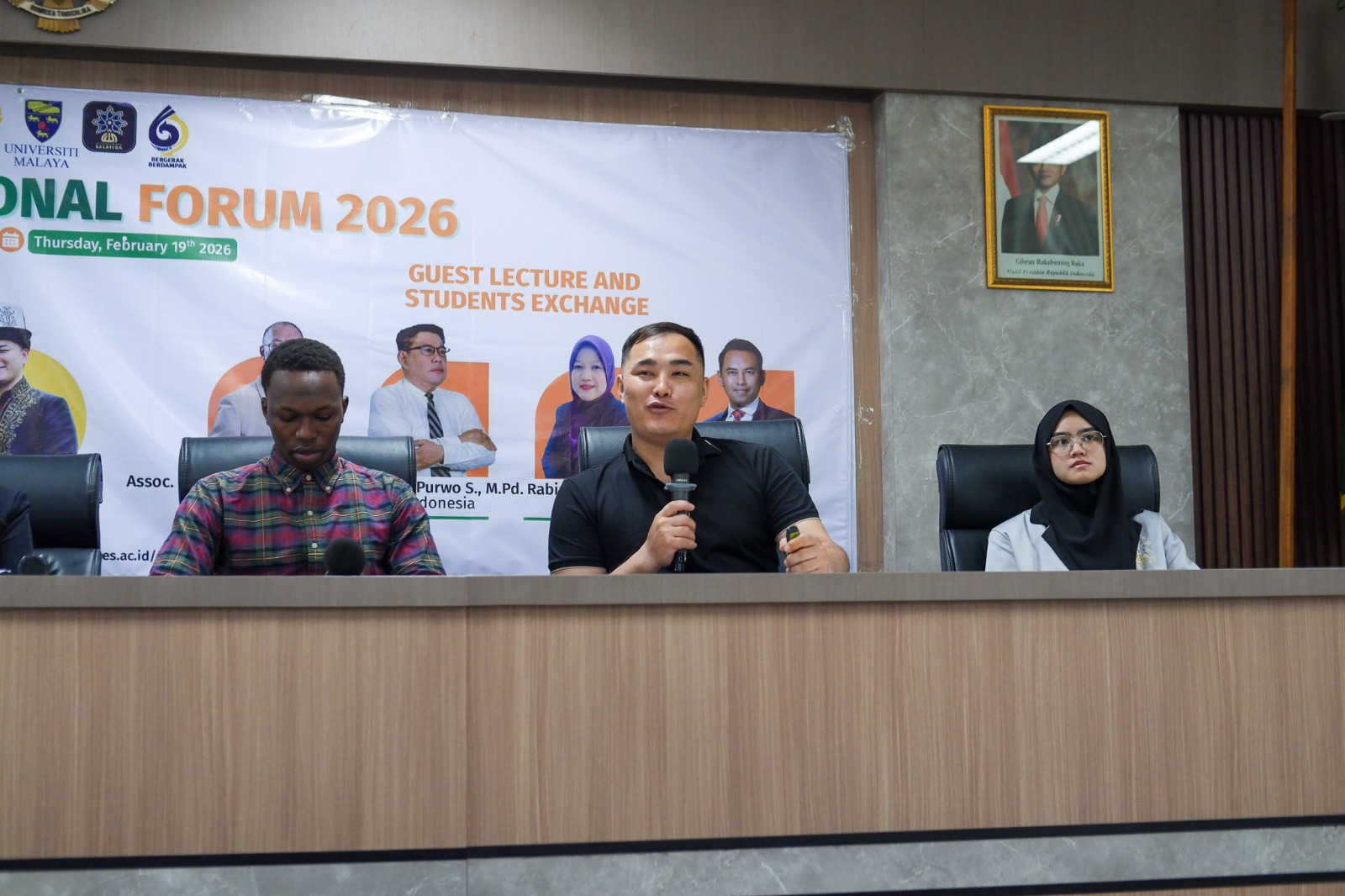
A range of strategic issues concerning global education and psychology were brought to the forefront during the International Seminar held as part of the FIPP International Forum 2026.
The event took place solemnly at the Deanery Hall of the Faculty of Education and Psychology (FIPP), Universitas Negeri Semarang (UNNES), on Thursday, 19 February 2026.
The seminar addressed critical topics, including the adaptation of international students within Javanese culture, educational resilience amid political crises, and the phenomenon of the “illusion of understanding” arising from the use of Artificial Intelligence (AI).
The Dean of FIPP UNNES, Prof. Dr. Edy Purwanto, M.Si., emphasized that the international forum reflects UNNES’s commitment to serving as a pioneer of globally reputable educational excellence. He noted that international collaboration, through student exchanges and cross-border academic engagements, constitutes a strategic effort to broaden students’ intellectual horizons.
“International collaboration through student exchanges and cross-border academic meetings is our endeavor to continue expanding students’ horizons,” he stated.
The seminar featured perspectives from Kyrgyzstan, Myanmar, Gambia, and Indonesia. One of the central themes that emerged was the resilience of educational actors in navigating various limitations and challenges.
Jenyes Intan Sururoh, a Guidance and Counseling student at FIPP UNNES, underscored the resilience of school guidance and counseling teachers. In her research, she highlighted that innovations in counseling services often emerge not from formal directives, but from teachers’ professional agency, namely their proactive and responsive actions in the face of limited facilities to address increasingly complex student emotional needs.
The issue of educational resilience was further elaborated by Hsu Nandar Myint, a Master’s student in Curriculum Development from Myanmar. She shared insights into curriculum transformation in her country following the 2021 political crisis. The use of printed modules and educational radio demonstrated that when advanced technology becomes inaccessible, community creativity remains capable of sustaining the continuity of learning.
From the perspective of cross-cultural adaptation, Nurtilek Kadyrov, a doctoral candidate at UNNES from Kyrgyzstan, reflected on his 11-year experience in Indonesia through the lens of Cultural Intelligence. According to him, adapting to life in Java involves not only linguistic proficiency, but also the capacity for nuanced psychological negotiation.
“Cultural intelligence is the key to transforming walls of difference into bridges of collaboration,” stated the recipient of the Indonesian Handai Festival 2023 award.
Meanwhile, Psychology student Shelma Rania Putri Nugroho addressed the issue of women classified as NEET (Not in Education, Employment, or Training). She examined how gender norms frequently act as structural barriers that constrain women’s self-efficacy.
Mafu Ceesay, a student from UIN Salatiga originating from Gambia, emphasized the importance of data literacy and coding as the new “mother tongue” in the logic of 21st-century education.
The forum also delivered a critical reflection on the use of Artificial Intelligence. Annisa Denti Papita, a student of Sharia Economic Law, highlighted the phenomenon of the Illusion of Understanding facilitated by the ease of access to AI tools.
She cautioned that such convenience may foster a false sense of comprehension, potentially eroding the depth of critical analysis and intellectual integrity among students if not approached with discernment and responsibility.
Through this international seminar, FIPP UNNES reaffirmed its commitment to supporting the Sustainable Development Goals (SDGs), particularly in advancing inclusive education and gender equality, while ensuring that academic discourse remains grounded in human realities amid the accelerating currents of future technological advancement.
It is hoped that this forum will further strengthen global collaboration and generate transformative ideas for the advancement of competitive, resilient, and ethically grounded education and psychology.