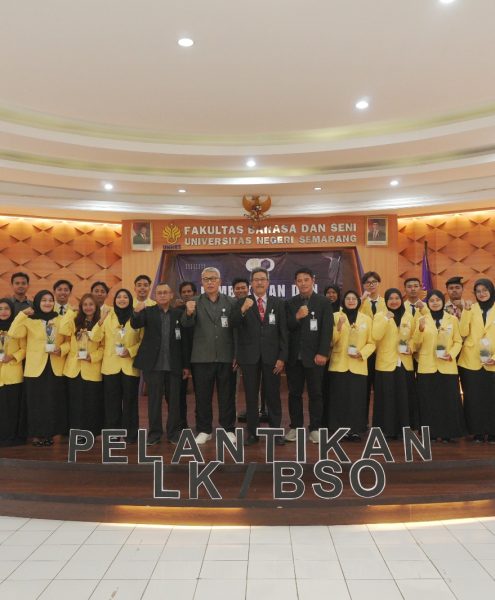


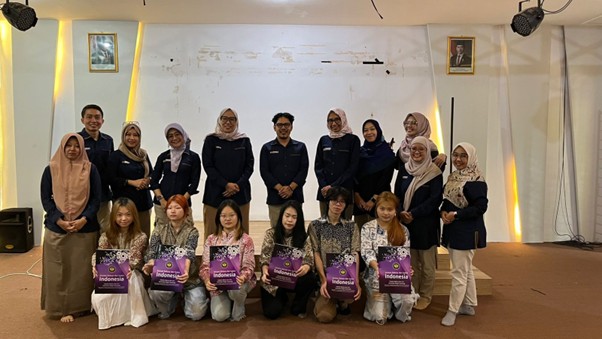
SEMARANG, January 8, 2026 – Six students from China’s Fujian Polytechnic Normal University (FPNU) have completed an intensive credit transfer program at Universitas Negeri Semarang (UNNES). The three-month program, running from October 6, 2025, to January 5, 2026, was not merely a student exchange but a strategic step reinforcing UNNES’s commitment as a World Class University (WCU) and realizing its Key Performance Indicator (IKU) targets.
This academic collaboration commenced with the signing of a Memorandum of Understanding (MoU) between the two institutions, which was subsequently implemented through complete coursework in the Indonesian Language and Literature Education (PBSI) and Indonesian Literature (SI) study programs under UNNES’s Faculty of Languages and Arts. The program culminated in the presentation of official UNNES academic transcripts to the six students—a document directly applicable for credit recognition at their home university, FPNU.
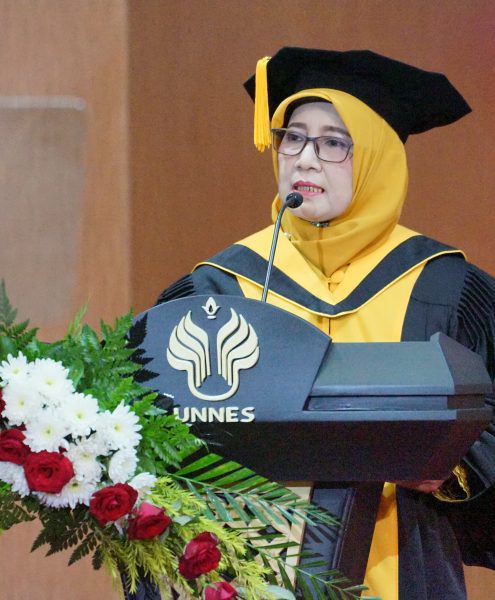
The Coordinator of the PBSI Study Program at UNNES, Dr. Deby Luriawati Naryatmodjo, M.Pd., emphasized that this program is a concrete achievement of the campus’s internationalization efforts. “The program’s success, from the initial MoU signing to the issuance of transcripts, directly contributes to UNNES’s international reputation. This is a tangible manifestation of the WCU vision we champion, as well as a significant IKU achievement, particularly in terms of cooperation with foreign partners and enhancing globally-standardized learning quality,” she stated.
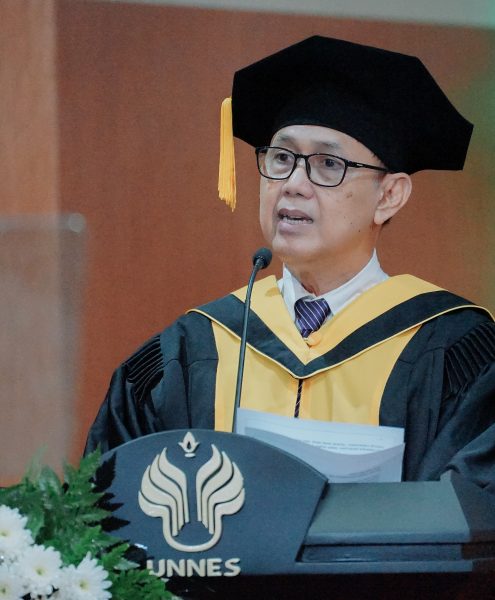
The Coordinator of the SI Study Program, Suseno, S.Pd., M.A., expressed a similar view. He sees the program as having multi-layered impacts. “At the academic level, we demonstrate that our curriculum and assessment processes have met internationally recognized standards. At the institutional level, the presence of international students and the sustainability of this program contribute to several key IKU achievements, including those related to international student enrollment and sustainable cooperation practices,” Suseno explained.
One of the participating students, Lin Jiaqi (Kiki), admitted to gaining a complete and well-structured experience. “The process was obvious. We arrived after an official agreement was reached between the two universities, attended lectures seriously, and returned with recognized academic credentials. This made things easier for us and provided certainty that our time studying at UNNES was very meaningful for our further studies,” Kiki shared.
With the official and administrative closure of this inaugural program, UNNES affirms a collaborative model that is not merely ceremonial but based on measurable academic output. This success is expected to open doors for more similar programs with FPNU and other partner universities, solidifying UNNES’s steps on the global higher education map.