

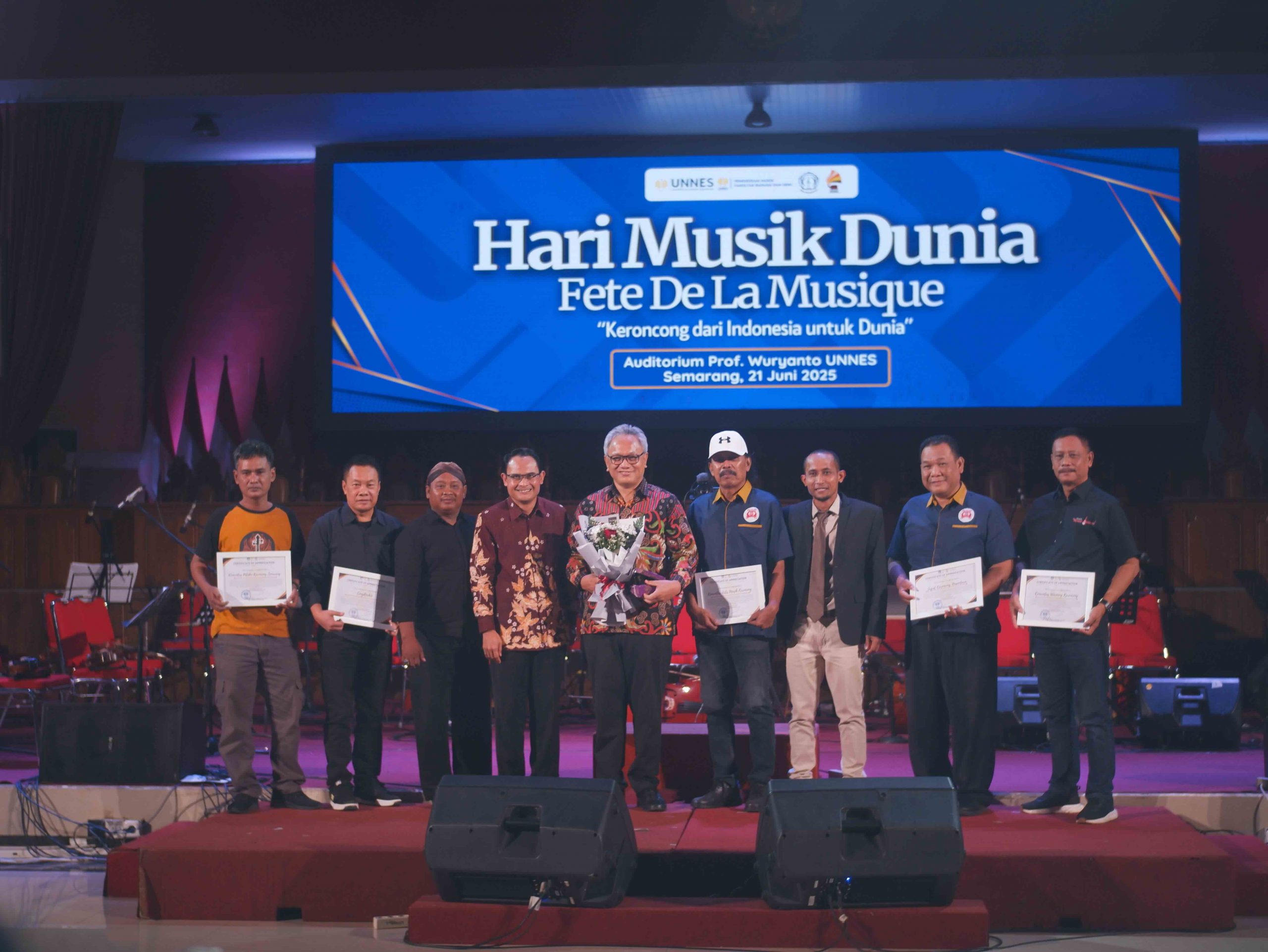
The Music Education Study Program at the Faculty of Languages and Arts Universitas Negeri Semarang celebrated World Music Day (Fête de la Musique) on Saturday, June 21, 2025, at the Prof. Wuryanto Auditorium. This year’s celebration adopted the theme “Keroncong, from Indonesia to the World,” aiming to support the ongoing submission of keroncong music as a UNESCO intangible cultural heritage.
This celebration featured an international collaboration between Universitas Negeri Semarang and Universiti Malaya, Malaysia. For the first time since 2015, the event showcased a cross-country performance blending elements of traditional keroncong music with modern performance styles.
A cultural heritage recognized by The United Nations Educational, Scientific, and Cultural Organization (UNESCO) is a site or cultural practice acknowledged by the organization for its outstanding universal value, warranting preservation for future generations. Several cultural heritage sites in Indonesia have received UNESCO recognition, including Borobudur Temple, Prambanan Temple, the Sangiran Early Man Site, the Cultural Landscape of Subak in Bali, and the Ombilin Coal Mining Heritage of Sawahlunto. Beyond physical sites, there’s also recognition for intangible cultural practices such as batik, wayang, gamelan, keris, angklung, and the Saman dance.
Professor Ismunandar, PhD, Expert Staff to the Indonesian Minister of Culture for Inter-Agency Relations, stated that submitting keroncong to UNESCO faces unique challenges, primarily due to the limited capacity for proposals from member states. Therefore, cross-country collaborative strategies, such as with Malaysia, which shares similar traditions, become a crucial option.
“This requires another strategy: proposing it jointly with other countries like Malaysia,” he stated. “However, what’s more important than mere recognition is the transmission of culture to younger generations through innovation and creativity.”
Abdul Rachman, M.Pd., Coordinator of the Music Education Study Program at UNNES, added that keroncong has significant potential to be introduced globally. The collaboration with the Universiti Malaya marks an initial step in opening avenues for cultural diplomacy.
The event also featured performances by various artists, including Congrock 17 Semarang, Halmahera Music School alumni like Hendra Kumbara and Alfa Bintang, and UNNES lecturers and students. The Head of the Committee, Deniska Yoga Pratama, stated that this year’s celebration marked a historic achievement as it was the first time an international collaboration had been established.
“Although keroncong music is often considered the music of older generations, it actually becomes a luxury when combined with an orchestra on a cross-country collaborative stage,” he remarked.
One notable musical collaboration featured students from Universitas Negeri Semarang’s Music Education program and Dr. Marzelan Saleh from Universiti Malaya. Even though it was held in a hybrid format, this collaboration successfully united the musical expressions of both countries in a harmonious performance.
Professor Dr. Tommi Yuniawan, M.Hum., the Dean of the Faculty of Languages and Arts Universitas Negeri Semarang, who opened the event, expressed deep appreciation for the spirit of preserving and developing keroncong music as a national cultural identity.
Over 1,000 spectators from various backgrounds attended the event, marking a new milestone in cultural diplomacy through traditional music. (Ika Rizki refima Putri/Student Staff Humas FBS UNNES/*)
Translated by Dafele Arozal/Student Staff Humas FBS UNNES