

Universitas Negeri Semarang (UNNES), recognized as a Conservation University, strengthens its commitment to protecting coastal and marine ecosystems through mangrove planting, student-led conservation, and collaboration with industry partners, local communities, and international participants. These initiatives combine practical rehabilitation activities with environmental education, encouraging participants to understand the importance of coastal habitats for aquatic biodiversity and community livelihoods.
ILING PROJECT 2025: Mangrove Rehabilitation in Mangunharjo
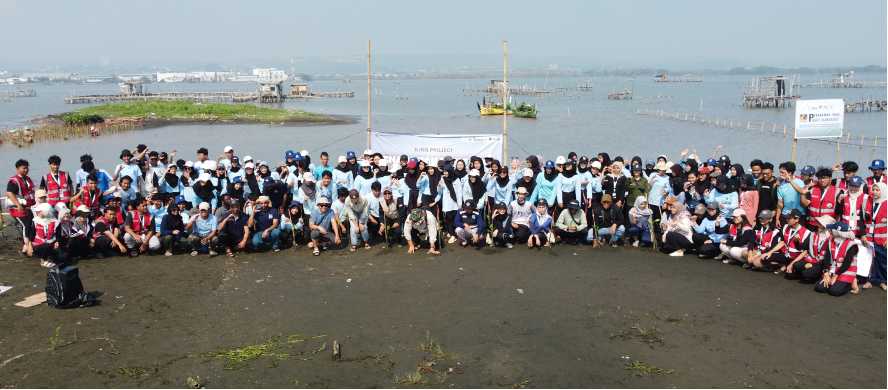
On 21 June 2025, Environmental Science students from the Faculty of Mathematics and Natural Sciences (FMIPA) UNNES organized ILING PROJECT 2025 at Mangunharjo Beach, Semarang City. Under the theme “One Action, One Solution, Collaboration for the Ocean,” participants planted 7,000 mangrove seedlings.
The activity brought together Environmental Science and Science Education students, international students from Ghana, Timor-Leste, and Pakistan, students from Universitas Ivet Semarang, and Abrasea Indonesia. Lecturers from the participating study programmes also attended, connecting field activities with academic learning about environmental conservation.
The initiative received support from PT PAMA and Kawasan Industri Wijayakusuma, with the Mangrove Lestari Farmers Group providing field assistance. As documented in the official UNNES report, the activity combined coastal rehabilitation with environmental learning and continued a student-led conservation initiative established in 2021. It also demonstrated cooperation among academic, industry, and community partners in addressing coastal environmental challenges.
Mangrove planting contributes to rehabilitation efforts by reintroducing vegetation that can provide habitat for aquatic organisms, retain sediment, and support shoreline stability as it develops. The recorded seedling total documents the scale of planting, while the recovery of these ecological functions depends on subsequent establishment and growth.
Mangrove Replant #12: Student-Led Conservation at Tambakrejo Beach
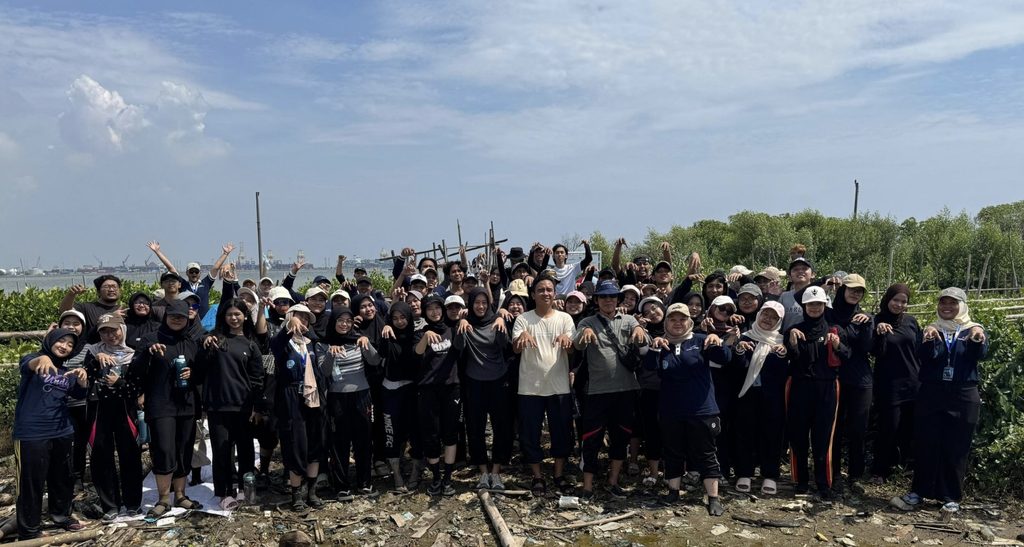
Student participation in coastal conservation continued through Mangrove Replant #12, organized by the Chemical Engineering Professional Student Association (HMPTK) of the Faculty of Engineering UNNES. Held at Tambakrejo Beach on 17 May 2025, the programme carried the theme “MANTA: Mangrove Action for Nature and Tropical Aquatic Life.”
The programme formed part of HMPTK UNNES’s continuing environmental conservation activities and provided students with practical experience in coastal rehabilitation. The official report, “Mangrove Replantation Effort Strengthens Coastal Conservation,” records the participation of 50 students from universities across Indonesia in planting 1,600 mangrove seedlings. Alongside planting, the programme raised awareness of mangroves’ role in protecting coastal habitats and helping coastal areas withstand erosion and tidal flooding.
Through direct involvement in planting, participants connected environmental awareness with practical action. The activity also created opportunities for students from different universities to work together and develop a shared understanding of coastal conservation.
Mangrove Planting and Beach Cleanup at Mangkang Wetan
Complementing these planting initiatives, the Social Adventure Club (SAC) of FISIP UNNES combined mangrove conservation with coastal waste removal. Its 17th mangrove planting and beach cleanup activity took place at Mangkang Wetan Beach, Tugu District, Semarang City, on 18 May 2025, under the slogan “Planting Hope, Reaping Life.”
The official FISIP UNNES report describes the involvement of 75 participants, including students, environmental communities, and residents, in collaboration with the Mangrove Lestari Farmers Group. The activity took place within a coastal area reported as approximately 140,000 square metres, or 14 hectares, and emphasized shared responsibility for maintaining coastal vegetation and cleanliness.
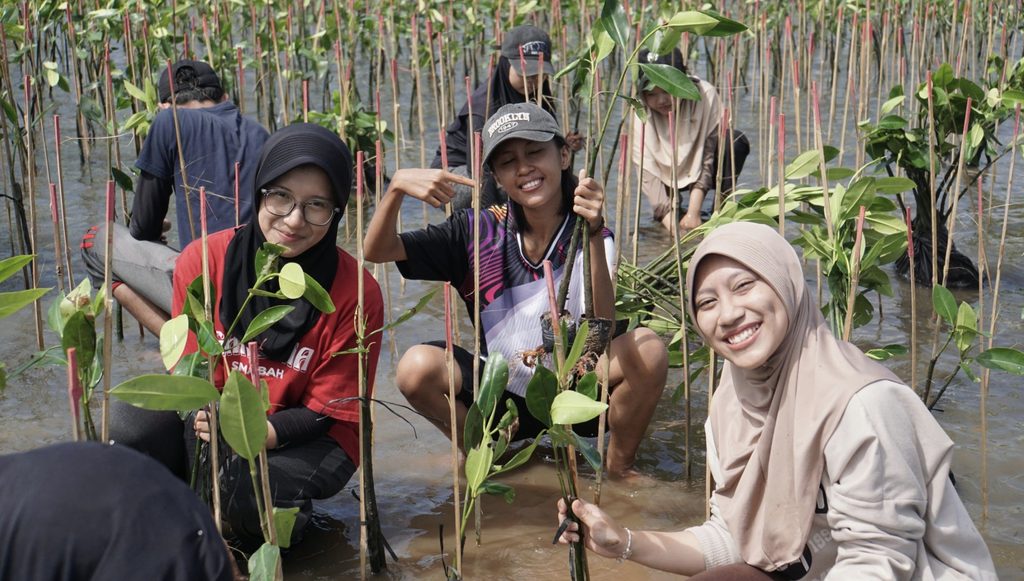
SAC FISIP UNNES brings together students and community members for mangrove planting and beach cleanup at Mangkang Wetan Beach. Photo source: FISIP UNNES.
Combining planting with waste removal connects habitat rehabilitation with pollution prevention. The reported 14 hectares describes the coastal area associated with the activity; it does not establish that the entire area was planted or successfully restored. Nevertheless, the programme documents collective participation in caring for the coastal environment.
Institutional Collaboration with PLN for Coastal Rehabilitation
Beyond student-led programmes, UNNES supports coastal conservation through institutional partnerships. Its Conservation Sub-Directorate collaborated with PT PLN (Persero) and PT PLN Indonesia Power UBP Semarang to plant mangroves in commemoration of Indonesia’s Tree Planting Day, or Hari Menanam Pohon Indonesia (HMPI), in 2025.
The partnership is documented in the official report, “UNNES and PLN Plant 10,000 Mangroves in HMPI 2025 to Strengthen Coastal Ecosystems.” The initiative planted 10,000 mangrove seedlings across Tapak Mangrove Forest in Tugurejo and Tirang Island, mobilizing university, industry, and community participation. Its stated aims included coastal habitat protection and stronger resilience against erosion, seawater intrusion, and environmental degradation.
This collaboration extends conservation participation beyond the university community. By bringing together institutional partners and coastal stakeholders, the programme combines resources and expertise in support of mangrove rehabilitation.
Documenting Conservation Activities and Ecological Outcomes
Across the three initiatives reporting seedling numbers, the documented planting total reached 18,600 mangrove seedlings: 7,000 at Mangunharjo, 1,600 at Tambakrejo, and 10,000 across Tapak Mangrove Forest and Tirang Island. SAC’s Mangkang Wetan programme added community participation in mangrove planting and beach cleanup, although its report did not specify a seedling total.
These records establish the scale of planting and participation. Longer-term ecological outcomes—including seedling survival, vegetation recovery, shoreline changes, and aquatic habitat conditions—remain distinct from the initial planting outputs.
Together, the activities demonstrate UNNES’s involvement in coastal conservation through student organizations, academic participation, community partnerships, and institutional cooperation. They connect environmental learning with practical care for mangrove habitats, reinforcing the university’s commitment to protecting coastal ecosystems and the aquatic life they support.