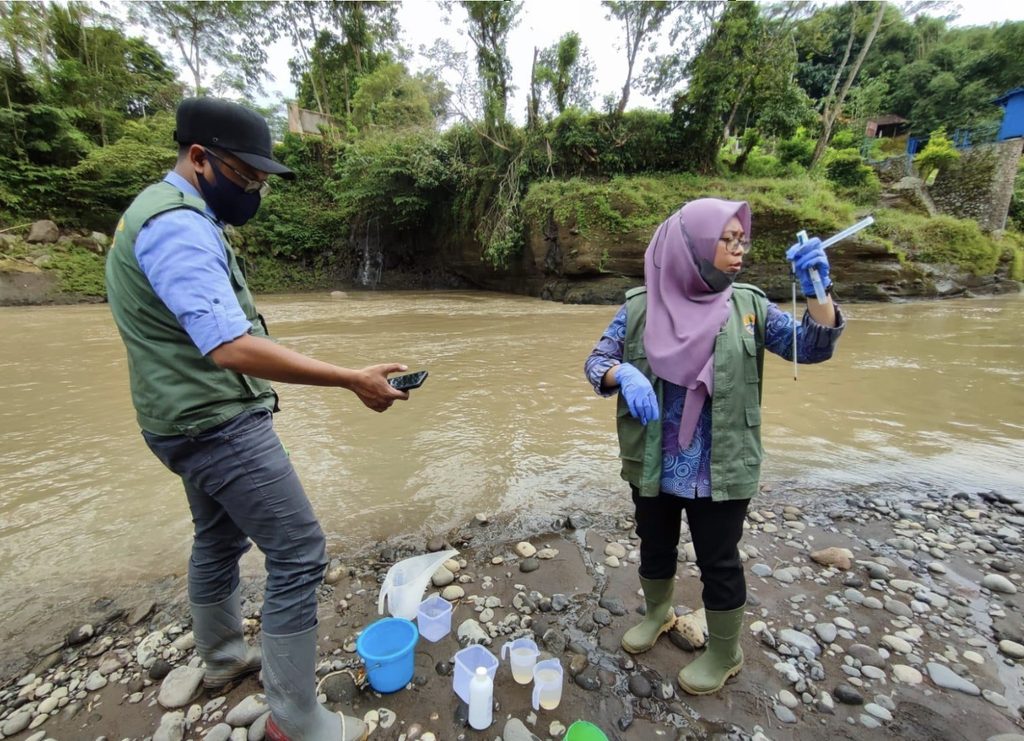
UNNES’s report, “UNNES Strengthens Aquatic Ecosystem Monitoring in Rivers and Coastal Areas,” describes monitoring at the campus retention basin and the Kreo, Tapak, Garang (West Flood Canal), and Babon rivers. The approach combines water-quality assessment—including temperature, pH, turbidity, dissolved oxygen, chemical oxygen demand, nitrate, and phosphate—with freshwater invertebrates as biological indicators of aquatic habitat conditions. It also describes student and faculty participation in mangrove planting and monitoring, connecting scientific assessment with conservation education and community engagement. Published in November 2024, the report provides institutional context for these activities but does not specify monitoring frequencies or present location-specific measurement results for 2025.
Water-Quality Assessment in Rivers and Campus Water Bodies
Water-quality assessment can help identify environmental pressures and support the management of rivers and other aquatic environments. Parameters commonly used in aquatic studies include temperature, pH, turbidity, dissolved oxygen (DO), chemical oxygen demand (COD), nitrate, and phosphate.
UNNES’s published monitoring report identifies these parameters as relevant to assessing water quality in rivers around Semarang. Temperature and pH provide information about basic water conditions, while turbidity can indicate the presence of suspended particles. Dissolved oxygen is important for aquatic organisms, COD provides an indication of the oxygen demand associated with oxidizable substances, and nitrate and phosphate measurements can help assess nutrient conditions.
The report also identifies the campus retention basin and the Kreo, Tapak, Garang, and Babon rivers as relevant aquatic environments. Nevertheless, the available source does not provide a complete set of numerical measurements, sampling dates, sampling-point coordinates, or results for each parameter at every location during 2025.
For this reason, the current evidence does not support a quantitative comparison of water quality among these sites or an assessment of trends over multiple observation periods. Such conclusions would require verified field records or laboratory reports identifying the sampling locations, dates, analytical methods, measured values, and applicable water-quality standards.
UNNES’s report, “UNNES Advances Watershed Management and Aquatic Biodiversity Monitoring in Semarang,” describes an approach combining water-quality assessment with observations of fish and riparian vegetation in the Kaligarang, Kreo, Tapak, and Babon river systems. It identifies collaboration with the BINTARI Foundation and SEAMEO BIOTROP to monitor freshwater fish, including baung, nilem, and wader, linking scientific research with local ecological knowledge. The report also connects biodiversity monitoring with riparian vegetation restoration and community participation in watershed management. These activities demonstrate UNNES’s reported approach to assessing aquatic ecosystem health, although the available information does not provide a complete 2025 dataset detailing species inventories, sampling methods, observation dates, and results across the campus retention basin and all four rivers.
Future reporting could strengthen this component by documenting species identification, abundance or occurrence, sampling frequency, and changes observed between monitoring periods. When combined with physicochemical measurements, these data could support a more comprehensive assessment of aquatic ecosystem health.
Coastal Conservation and Mangrove Monitoring
UNNES also supports coastal conservation activities, including mangrove planting initiatives involving students and institutional partners. Mangroves provide habitat for coastal organisms, help stabilize shorelines, and contribute to the ecological functions of suitable coastal environments.
Mangrove planting is an important conservation activity, but the number of seedlings planted alone does not establish whether restoration has been successful or whether coastal erosion has decreased. Evidence of these outcomes requires follow-up observations, such as seedling survival rates, vegetation growth, the extent of established mangrove cover, and documented changes in shoreline conditions.
The available evidence for the aquatic monitoring article does not provide a complete set of 2025 monitoring results on mangrove growth, coastal habitat conditions, or erosion changes. Accordingly, these outcomes should not be presented as verified results without supporting field records.
Future reporting could include dated photographs, monitoring sheets, mapped planting areas, survival-rate assessments, and observations of coastal habitat conditions. The responsibilities of researchers, students, and community groups should also be documented where their participation in monitoring is confirmed.
Research, Student Participation, and Community Engagement
UNNES integrates education, research, and community service within its Conservation University mission. These activities can provide opportunities for researchers and students to collect environmental data, develop fieldwork skills, and support local conservation initiatives.
Community collaboration can further contribute local knowledge about changes in river conditions, aquatic resources, and coastal habitats. To demonstrate how these partnerships contribute to systematic monitoring, however, reporting should identify the participating research teams, student groups, community organizations, locations, dates, and activities undertaken.
The available institutional reports provide evidence of UNNES’s stated monitoring and conservation approach, but they do not establish a comprehensive record of all researchers, students, and community groups involved in monitoring each location during 2025. Details of participation should therefore be added only when supported by project reports, field records, or other verifiable documentation.
UNNES’s published reports establish an institutional basis for aquatic ecosystem monitoring and watershed conservation by identifying relevant water-quality parameters, river systems, and biodiversity-related activities. Through environmental monitoring, the university supports the identification of pollution pressures, the protection of aquatic habitats, and the assessment of conservation measures, contributing to the long-term health and sustainable management of aquatic ecosystems.
To demonstrate implementation during 2025 more conclusively, future or supplementary reporting should include:
- Monitoring locations and dates: Specific sampling points at the campus retention basin and the Kreo, Tapak, Garang, and Babon rivers, with documented observation dates and frequency.
- Water-quality results: Numerical measurements for temperature, pH, turbidity, DO, COD, nitrate, and phosphate, supported by field or laboratory reports.
- Standards comparison: Assessment against the applicable Indonesian water-quality standards, taking into account the designated water-body classification and relevant regulatory requirements.
- Biological indicators: Verified records of freshwater macroinvertebrates, fish, or other organisms, including identification methods and sampling results.
- Coastal monitoring: Evidence of mangrove survival, vegetation growth, habitat condition, and shoreline changes where monitoring has been conducted.
- Participation and follow-up: Documentation of the researchers, students, and community partners involved, together with evidence of how monitoring findings inform subsequent conservation activities.
Until these records are available, the article should be understood as a description of UNNES’s institutional monitoring framework rather than proof of specific water-quality trends or measured improvements in ecosystem health during 2025.
By strengthening the continuity, transparency, and accessibility of environmental monitoring data, UNNES can better demonstrate how scientific assessment and collaborative conservation contribute to protecting aquatic habitats, preserving biodiversity, and supporting the sustainable management of water ecosystems.