Universitas Negeri Semarang (UNNES) strengthened economic support for community-based enterprises throughout 2025 by providing productive assets, implementing appropriate technologies, and offering operational equipment training. Implemented through the Institute for Research and Community Service (LPPM) and university faculties, these programs helped local business groups overcome technological constraints in production while strengthening their capacity to develop sustainable enterprises.
Tangible support was provided to the Sukses Bersama (SUKMA) micro, small, and medium-sized enterprise (MSME) group in Peron Village, Limbangan District, Kendal Regency, through the provision of product-processing machinery. Similar support was extended to the Atish Hidrofarm Millennial Farmers Group in Bawang Village, Batang Regency, through smart hydroponic equipment based on the Internet of Things (IoT) and solar energy.
UNNES LPPM Provides Production Machinery to SUKMA MSMEs in Kendal
In September 2025, a community service team from the LPPM Business Unit Incubator at UNNES conducted a program to strengthen production capacity and business management in collaboration with the Sukses Bersama (SUKMA) MSME group in Peron Village, Kendal Regency.
Led by Professor Sunyoto, the program aimed to help community members develop local product processing, particularly for granulated palm sugar and coffee.
On 15 September 2025, the Peron Village Government documented the handover of a crystallization mixing machine from the UNNES LPPM community service team to the SUKMA group. The transfer was accompanied by an official handover report signed by the community service team leader and Nilla Amalia, the head of the MSME group.
The machine helps improve the processing of granulated palm sugar, which had previously been carried out manually. According to the program documentation, the machine can process up to five kilograms of raw materials in approximately three hours per cycle, compared with the manual method, which produces around three kilograms in five hours.
At a group meeting reported on 16 September 2025, SUKMA members also confirmed receipt of other production equipment from UNNES LPPM, including a grinding machine and an oven.
This assistance strengthened the group’s production capacity by providing additional assets for its day-to-day business operations.
In addition to handing over the machinery, the program included practical demonstrations to ensure that group members understood how to operate the equipment and use the technology provided.
The provision of production machinery represents a form of in-kind economic support that directly helps businesses address equipment shortages and improve their production capacity.
Faculty of Engineering Provides Smart Hydroponic Equipment to Farmers in Batang
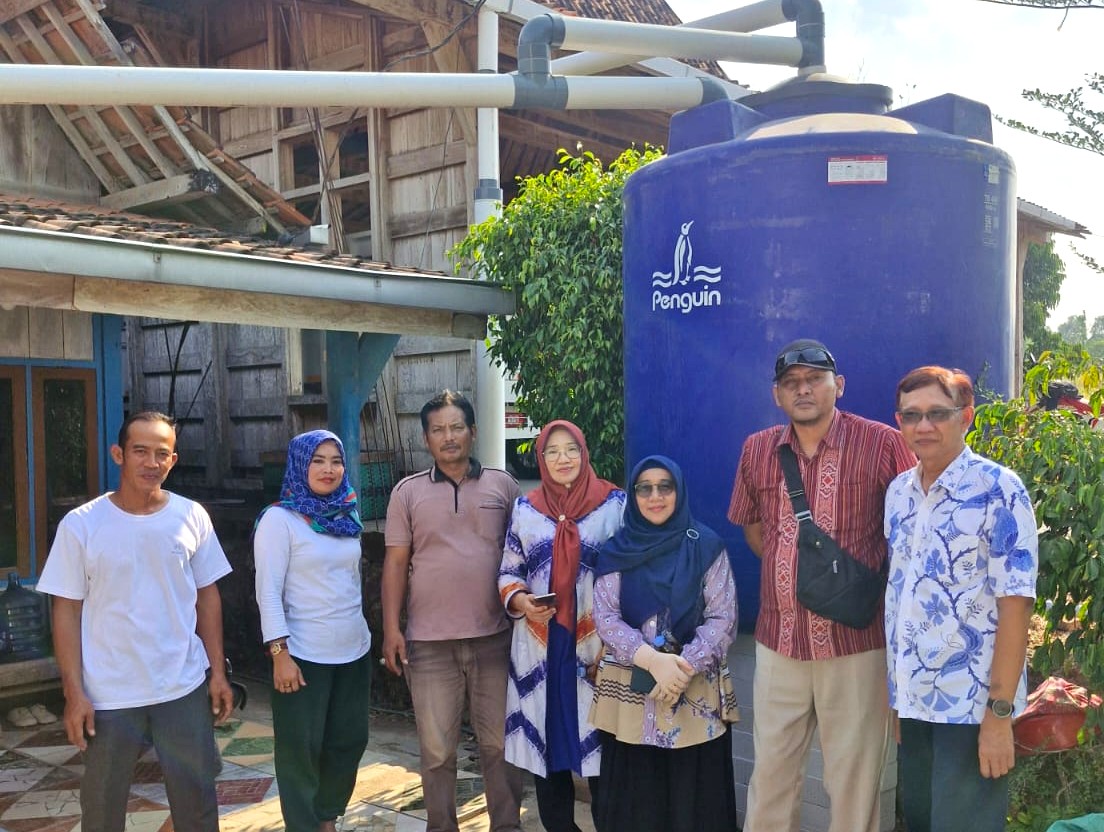
Productive asset support was also provided by the UNNES Faculty of Engineering to the Atish Hidrofarm Millennial Farmers Group in Bawang Village, Bawang District, Batang Regency.
On 8 July 2025, a community service team led by Professor Subiyanto, S.T., M.T., implemented smart farming technology to support the management of a hydroponic farm.
The technology incorporates an Internet of Things (IoT) system using an ESP32 microcontroller, monitoring sensors, nutrient-regulation pumps, and a web-based application.
The equipment is also supported by solar panels with a total capacity of 80 watt-peak (Wp) to meet the system’s energy requirements.
The UNNES team handed over the smart hydroponic equipment to the farmers’ group and provided training on equipment operation and maintenance.
With this technology, plant nutrient levels can be monitored and regulated more systematically. Processes that previously depended on manual adjustments can therefore be supported by an automated system.
Initial testing indicated that the equipment could maintain nutrient concentrations close to the specified target values.
The program received funding through UNNES’s 2025 community service scheme. Rector’s Decree No. B/255/UN37/HK.02/2025 allocated IDR 15 million for agricultural technology development activities involving the Atish Hidrofarm Millennial Farmers Group.
The allocation supported the implementation of the community service program, while the direct assistance received by the partner group consisted of productive technological equipment and training in its use.
This support helped the farmers’ group gain access to cultivation technology that could strengthen its production management capabilities.
Productive Equipment Assistance Reduces Barriers to Business Development
The provision of production machinery to the SUKMA group and smart hydroponic equipment to Atish Hidrofarm demonstrates UNNES’s support for local businesses seeking access to production technology.
For SUKMA, the crystallization machine, grinding machine, and oven provide equipment to help process agricultural products into higher-value goods.
Meanwhile, the smart hydroponic system enables the millennial farmers’ group to adopt automation in cultivation, allowing plant management processes to be conducted with greater precision and consistency.
Both programs included technical assistance to support the effective use of the equipment provided.
By combining productive asset assistance with skills transfer, UNNES seeks to help local enterprises strengthen their production capacity and adopt more efficient business management practices.
University–Community Collaboration for Sustainable Enterprises
The implementation of equipment assistance programs in 2025 demonstrates the role of higher education institutions in supporting community-based enterprises through resource provision, technological development, and community service initiatives.
The involvement of LPPM, university faculties, village governments, and business groups enabled the assistance to address the practical needs of local enterprises, particularly in overcoming limitations in technology and production equipment.
From an economic perspective, this support is intended to improve production efficiency and strengthen businesses’ capacity to produce goods with market potential. Socially, the use of shared equipment helps reinforce cooperation among group members in managing collective economic activities.
Through this approach, UNNES seeks to expand community access to technology and productive resources to support the long-term sustainability of local enterprises.
UNNES’s Contribution to SDG 1: No Poverty
Throughout 2025, UNNES provided economic support to community-based enterprises through the transfer of product-processing machinery and agricultural technology equipment.
The assistance provided to the SUKMA and Atish Hidrofarm groups illustrates the university’s contribution to supplying productive assets to local enterprises, alongside training and technical assistance to ensure that the equipment can be used in accordance with production needs.
Through these programs, UNNES supports efforts to strengthen community economic capacity and develop enterprises with the potential to achieve financial and social sustainability.
This initiative aligns with Sustainable Development Goal (SDG) 1: No Poverty, particularly through support for productive economic activities and expanded community access to resources for business development.