

Universitas Negeri Semarang (UNNES), as a Conservation University, promotes responsible fisheries management and aquatic ecosystem conservation through community education, technological innovation, and collaboration with fisheries stakeholders. These initiatives address challenges related to overfishing, environmental degradation, and the sustainability of aquatic resources. They contribute to the objectives of Sustainable Development Goal (SDG) 14, particularly the sustainable management of marine resources and the reduction of destructive fishing practices.
Quota-Based Fishing Education for Coastal Communities
UNNES has supported community education on quota-based fishing through the student organization PPK Ormawa UKM RIPTEK, in collaboration with the Central Java Department of Marine Affairs and Fisheries. On 23 September 2023, the team conducted an educational and training program on quota-based fishing at Mangkang Wetan Village Hall, Semarang. The activity involved local fishermen and community representatives, with support from the village head, Beni Irawan, and technical instruction from Sujiyanto, S.St.Pi., M.Si., representing the provincial fisheries department.
The program introduced the principles of regulated fishing, including fishing quotas and designated fishing zones, to encourage responsible harvesting and the preservation of fish stocks. By increasing fishermen’s understanding of fishing regulations and resource limitations, the initiative sought to promote practices that help maintain aquatic biodiversity and the long-term sustainability of fisheries. Further details are available in the report, “PPK Ormawa UKM RIPTEK UNNES Edukasikan Pengawasan Sumber Daya Laut”.
The educational approach is relevant to SDG 14 because excessive harvesting can reduce fish populations and disrupt aquatic food webs. Nevertheless, evidence of actual reductions in overfishing would require follow-up monitoring, such as fishing effort records, catch data, compliance observations, and assessments of fishermen’s knowledge and practices.
Reporting note: The available documentation identifies this activity as a 2023 program. It should not be presented as a 2025 training activity unless a separate report confirms that the program was implemented again in 2025.
SMARCOS: Web-Based IoT Innovation for Sustainable Aquaculture
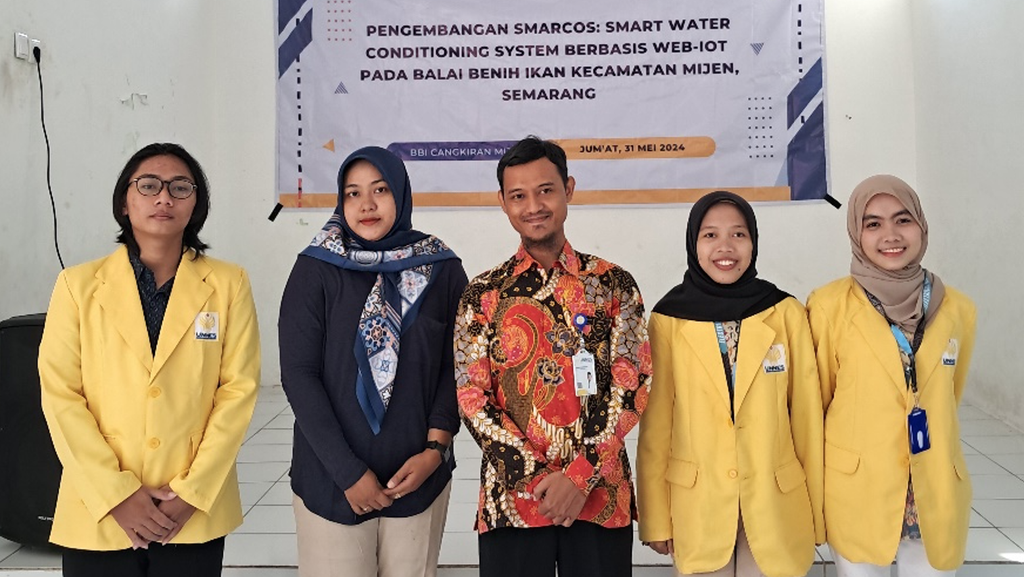
UNNES has also developed technological solutions to improve aquaculture management through SMARCOS (Smart Water Conditioning System), a web-based Internet of Things (IoT) initiative developed by the university’s community service team from the Directorate of Information Systems and Public Relations (DSIH). The system was introduced at the Fish Seed Center in Mijen District, Semarang, with the objective of addressing fish seed mortality and improving access to reliable information about fish stocks and distribution.
The community service activity took place on 5 June 2024 and involved 15 participants from the fish seed center and Mina Lestari, as well as representatives of the Semarang City Fisheries Service. The system was designed to support monitoring and control of pond conditions and relevant aquaculture equipment. The project also included plans for continued assistance, including system implementation, guidance on the web marketplace, equipment supervision, and user education.
The official report, “Tim Pengabdian DSIH UNNES Ciptakan SMARCOS, Teknologi Berbasis Web-IoT untuk Perikanan”, explains how the initiative addresses challenges related to water conditions and fish seed mortality.
By improving monitoring of aquaculture conditions, SMARCOS has the potential to reduce fish losses, improve operational efficiency, and support more responsible use of water and aquaculture resources. Maintaining suitable water conditions and preventing contamination are important for fish health and the sustainability of aquaculture production. However, the actual effects on mortality rates, water quality, and production efficiency should be demonstrated through operational records and follow-up evaluations.
Conservation Education and Community Participation
UNNES also promotes aquatic conservation awareness through community outreach and student-led initiatives. These activities encourage students and local communities to understand the ecological consequences of excessive fishing, destructive fishing practices, and the unsustainable use of aquatic resources.
The PPK Ormawa UKM RIPTEK outreach program conducted in collaboration with the Central Java Department of Marine Affairs and Fisheries provides an example of cooperation between a university student organization and a government fisheries agency in delivering conservation education to coastal communities.
To strengthen the program’s relevance to SDG 14, educational materials and activity reports should explicitly document topics such as compliance with fishing regulations, the ecological consequences of overfishing, the risks associated with destructive fishing gear and methods, and the prevention and reporting of illegal, unreported, and unregulated (IUU) fishing.
Such education can help fishermen and community members recognize unsustainable practices and understand the importance of protecting fish populations and aquatic habitats. However, participation in awareness activities alone does not demonstrate a reduction in IUU fishing or destructive practices. Evidence of behavioral change would require follow-up assessments, records of community monitoring, documented reports of violations, or other reliable indicators.
Evidence, Evaluation, and Long-Term Sustainability
To demonstrate a measurable contribution to SDG 14, UNNES should maintain systematic records of its fisheries and aquaculture initiatives. Relevant evidence includes dated activity reports, participant lists, photographs, training materials, stakeholder involvement, evaluation results, and documentation of follow-up activities.
For quota-based fishing education, useful indicators include the number of fishermen trained, improvements in knowledge of fishing regulations, documented compliance with applicable rules, and changes in fishing practices. For SMARCOS, relevant indicators include fish seed mortality rates before and after implementation, water-quality measurements, system usage records, and evidence of continued technical assistance. For conservation education, indicators may include participant knowledge gains, community monitoring activities, and documented actions to address unsustainable fishing practices.
These measures would help distinguish program implementation from actual environmental outcomes. Where possible, data should be collected before and after interventions and compared over an appropriate period. Claims about reduced overfishing, lower IUU fishing incidence, or improved fish populations should only be made when supported by credible evidence.
Through collaboration among researchers, students, government agencies, and coastal communities, UNNES can strengthen its contribution to responsible fisheries management and sustainable aquaculture. By combining regulatory education, technological innovation, and community engagement with systematic monitoring, UNNES supports the long-term objectives of SDG 14 and reinforces its commitment to aquatic ecosystem conservation.