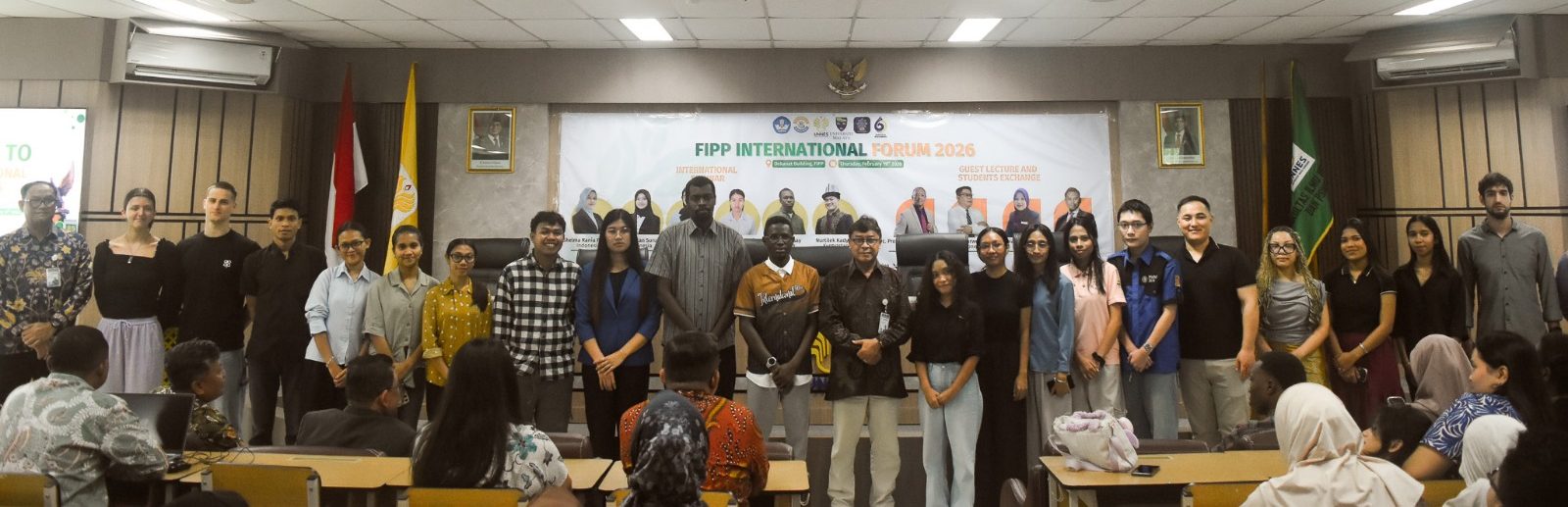
Universitas Negeri Semarang (UNNES) stands firmly against all forms of gender discrimination, guided by the belief that inclusivity is fundamental to educational integrity and institutional growth. The university asserts that without an inclusive environment, the core values of education cannot truly flourish.
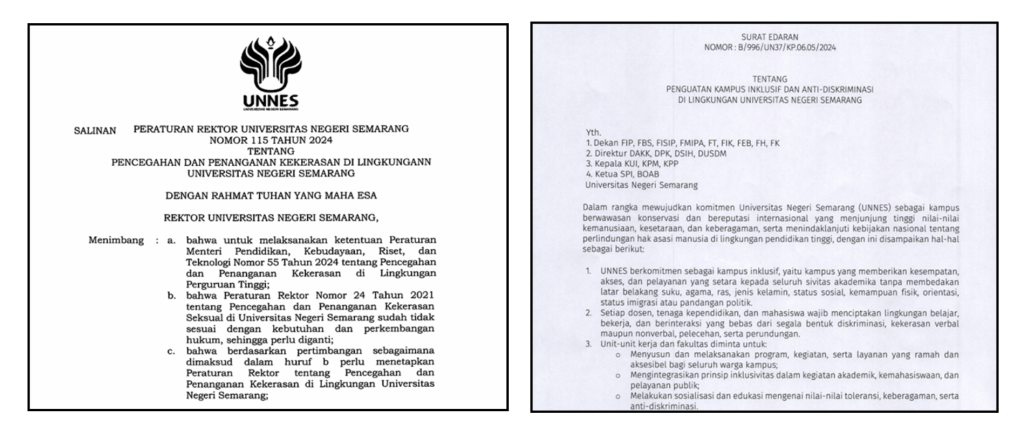
The Rector’s Regulation No. 115 Year 2024 on the Prevention and Handling of Violence within the Universitas Negeri Semarang Environment serves as the regulatory basis. Article 22 specifically mentions that women need to make up 2/3 of the task force for the prevention and handling of violence, highlighting the representation and safety of the victims who, according to the data, are dominated by women.
The Circular Letter Number B/996/UN37/KP.06.05/2024 on non-discrimination on the basis of sex strengthens the Rector’s Regulation and demonstrates the university’s commitment to advancing gender equality. The letter highlights five important points, which mention its commitment to being an inclusive institution, the responsibility of everyone to create a non-discriminatory environment, the programs and education provided by faculties and units to support the commitment, the existence of the Counseling Service Center, the Task Force for the Prevention and Handling of Sexual Violence, and sanctions for those who violate the regulation.
The policy explicitly prohibits discrimination, harassment, or any act that restricts women’s rights to study, grow, and participate equally in academic life. UNNES’s policies are rooted in universal human rights principles and Indonesia’s national legal framework. The university upholds the belief that academic spaces must be free from bias, intimidation, and discrimination of any kind, ensuring fairness and equality in every aspect of campus life.
Promoting Gender Non-Discrimination
To translate the third point of the Circular Letter, faculties and units are encouraged to provide the following programs:
- Sexual Violence Prevention and Response: Comprehensive services, training sessions, and reporting mechanisms ensure every case is handled promptly and confidentially.
- Gender Sensitivity Training: Regular programs for students, faculty, and staff aim to build awareness, prevent unconscious bias, and promote gender equity.
- Inclusive Leadership and Representation: The university actively encourages women’s participation in governance, research, and student organizations to strengthen their representation in decision-making processes.
- Support Services: Counseling and advocacy programs are provided to guarantee psychological safety and legal fairness for anyone facing discrimination.
Preventive and Educational Efforts
UNNES believes that building a non-discriminatory environment requires ongoing education and awareness. The university regularly organizes seminars, workshops, and training on gender equity and anti-violence initiatives. These activities reflect UNNES’s effort to make non-discrimination not just a written policy but a living culture of respect and equality across its academic community.
A tangible example of UNNES’s gender empowerment initiatives can be seen in its collaboration with Solidaritas Perempuan Flobamoratas through the research project “Belis from the Perspective of Women Writers in NTT” that ran from June to December 2025. The project amplifies NTT women’s voices in cultural narratives and promotes gender equality through literature. The project involves ten women writers from Flores, Sumba, Timor, Alor, Rote, and Sabu. The researchers from UNNES facilitate the production of short stories centered on the belis tradition by the women writers, organize the focus group discussions (FGDs), and conduct in-depth interviews. The outcomes will include international journal publications, an article on The Conversation, and an anthology of short stories that will also be registered for intellectual property rights.