


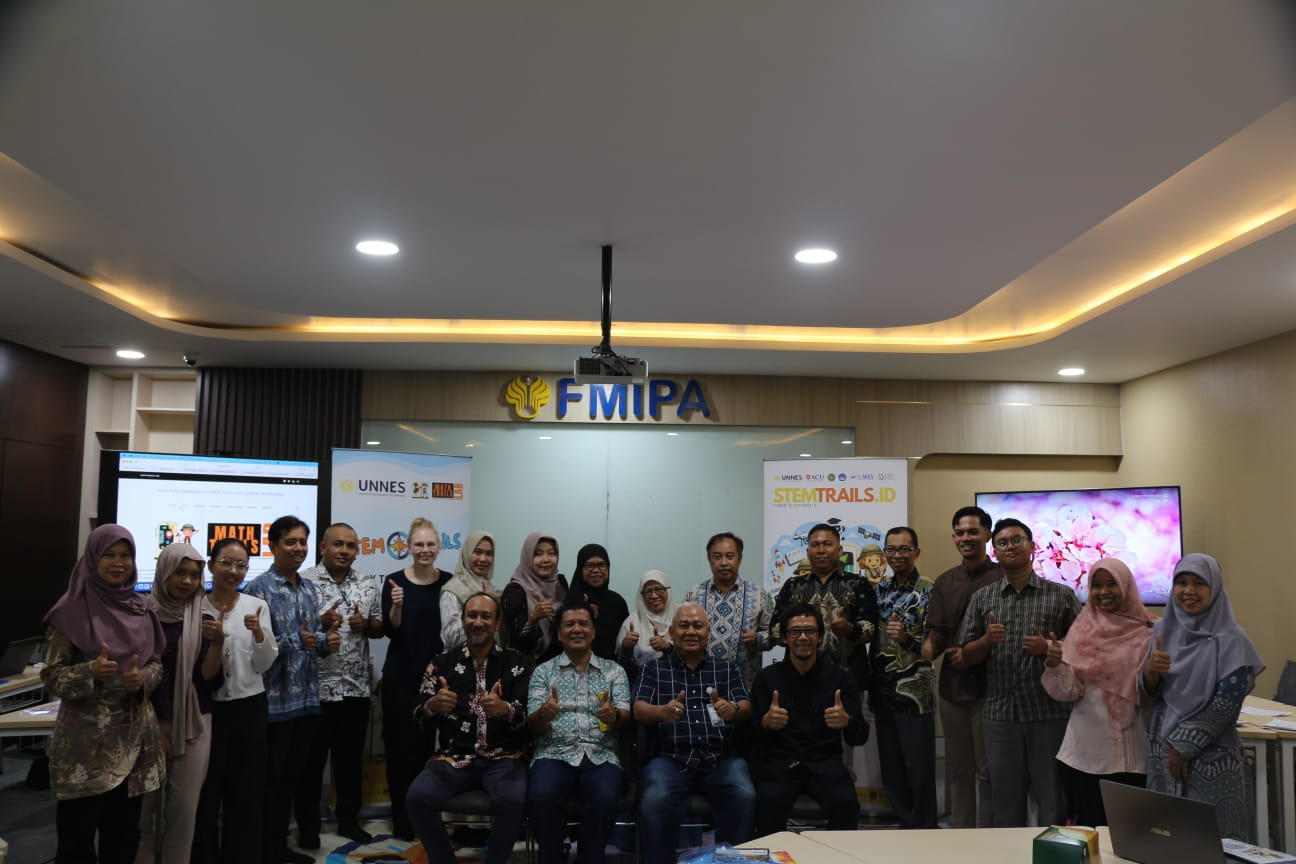
Semarang, 16 May 2026 – Universitas Negeri Semarang (UNNES) has officially launched an international research project focused on improving children’s numeracy skills through the use of technology. The initiative was marked by the STEMTrails workshop, which carries the research title “Code, Count, Connect: Enhancing Inclusive Numeracy through AI and Coding integrated STEM Trails in Indonesia”. This strategic project is fully funded by KONEKSI (Australia–Indonesia Knowledge Partnership Platform).
This collaborative research reflects the academic community’s commitment to supporting global sustainable development agendas, particularly SDG 4 (Quality Education) to ensure inclusive and equitable education, and SDG 10 (Reduced Inequalities) through expanding access to educational technology across regions in Indonesia.
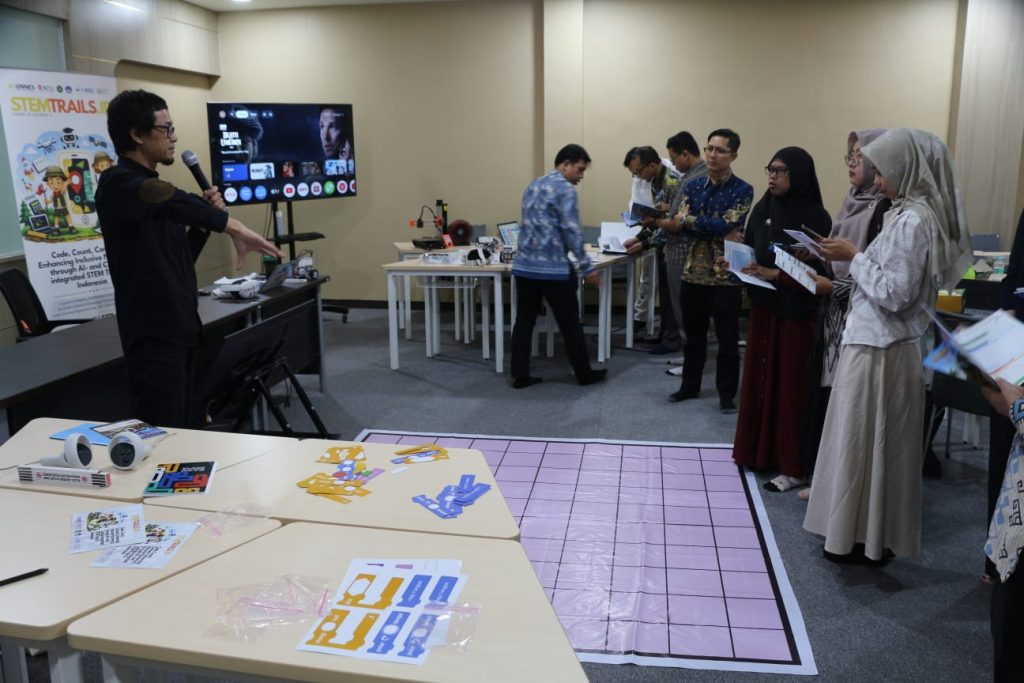
The workshop, held on Saturday (16/5) at the Faculty of Mathematics and Natural Sciences (FMIPA) UNNES, marked the beginning of collaboration between academics, education practitioners, and partner schools. The event was attended by research partners, including Universitas Mulawarman, Universitas Pattimura, the Indonesian Numeracy Movement Committee (KPNI), and the Indonesian Mathematics Educators Society (I-MES).
The event was officially opened by the Head of the Institute for Research and Community Service (LPPM) UNNES, Prof. Dr. R. Benny Riyanto, S.H., M.Hum., C.N. In his remarks, he emphasized the importance of innovative research that has a direct impact on society. Similar optimism was expressed by the Dean of FMIPA UNNES, Prof. Dr. Edy Cahyono, M.Si., who also conveyed strong support for the integration of Artificial Intelligence (AI) and coding in elementary mathematics education.
The lead researcher, Dr. rer. nat. Adi Nur Cahyono, explained that the implementation of this STEM-based research (Science, Technology, Engineering, and Mathematics) will be conducted across three strategic regions in Indonesia: Semarang, Samarinda, and Ambon. In each region, 100 elementary school students will participate in the research activities.
“In this study, we will conduct implementation in three regions: Semarang, Samarinda, and Ambon. In each location, we involve 100 elementary school students. Through an inclusive approach, we integrate AI and coding to make mathematics more contextual and connected to students’ environments,” said Dr. Adi Nur Cahyono.
For the Semarang implementation site, teachers from partner schools also participated actively in the workshop, namely SDN 2 Sekaran and SD Islam Bintang Juara. Their involvement is expected to ensure readiness in adopting technology-based curriculum implementation for students.
Through the STEMTrails project, the research team aims to ensure that the outcomes go beyond academic outputs. The final results are expected to make a tangible contribution to improving elementary students’ numeracy skills in an inclusive manner. In addition, the project is expected to provide strategic recommendations for the government in developing future technology-based learning models for primary education.