


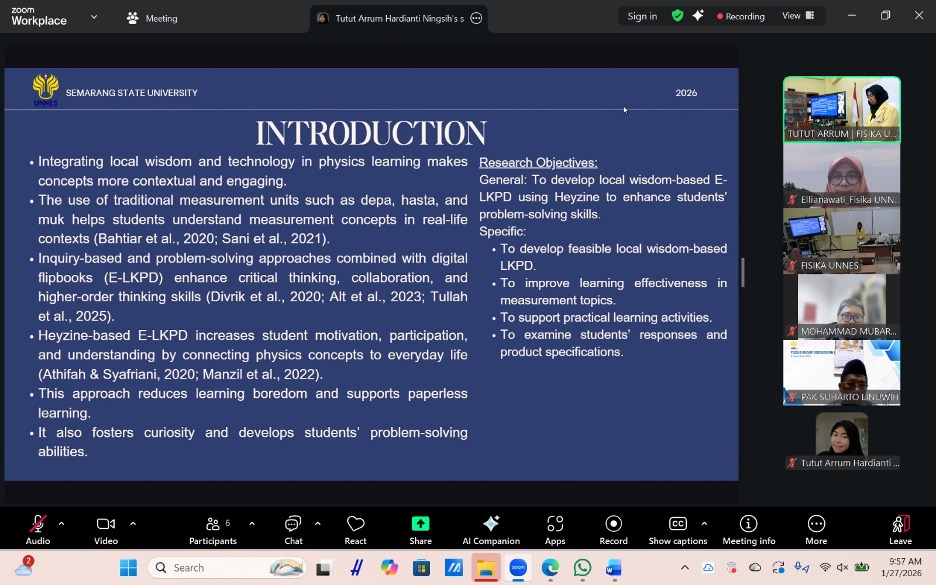
Semarang, 27 January 2026 — Tutut Arum, a seventh-semester undergraduate student in the Physics Education Study Program, Faculty of Mathematics and Natural Sciences (FMIPA), Universitas Negeri Semarang (UNNES), and a participant in the Fast Track Master’s Program in Science Education, successfully conducted her undergraduate thesis examination in a hybrid format on Tuesday, 27 January 2026. Her research, entitled “Development of Local Wisdom-Based E-LKPD Flipbooks on the Topic of Quantities, Units, and Measurement to Improve Problem-Solving Skills,” focuses on developing innovative digital learning materials for the fundamental physics topic of quantities, units, and measurement to enhance students’ problem-solving skills. Dr. Ellianawati supervised the study and is part of the research outputs of the Matching Grant 2025 scheme funded by DPA Universitas Negeri Semarang (UNNES), reflecting institutional support for student-led educational innovation.
In this study, Tutut Arum integrated traditional measurement practices and local units from the Purbalingga region as contextual learning resources in physics instruction. Traditional units such as hasta (cubit), jengkal (span), and depa (fathom) served as conceptual bridges to help students understand scientific quantities and units in the International System of Units (SI). This contextual approach made physics learning more meaningful and culturally relevant, while significantly increasing students’ learning motivation and engagement in STEM-related activities.
Empirical findings demonstrated a significant improvement in students’ problem-solving skills following the implementation of the local wisdom-based E-LKPD flipbook. Statistical analysis revealed an essential difference between pretest and posttest scores (p < 0.001), with N-Gain results indicating improvements in the low-to-moderate range, and several students achieving high gains. These results highlight the potential of culturally responsive STEM learning environments to foster higher-order thinking and analytical problem-solving competencies. Student responses were highly positive, indicating that the digital learning media was engaging, accessible, and contextually relevant.
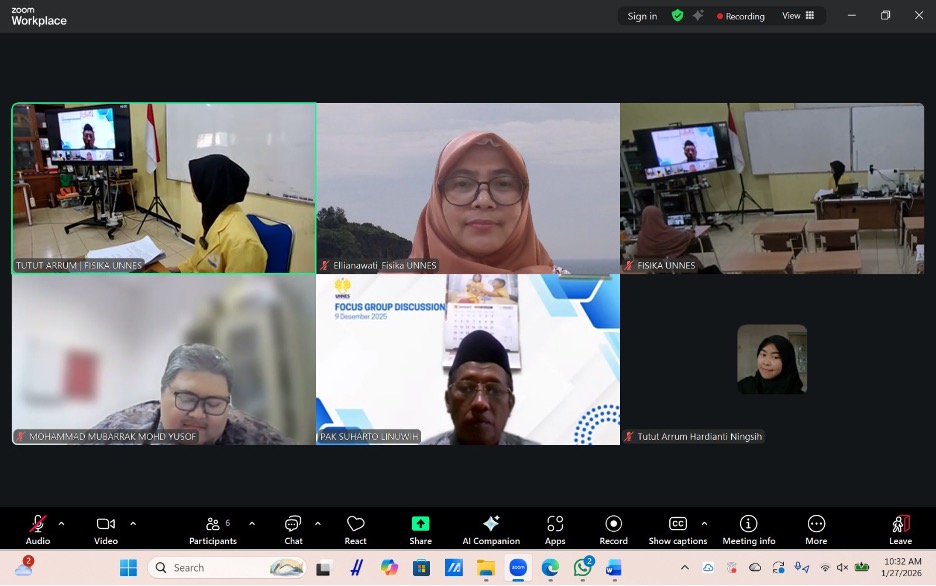
The thesis examination involved an international external examiner, Mr. Mohammad Mubarrak Mohd. Yusof, M.Ed. from Universiti Teknologi MARA (UiTM), Malaysia, and an internal examiner, Dr. Suharto Linuwih, M.Si. from the Physics Education Study Program, UNNES. The involvement of an international examiner reflects UNNES’s strong commitment to global academic engagement and to achieving Key Performance Indicators (IKU) through international collaboration, research quality enhancement, and global networking.
The hybrid examination format demonstrates UNNES’s commitment to digital transformation in higher education and expands opportunities for cross-border academic collaboration. The Fast Track program represents UNNES’s strategic initiative to accelerate the development of highly qualified human resources and supports the university’s vision toward becoming a World Class University (WCU).
This research also aligns with the Sustainable Development Goals (SDGs), particularly SDG 4 (Quality Education), by promoting inclusive, contextual, and technology-enhanced learning. By integrating local wisdom into STEM education, the study contributes to the development of 21st-century skills, including critical thinking, problem-solving, digital literacy, and cultural awareness. Overall, the findings confirm that integrating local wisdom into fundamental physics topics can enhance students’ conceptual understanding, learning motivation, and problem-solving abilities, contributing to research-based innovation in science education at both national and international levels.