


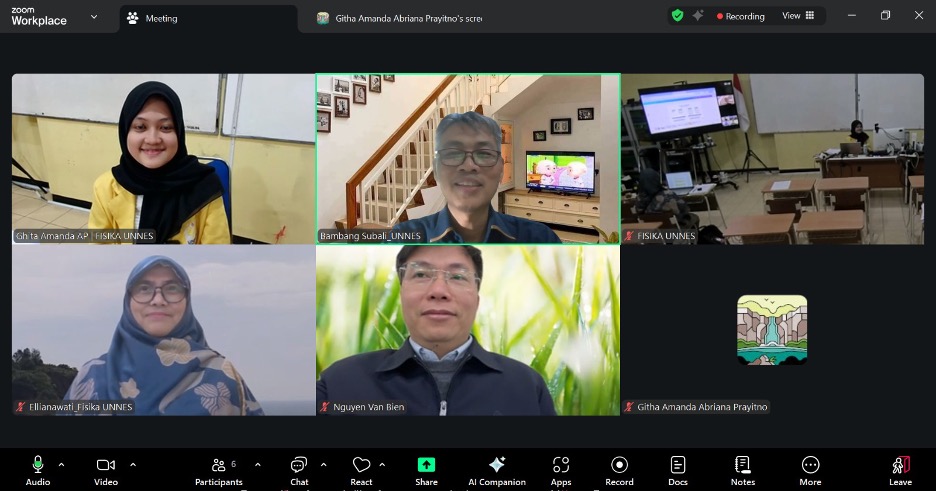
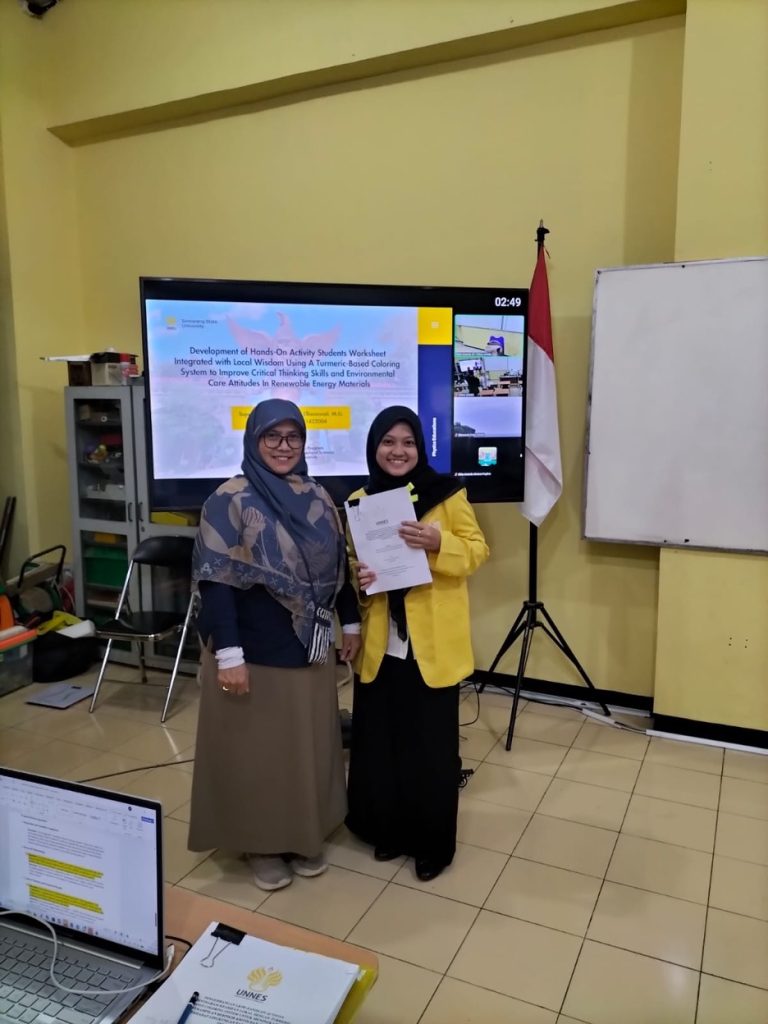
The Faculty of Mathematics and Natural Sciences (FMIPA), Universitas Negeri Semarang (UNNES), recently conducted an international-standard undergraduate thesis defense featuring the work of Githa Amanda Abriana Prayitno, a student of the Physics Education study program. Her research developed a Student Worksheet (LKPD) centered on hands-on activities that integrate the local wisdom of Semarang’s Jamu Village into physics instruction on renewable energy. The thesis, entitled *”Development of Integrated Local Wisdom Hands-on Activity Student Worksheet with Turmeric-Based Coloring System to Improve Students’ Critical Thinking Skills and Environmental Awareness in Renewable Energy Materials,”* was examined by a distinguished panel comprising Assoc. Prof. Dr. Nguyen Van Bien from Hanoi National University of Education (HNUE), Vietnam, as the external examiner, and Dr. Bambang Subali, M.Pd., as the internal examiner from UNNES.
The core innovation of this research lies in using a solar cooker as both a medium for exploring fundamental physics concepts—heat transfer and energy conversion—and a tool for observing the thermochromic properties of turmeric extract, in which color transformation occurs in response to temperature variations during the natural dye extraction process. Through a Project-Based Learning (PBL) approach, students not only grasp the theoretical principles of solar energy but also directly investigate the relationship between physical variables (temperature, heating duration) and the physicochemical changes in turmeric, subsequently applying their findings to eco-friendly textile dyeing. Developed using the ADDIE model and subjected to comprehensive validation (content, presentation, language, and graphics), the worksheet achieved excellent validity indices (Aiken’s V = 0.85–0.91). It was rated “Highly Practical” by both teachers (91.48%) and students (89.08%). Quasi-experimental effectiveness testing demonstrated significant improvements in critical thinking skills (N-Gain = 0.79) and environmental awareness (N-Gain = 0.73) among the experimental group.
This research aligns with the implementation of Key Performance Indicators (IKU) under Indonesia’s Merdeka Belajar–Kampus Merdeka policy, particularly IKU #3 (enhancing graduate quality through 21st-century competencies), IKU #4 (research-based and locally contextualized learning innovation), and IKU #7 (strengthening international collaboration), exemplified by the active involvement of an ASEAN science education expert in academic quality assurance. The partnership with HNUE Vietnam reinforces cross-border research networks in science education. It supports UNNES’s trajectory toward World Class University (WCU) status through enhanced international reputation and knowledge exchange in contextualized STEM curriculum development. Furthermore, integrating Jamu Village wisdom into physics instruction directly contributes to the Sustainable Development Goals (SDGs), especially Goals 4 (quality education), 7 (affordable and clean energy), 12 (responsible consumption and production), and 13 (climate action).
Githa’s work affirms that local wisdom is not merely a curricular supplement but an epistemic foundation enabling students to engage with physics concepts through culturally rooted phenomena meaningfully. By connecting sunlight, temperature change, and turmeric’s color transformation within a single, purposeful learning sequence, this research offers a holistic instructional model that cultivates analytical rigor, ecological sensitivity, and cultural appreciation—essential qualities for young generations confronting global sustainability challenges. Congratulations to Githa Amanda Abriana Prayitno for her substantive and inspiring academic contributions to advancing physics education in Indonesia.