
Philippine Examiner Commends Innovative Local Wisdom-Based Renewable Energy Worksheets in Undergraduate Thesis Examination at FMIPA UNNES

Universitas Negeri Semarang/Faculty of Mathematics and Natural Sciences/Berita/Philippine Examiner Commends Innovative Local Wisdom-Based Renewable Energy Worksheets in Undergraduate Thesis Examination at FMIPA UNNES

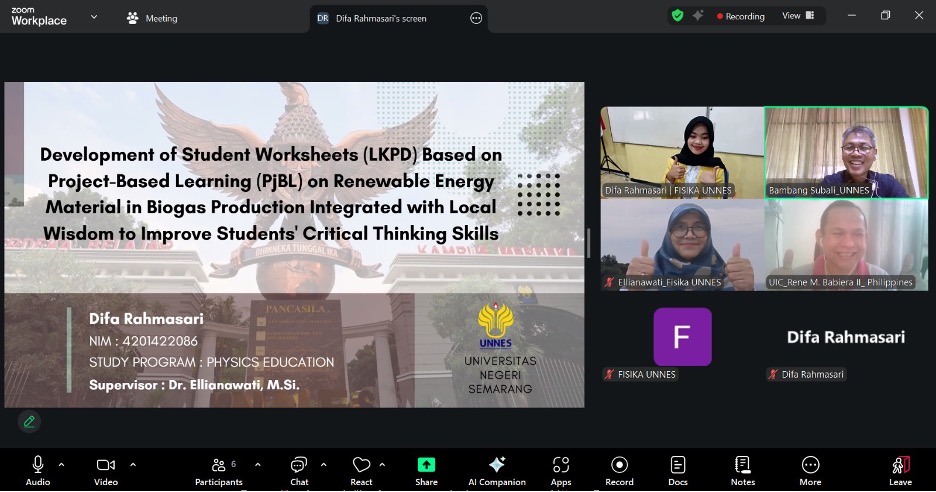
The Faculty of Mathematics and Natural Sciences (FMIPA), Universitas Negeri Semarang (UNNES), continues to strengthen its academic internationalization by involving international examiners in undergraduate thesis examinations. On Monday, 26 January 2026, at 08.00 WIB, Difa Rahma Sari, an undergraduate student in the Physics Education Study Program, successfully conducted her thesis examination with the presence of an international examiner from the Philippines.

In the examination, Difa presented her research entitled “Development of Student Worksheets (LKPD) Based on Project-Based Learning (PBL) on Renewable Energy Material in Biogas Production Integrated with Local Wisdom to Improve Students’ Critical Thinking Skills.” The study focused on developing Project-Based Learning (PjBL)-oriented student worksheets integrated with local wisdom in the context of biogas production as a renewable energy, aiming to enhance students’ critical thinking skills.

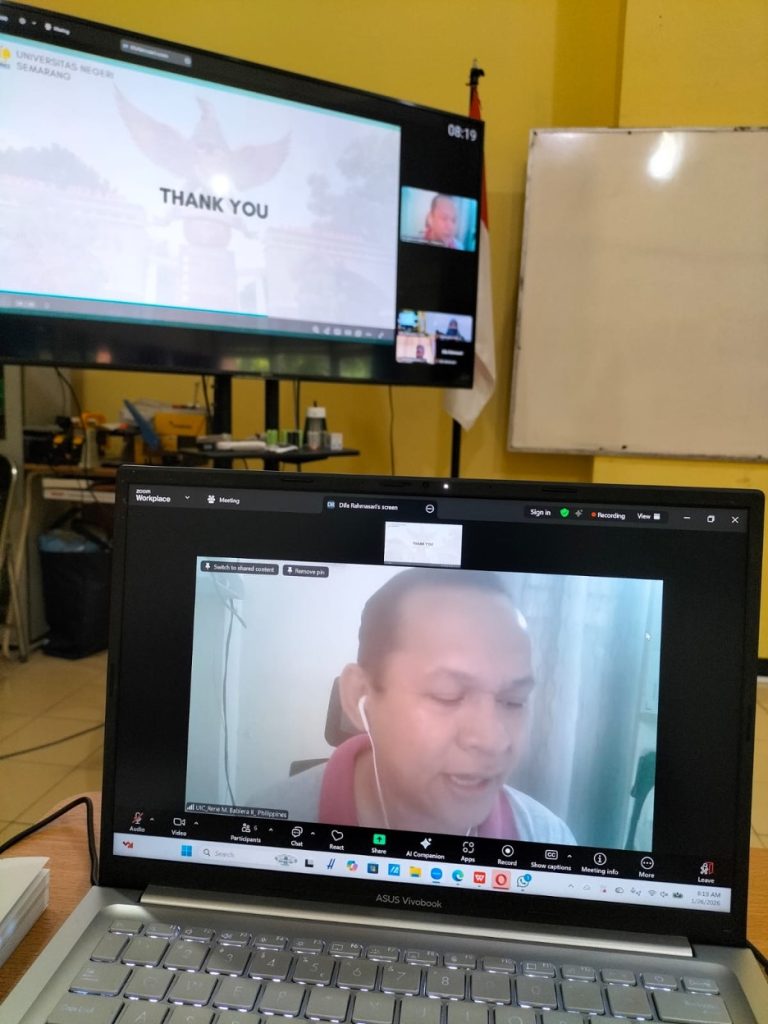
The examination involved Assistant Professor Rene M. Babiera II, MAED-PE, CSASS, from the University of the Immaculate Conception, Philippines, as the international external examiner, and Dr. Bambang Subali from Universitas Negeri Semarang as the internal examiner. The participation of an international examiner provided global academic benchmarking on the quality, novelty, and reliability of the developed learning product.

During the examination, Assistant Professor Rene M. Babiera II raised critical questions regarding the novelty and reliability of the developed worksheets. Difa Rahma Sari responded convincingly, presenting strong scientific arguments regarding the instructional design, validation process, and implementation of PjBL-based worksheets integrated with local wisdom in renewable energy learning.
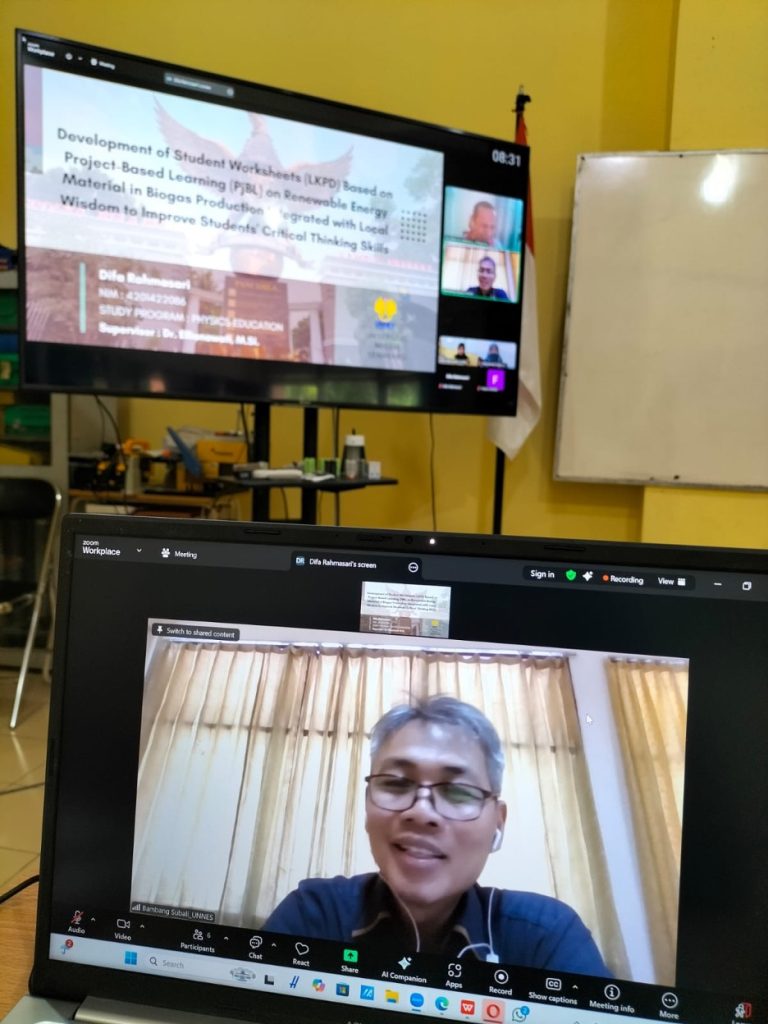
Meanwhile, Dr. Bambang Subali highlighted the rationale for selecting renewable energy as the research topic and the notable achievements in students’ critical thinking and creativity skills. He encouraged the student to emphasize the strengths and innovative contributions of the developed worksheets as a learning product that supports higher-order thinking skills in physics education.

Internationalization, Key Performance Indicators (KPI), and Global Engagement Highlights

The involvement of an international examiner in this undergraduate thesis examination reflects FMIPA UNNES’s strong commitment to global academic quality assurance, international benchmarking, and World Class University (WCU) initiatives. This activity contributes directly to several internationalization performance indicators, including:

  • International Key Performance Indicators (KPI): The participation of an international academic in the examination process supports IKU 6 (Collaborative and Participatory Learning) and IKU 7 (International Academic Reputation) by enhancing global academic collaboration and visibility.
  • World Class University (WCU) Roadmap: The presence of an international external examiner strengthens academic quality assurance and global benchmarking, while expanding UNNES’s international academic network with higher education institutions in Southeast Asia.
  • Global Engagement and International Exposure: This initiative provides students and faculty with international academic exposure and cross-cultural scholarly interaction. It opens pathways for joint research, co-publications, student exchange programs, and joint supervision between UNNES and international partner universities.

The research topic also aligns with global educational and sustainability agendas, particularly SDG 4 (Quality Education) and SDG 7 (Affordable and Clean Energy), emphasizing the integration of sustainability, local wisdom, and 21st-century skills in science education.

The research outcomes are expected to contribute to the development of innovative, project-based instructional materials integrated with local wisdom and to strengthen physics learning that promotes students’ critical and creative thinking skills.
Related Posts

Leave a Reply

* Kode Akses Komentar:

* Tuliskan kode akses komentar diatas:

GDPR

  • Privacy Policy

Privacy Policy

At unnes.ac.id, the privacy of our visitors is of extreme importance to us. This privacy policy document outlines the types of personal information that is received and collected by unnes.ac.id and how it is used.

Log Files

Like many other Web sites, unnes.ac.id makes use of log files. The information inside the log files includes internet protocol (IP) addresses, type of browser, Internet Service Provider (ISP), date/time stamp, referring/exit pages, and number of clicks to analyze trends, administer the site, track user’s movement around the site, and gather demographic information. IP addresses and other such information are not linked to any information that is personally identifiable.

Cookies

unnes.ac.id uses cookies to store information about visitors’ preferences, to record user-specific information on which pages the site visitor accesses or visits, and to personalize or customize our web page content based upon visitors’ browser type or other information that the visitor sends via their browser.

Third-party ad servers or ad networks use technology in their respective advertisements and links that appear on unnes.ac.id and which are sent directly to your browser. They automatically receive your IP address when this occurs. Other technologies (such as cookies, JavaScript, or Web Beacons) may also be used by our site’s third-party ad networks to measure the effectiveness of their advertising campaigns and/or to personalize the advertising content that you see on the site.

unnes.ac.id has no access to or control over these cookies that are used by third-party advertisers.

You should consult the respective privacy policies of these third-party ad servers for more detailed information on their practices as well as for instructions about how to opt-out of certain practices. unnes.ac.id’s privacy policy does not apply to, and we cannot control the activities of, such other advertisers or web sites.

If you wish to disable cookies, you may do so through your individual browser options. More detailed information about cookie management with specific web browsers can be found at the browsers’ respective websites.

Consent

By using our website, you hereby consent to our privacy policy and agree to its terms.

Update

This Privacy Policy was last updated on: 2023-02-14. Should we update, amend or make any changes to our privacy policy, those changes will be posted here.

Contact Us

If you have any questions, comments, or concerns about our Privacy Policy or our practices with regards to your personal information, please feel free to contact us through the contact form on our website or by emailing us at humas[at]mail.unnes.ac.id.

This Privacy Policy is intended as a general guide to our practices in collecting and using information. If there is any inconsistency between this Privacy Policy and the terms of the Service Agreement or any other terms that may apply to specific services you use, then those specific service terms shall apply.

Terms of Use

By using our website, you agree to abide by this Privacy Policy. If you do not agree with this Privacy Policy, please do not use our website. We reserve the right to update this Privacy Policy from time to time without prior notice. Please review our Privacy Policy periodically to check for changes. Your continued use of our website following the posting of changes to this Privacy Policy means that you accept the changes.

Thank you for reading our Privacy Policy. We are committed to protecting the privacy of our website visitors and will continue to update our Privacy Policy to ensure optimal protection.