


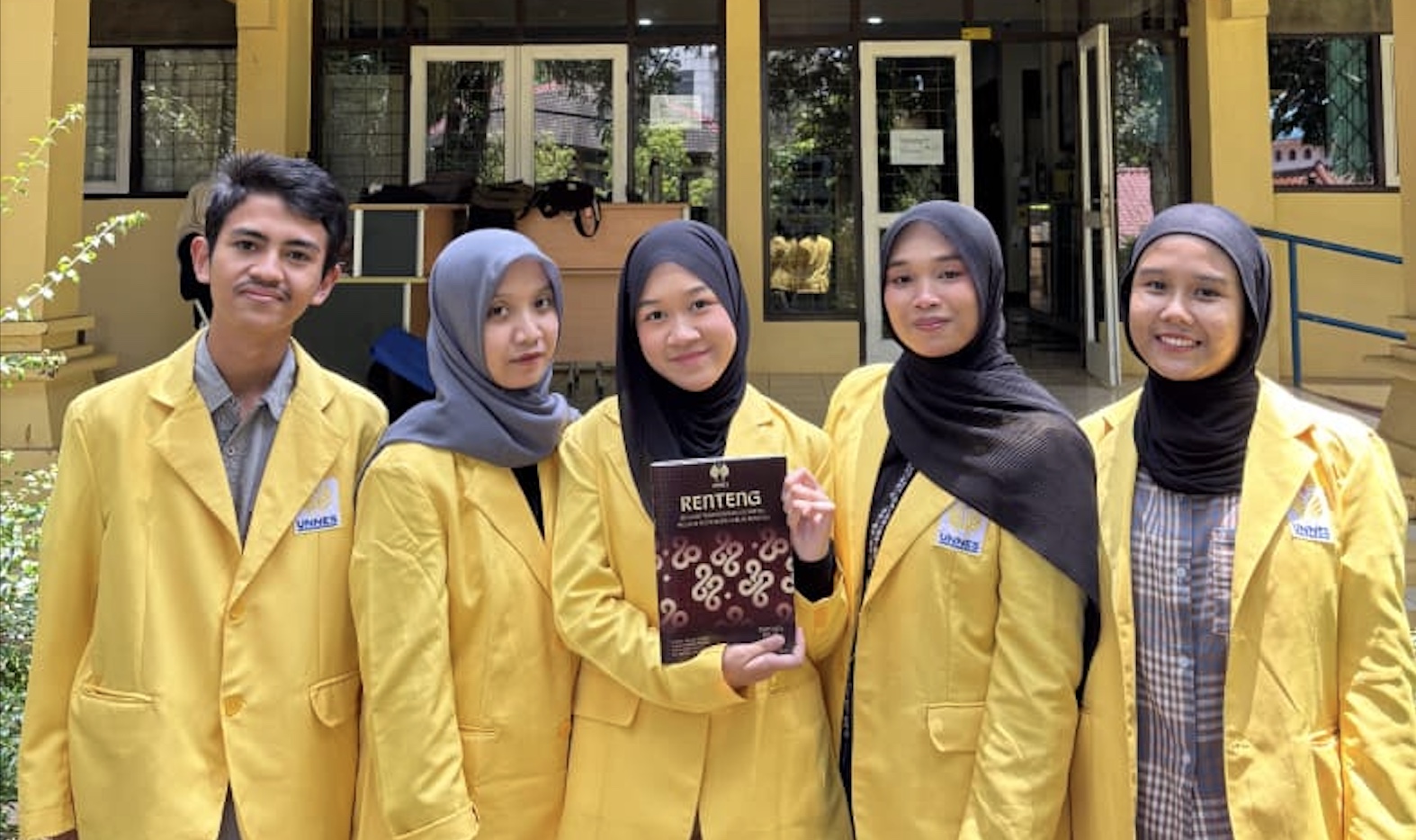
The Undergraduate Mathematics Education Study Program at Semarang State University (UNNES), under the guidance of Mr. Adi Satrio Ardiansyah, S.Pd., M.Pd., presented a learning innovation titled RENTENG, an ethnomathematics exploration inspired by the Geblek Renteng batik motif, typical of Kulon Progo, Yogyakarta Special Region. The development team, consisting of Hasna’ Azzah Yumna, Faiza Jasmine Syakir, Aulia Nur Azizah, Dwita Juliandira, and Muhamad Wildan Alfiansyah, successfully created geometric transformation teaching materials that combine local cultural values with modern mathematical concepts.
The Geblek Renteng batik motif, which features the chain-like shape of the traditional food “geblek,” has a repeating and symmetrical pattern rich in the concepts of translation, reflection, rotation, and dilation. This pattern was then transformed into a learning medium that helps students understand the concept of geometric transformation in a contextual and enjoyable way.
This innovation stems from a passion to make mathematics more alive, closer to students’ daily lives, and relevant to the nation’s cultural heritage. Through an ethnomathematics approach, UNNES students demonstrate that mathematics lessons are not always synonymous with numbers and rigid formulas, but can also be a means to instill a love for Indonesian culture.
In addition to enriching students’ learning experiences, this work also supports the Independent Curriculum program, which emphasizes contextual, meaningful learning, and is oriented toward the Pancasila Student Profile. RENTENG serves as a concrete example of how learning can integrate numeracy literacy with the preservation of local culture in a unified whole.
With the presence of RENTENG teaching materials, it is hoped that students can learn mathematics in a more enjoyable way while also becoming acquainted with Indonesia’s rich cultural heritage. This innovation also demonstrates the contribution of the younger generation to building a creative, contextual education rooted in national identity.