


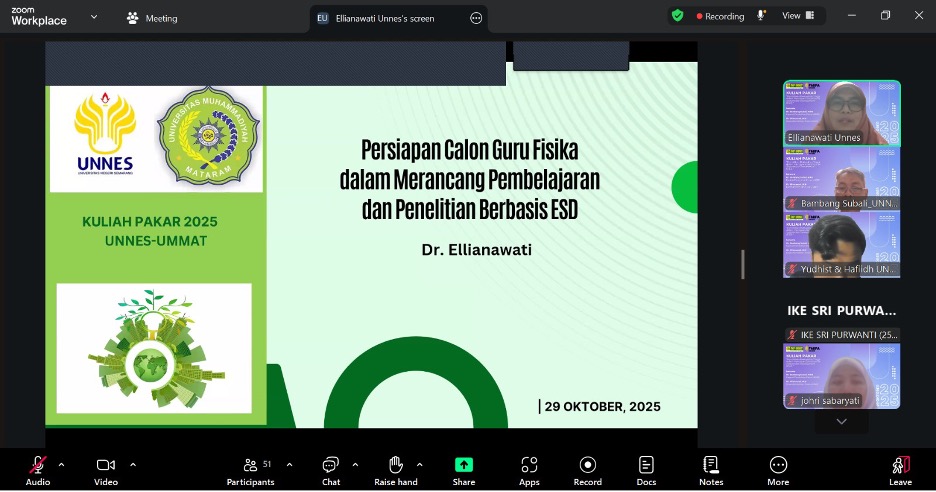
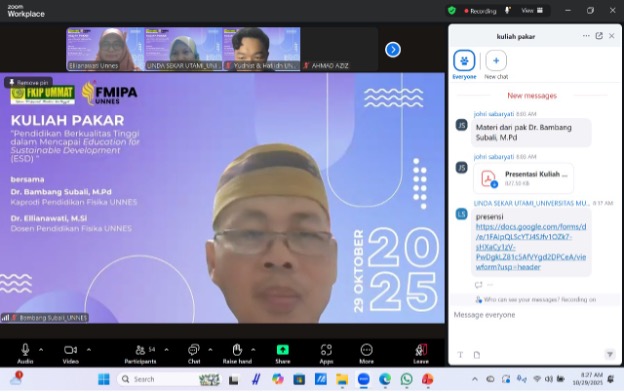
Semarang and Mataram, October 29, 2025 — The Physics Education Study Program of Universitas Negeri Semarang (UNNES) in collaboration with the Physics Education Study Program of Universitas Muhammadiyah Mataram (UMMAT) successfully held an Expert Lecture titled “Quality Education as a Pillar of Sustainable Development.” The event was conducted online via Zoom on Wednesday, October 29, 2025, at 7:30 AM WIB (8:30 AM WITA) and was attended by lecturers and students from both universities.
The lecture was officially opened by Dr. Muhammad Nizaar, M.Pd.Si., Dean of the Faculty of Teacher Training and Education (FKIP) at Universitas Muhammadiyah Mataram. In his opening remarks, Dr. Nizaar expressed his appreciation for the collaboration and emphasized the importance of the topic. “This lecture raises a timely and essential issue in addressing global challenges, particularly in improving science literacy and promoting sustainability awareness in education, especially in physics learning,” he stated.
The event featured two distinguished speakers from UNNES — Dr. Ellianawati, M.Si., and Dr. Bambang Subali, M.Si. As the Coordinator of the Physics Education Study Program at UNNES, Dr. Bambang Subali emphasized that high-quality education should be measured not only by academic achievement but also by relevance, equity, and sustainability. He elaborated on how SDG 4 (Quality Education) and Education for Sustainable Development (ESD) can serve as foundations for cultivating socially and environmentally conscious individuals. “Universities play a vital role as agents of transformation — not merely transferring knowledge but fostering values and actions toward sustainability,” he emphasized.
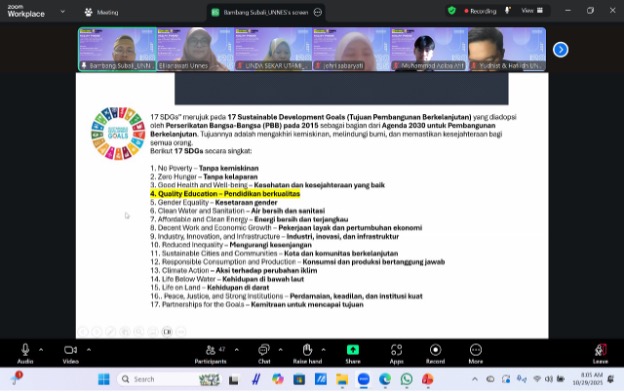
Meanwhile, Dr. Ellianawati, M.Si., discussed the importance of preparing future physics teachers to understand and apply ESD principles in their teaching practice. She introduced various learning models, including Project-Based Learning, the Socio-Scientific Issues Approach, and the RADEC model (Read–Answer–Discuss–Explain–Create), which can enhance students’ scientific literacy and sustainability awareness. “Future physics teachers must act as change agents who can connect energy concepts, environmental issues, and social responsibility,” she explained.
In addition, Dr. Ellianawati briefly introduced the role of PUI PRA (Center of Excellence for Child-Friendly Education) at UNNES, which promotes inclusive and child-friendly learning environments. She emphasized that this initiative also provides opportunities and exceptional support for students with disabilities to access education that meets their individual learning needs.
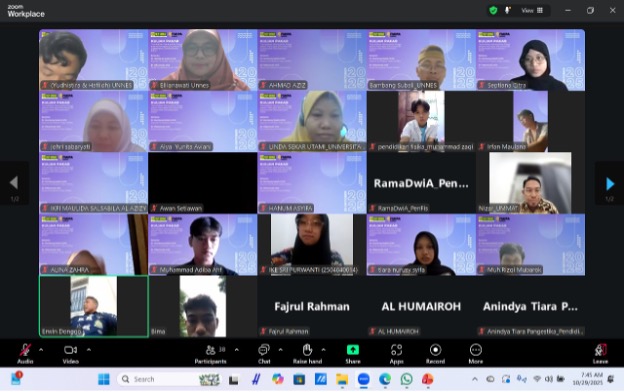
Dr. Johri Sabaryati, M.PFis, moderated the session, and supported by Linda Sekar Utami, S.Pd., M.PFis., Coordinator of the Physics Education Study Program at UMMAT. The discussion session was lively, with participants actively asking questions about implementing sustainability-based physics learning and potential research topics related to ESD. This collaboration between UNNES and UMMAT marks a significant step in strengthening academic partnerships, promoting joint research initiatives, and expanding the implementation of sustainability-based learning practices. Both institutions reaffirmed their commitment to advancing the Sustainable Development Goals (SDGs), particularly Goal 4: Quality Education.