

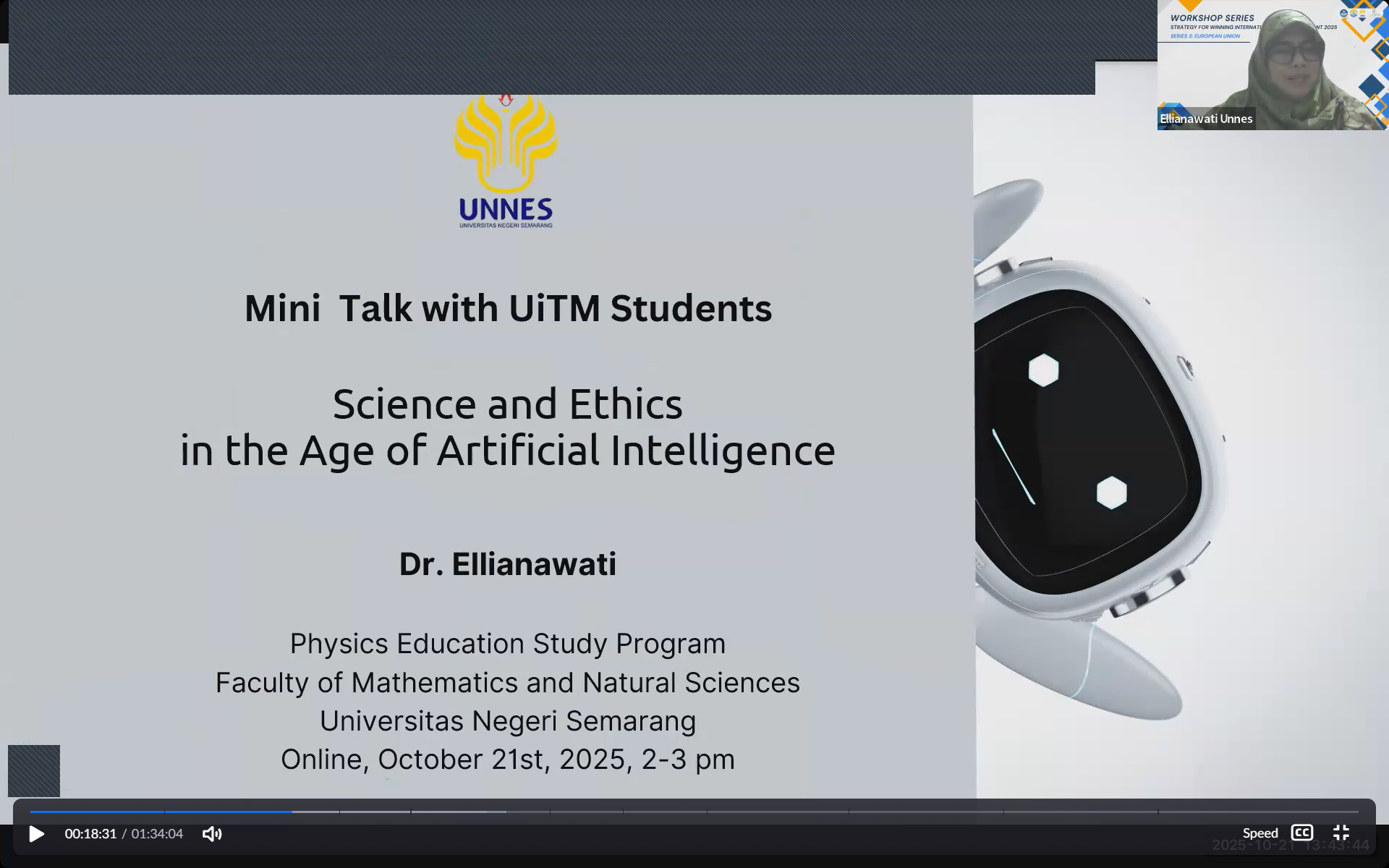
Mini Talk UNNES–UiTM Discusses Ethics and Challenges of Artificial Intelligence in Education

Universitas Negeri Semarang/Faculty of Mathematics and Natural Sciences/Berita/Mini Talk UNNES–UiTM Discusses Ethics and Challenges of Artificial Intelligence in Education

Semarang, October 21, 2025 — Universitas Negeri Semarang (UNNES) continues to strengthen its international academic presence through a Mini Talk with students from Universiti Teknologi MARA (UiTM), Malaysia. The event, held virtually via Zoom, featured Dr. Ellianawati, lecturer at the Physics Education Study Program, Faculty of Mathematics and Natural Sciences (FMIPA) UNNES, who presented a talk on “Artificial Intelligence (AI) in Education: Benefits, Challenges, and Ethical Considerations.”

This activity is part of a series of international collaborative research initiatives under the Matching Grant Scheme, involving six universities from six countries, with UiTM Malaysia as one of the participating institutions. The research collaboration is led by Dr. Ellianawati and funded by the 2025 DPA Research and Community Service Institute (LPPM) UNNES. The program aims to strengthen international research collaboration in science and technology education, as well as promote ethical digital literacy in the era of artificial intelligence.
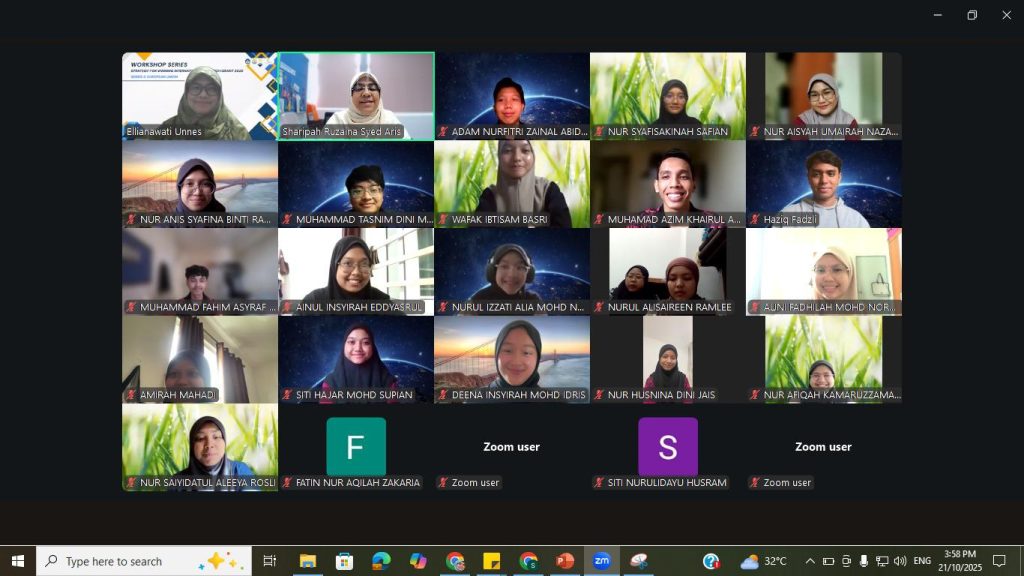
Participants of the Mini Talk were Mathematics Education students from UiTM who are currently taking STEM (Science, Technology, Engineering, and Mathematics) and STS (Science, Technology, and Society) courses under the supervision of Prof. Dr. Sharipah Ruzaina Syed Aris. This academic event served as an interactive international forum connecting scientific issues with human values and ethical responsibilities among future scientists and educators.

In her presentation titled “Science and Ethics in the Age of Artificial Intelligence,” Dr. Ellianawati explained the development of AI from the 1950s to the present. She discussed how algorithmic bias emerged as AI systems began learning from human-generated data, which often reflects social bias. One notable example she highlighted was the research conducted by Joy Buolamwini from the MIT Media Lab, who found that facial recognition systems from major companies, such as IBM and Microsoft, were less accurate in recognizing women and individuals with darker skin tones. Buolamwini’s study, titled “Gender Shades,” became a global milestone in raising awareness about algorithmic fairness.

Another topic that drew strong interest from participants was data privacy and the concept of the “data shadow”—the invisible digital footprint left by technology users in their online activities. Dr. Ellianawati emphasized that, “Your data shadow is like your digital fingerprint — invisible, permanent, and powerful. If you don’t protect it, someone else will use it to shape your world.” The message served as a potent reminder for students to be more cautious and responsible in managing their personal information online.

The discussion also covered ethical issues in genetic engineering, including the case of Chinese scientist Dr. He Jiankui, who edited human embryos using CRISPR technology without proper ethical approval. This case was presented as an extreme example of how science without ethics can threaten the essence of humanity.

The session concluded with an interactive quiz and reflective discussion on AI ethics and scientific responsibility, which the UiTM students joined enthusiastically. Through this Mini Talk, UNNES and UiTM not only strengthened their international research network but also fostered critical awareness, ethical responsibility, and digital literacy among students across nations. This initiative aligns with UNNES’s vision as a University with a Conservation Perspective and International Reputation, committed to advancing knowledge that enlightens society while upholding human values.
Related Posts

Leave a Reply

* Kode Akses Komentar:

* Tuliskan kode akses komentar diatas:

GDPR

  • Privacy Policy

Privacy Policy

At unnes.ac.id, the privacy of our visitors is of extreme importance to us. This privacy policy document outlines the types of personal information that is received and collected by unnes.ac.id and how it is used.

Log Files

Like many other Web sites, unnes.ac.id makes use of log files. The information inside the log files includes internet protocol (IP) addresses, type of browser, Internet Service Provider (ISP), date/time stamp, referring/exit pages, and number of clicks to analyze trends, administer the site, track user’s movement around the site, and gather demographic information. IP addresses and other such information are not linked to any information that is personally identifiable.

Cookies

unnes.ac.id uses cookies to store information about visitors’ preferences, to record user-specific information on which pages the site visitor accesses or visits, and to personalize or customize our web page content based upon visitors’ browser type or other information that the visitor sends via their browser.

Third-party ad servers or ad networks use technology in their respective advertisements and links that appear on unnes.ac.id and which are sent directly to your browser. They automatically receive your IP address when this occurs. Other technologies (such as cookies, JavaScript, or Web Beacons) may also be used by our site’s third-party ad networks to measure the effectiveness of their advertising campaigns and/or to personalize the advertising content that you see on the site.

unnes.ac.id has no access to or control over these cookies that are used by third-party advertisers.

You should consult the respective privacy policies of these third-party ad servers for more detailed information on their practices as well as for instructions about how to opt-out of certain practices. unnes.ac.id’s privacy policy does not apply to, and we cannot control the activities of, such other advertisers or web sites.

If you wish to disable cookies, you may do so through your individual browser options. More detailed information about cookie management with specific web browsers can be found at the browsers’ respective websites.

Consent

By using our website, you hereby consent to our privacy policy and agree to its terms.

Update

This Privacy Policy was last updated on: 2023-02-14. Should we update, amend or make any changes to our privacy policy, those changes will be posted here.

Contact Us

If you have any questions, comments, or concerns about our Privacy Policy or our practices with regards to your personal information, please feel free to contact us through the contact form on our website or by emailing us at humas[at]mail.unnes.ac.id.

This Privacy Policy is intended as a general guide to our practices in collecting and using information. If there is any inconsistency between this Privacy Policy and the terms of the Service Agreement or any other terms that may apply to specific services you use, then those specific service terms shall apply.

Terms of Use

By using our website, you agree to abide by this Privacy Policy. If you do not agree with this Privacy Policy, please do not use our website. We reserve the right to update this Privacy Policy from time to time without prior notice. Please review our Privacy Policy periodically to check for changes. Your continued use of our website following the posting of changes to this Privacy Policy means that you accept the changes.

Thank you for reading our Privacy Policy. We are committed to protecting the privacy of our website visitors and will continue to update our Privacy Policy to ensure optimal protection.