


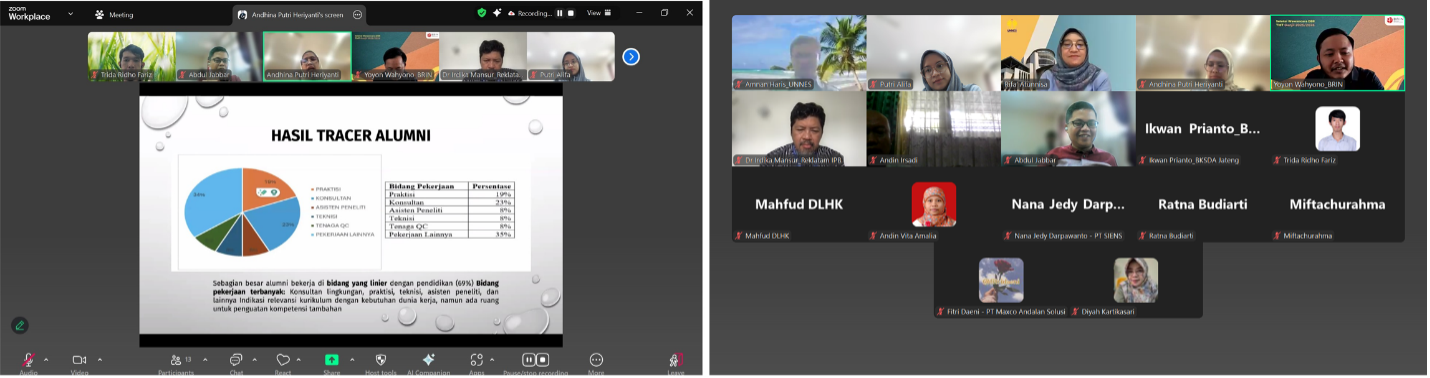
The Environmental Science Study Program of the Faculty of Mathematics and Natural Sciences, Universitas Negeri Semarang (UNNES), continues to demonstrate its commitment to improving educational quality by holding an online Focus Group Discussion (FGD) on Tuesday, 24 June 2025. Conducted via Zoom, the event aimed to sharpen the program’s scientific vision and enhance the alignment between the curriculum and labor-market needs (link & match) in preparation for an Outcome-Impactful Based Curriculum that will be introduced in UNNES Curriculum 2025.
The FGD brought together a wide range of strategic stakeholders, including government agencies, environmental consultants, academics, NGOs, and alumni. Resource persons included Dr. Mafut Munajat from the Central Java Provincial Office of Environment and Forestry (DLHK Jawa Tengah); Ir. Ratna Budiarti of PT Green Environesia Cendekia; Dr. Ir. Irdika Mansur from the Faculty of Forestry and Environment, IPB University; Fitri Daaeni, S.Ling of PT Maxco Andalan Solusi and an alumnus; Dr. Yoyon Wahyono, M.Ling from the National Research and Innovation Agency (BRIN); Ir. Nana Jedy Darpawanto, M.Ling of PT Sinergi Enviro Nusantara; Maryoto Danang Pambudi, S.Ling representing an NGO and also an alumnus; Miftachurahma Widanirmala, M.Si of CV Matra Mandiri; and Ir. Ikwan Prianto, S.Hut, M.Si from the Central Java Natural Resources Conservation Agency (BKSDA Jawa Tengah). Their presence enriched the discussion and provided constructive input for curriculum development.
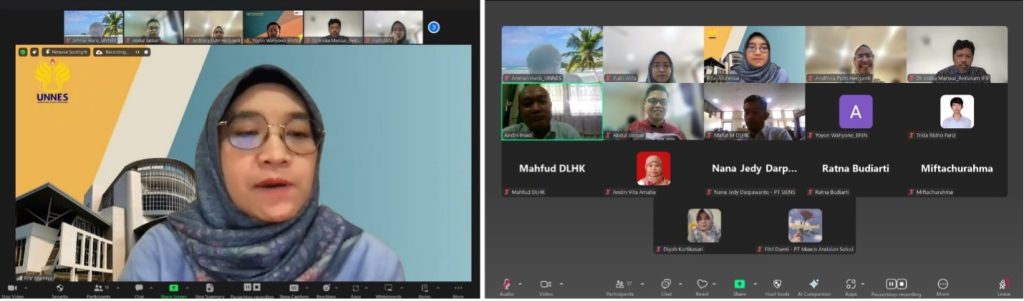
During the discussion, participants reviewed graduates’ workplace performance, identified competence gaps, and explored the soft and hard skills needed in the real sector. The FGD underscored the importance of strengthening graduates’ competencies in soft skills such as critical thinking, systems thinking, communication, and academic writing, alongside technical skills. The curriculum is also expected to address current environmental issues, including low-carbon and climate-resilient development, circular economy, and the triple planetary crisis. Mastery of foreign languages was deemed vital to widen graduates’ career opportunities in multinational companies. Courses on community empowerment in environmental contexts were considered essential to reinforce social perspectives in natural-resource conservation and environmental policy.
UNNES Environmental Science reaffirmed its commitment to intensifying concrete actions and capacity building for students in tackling environmental challenges. The program’s scientific vision is to advance environmental science through research and community service based on natural-resource conservation and sustainable community empowerment in rural, coastal, and industrial areas, thereby producing innovative and competitive graduates. One speaker also highlighted the need to address broader industrial sectors such as oil & gas and mining so that graduates are better prepared for global challenges.
This activity forms an important part of supporting the implementation of UNNES Curriculum 2025, which is based on Outcome-Impactful Learning Achievements. The new curriculum seeks to enhance the relevance and quality of graduates, create a flexible and adaptive learning ecosystem, and connect university research and expertise with industry and society. Through cross-sector collaboration and a strong commitment to developing a relevant and impactful curriculum, the Environmental Science Study Program of FMIPA UNNES is optimistic that it can produce graduates ready to compete nationally and globally and able to make tangible contributions to solving present and future environmental issues.