

15th National Science Seminar: Integrating Environmental Science and Science Education for the Golden Indonesia Vision

Universitas Negeri Semarang/Faculty of Mathematics and Natural Sciences/Berita/15th National Science Seminar: Integrating Environmental Science and Science Education for the Golden Indonesia Vision

The 15th National Science Seminar was successfully held online via Zoom on Saturday, May 24, 2025. This event was a collaborative effort between the Science Education Study Program and the Environmental Science Study Program of Universitas Negeri Semarang (UNNES), in partnership with the Indonesian Science Educators Association (PPII). With the theme “The Role of Environmental Science for Excellence in Science Education Towards a Golden Indonesia,” the seminar served as a strategic platform to strengthen the synergy between science education and environmental science in preparing for Indonesia Emas 2045.

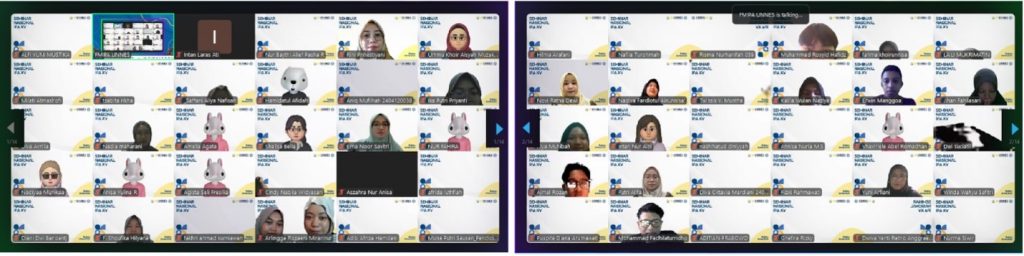
The seminar was officially opened by the Dean of the Faculty of Mathematics and Natural Sciences (FMIPA) UNNES, Prof. Dr. Edy Cahyono, M.Si., followed by a welcoming speech from the Chair of PPII, Prof. Parmin, M.Pd. and the Chair of the Committee, Rizki Nor Amelia, M.Pd. The event attracted significant attention with 465 registered participants, consisting of 155 paper presenters and 310 non-presenting participants. Attendees came from diverse professional backgrounds, including students, teachers, lecturers, and education practitioners from 13 provinces across Indonesia spanning Sumatra, Java, Kalimantan, and Sulawesi, demonstrating strong enthusiasm for sustainability and education-driven environmental action.
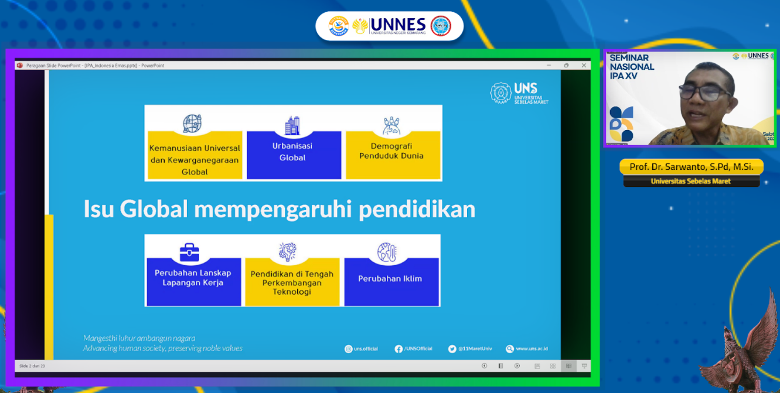
Three distinguished speakers contributed insightful presentations. Prof. Dr. Sarwanto, M.Si. from Universitas Sebelas Maret (UNS) opened his session by highlighting pressing global issues such as climate change and population dynamics. He then elaborated on the SETS (Science, Environment, Technology, Society) approach as an integrative framework for science education. This approach emphasizes the interconnectedness of scientific knowledge, technological advancement, societal needs, and environmental challenges in responding to global issues holistically.

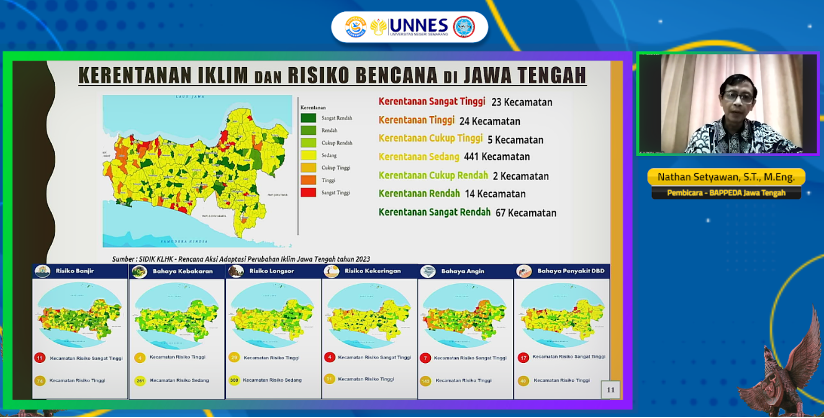
Nathan Setyawan, M.Eng. from the Central Java Regional Development Planning Agency (Bappeda), delivered a session on “The Problem-Solving Role of Science Education in Addressing Environmental Issues and the Impacts of Climate Change in Central Java.” He emphasized the importance of collaboration between academia particularly science education and environmental science lecturers and students—and local government in crafting actionable solutions. Nathan proposed several collaborative initiatives such as Thematic Spatial Environmental Parenting, Sustainable Community Development Projects, and the Local Adiwiyata Schools Sisterhood, aimed at fostering environmental awareness and action through mentoring programs for elementary to high schools.
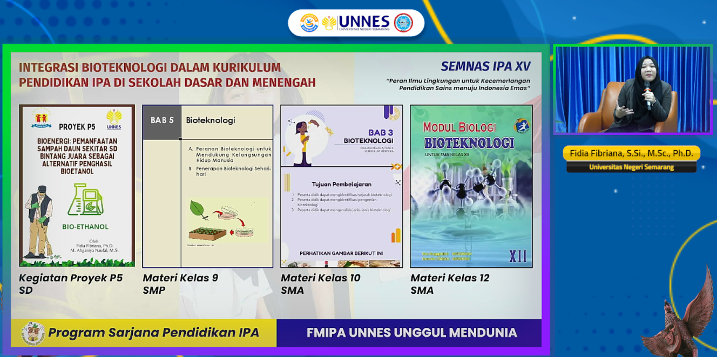
Fidia Fibriana, Ph.D. from UNNES, presented on the role of biotechnology in science education and environmental management. She stressed the importance of grounding scientific knowledge in real-world contexts to ensure its relevance and impact on society. By promoting contextual and practical approaches, she encouraged educators to bring science closer to everyday life as part of broader efforts to improve environmental literacy and resilience within communities.
With the participation of expert speakers and hundreds of enthusiastic attendees, the 15th National Science Seminar served not only as an academic forum but also as a strategic momentum for strengthening collaboration among stakeholders in education and environmental fields. The event is expected to foster innovation in science education that is responsive to environmental issues and capable of cultivating a generation that is environmentally literate, resilient, and ready to lead Indonesia toward a sustainable and climate-resilient future.
Related Posts

Leave a Reply

* Kode Akses Komentar:

* Tuliskan kode akses komentar diatas:

GDPR

  • Privacy Policy

Privacy Policy

At unnes.ac.id, the privacy of our visitors is of extreme importance to us. This privacy policy document outlines the types of personal information that is received and collected by unnes.ac.id and how it is used.

Log Files

Like many other Web sites, unnes.ac.id makes use of log files. The information inside the log files includes internet protocol (IP) addresses, type of browser, Internet Service Provider (ISP), date/time stamp, referring/exit pages, and number of clicks to analyze trends, administer the site, track user’s movement around the site, and gather demographic information. IP addresses and other such information are not linked to any information that is personally identifiable.

Cookies

unnes.ac.id uses cookies to store information about visitors’ preferences, to record user-specific information on which pages the site visitor accesses or visits, and to personalize or customize our web page content based upon visitors’ browser type or other information that the visitor sends via their browser.

Third-party ad servers or ad networks use technology in their respective advertisements and links that appear on unnes.ac.id and which are sent directly to your browser. They automatically receive your IP address when this occurs. Other technologies (such as cookies, JavaScript, or Web Beacons) may also be used by our site’s third-party ad networks to measure the effectiveness of their advertising campaigns and/or to personalize the advertising content that you see on the site.

unnes.ac.id has no access to or control over these cookies that are used by third-party advertisers.

You should consult the respective privacy policies of these third-party ad servers for more detailed information on their practices as well as for instructions about how to opt-out of certain practices. unnes.ac.id’s privacy policy does not apply to, and we cannot control the activities of, such other advertisers or web sites.

If you wish to disable cookies, you may do so through your individual browser options. More detailed information about cookie management with specific web browsers can be found at the browsers’ respective websites.

Consent

By using our website, you hereby consent to our privacy policy and agree to its terms.

Update

This Privacy Policy was last updated on: 2023-02-14. Should we update, amend or make any changes to our privacy policy, those changes will be posted here.

Contact Us

If you have any questions, comments, or concerns about our Privacy Policy or our practices with regards to your personal information, please feel free to contact us through the contact form on our website or by emailing us at humas[at]mail.unnes.ac.id.

This Privacy Policy is intended as a general guide to our practices in collecting and using information. If there is any inconsistency between this Privacy Policy and the terms of the Service Agreement or any other terms that may apply to specific services you use, then those specific service terms shall apply.

Terms of Use

By using our website, you agree to abide by this Privacy Policy. If you do not agree with this Privacy Policy, please do not use our website. We reserve the right to update this Privacy Policy from time to time without prior notice. Please review our Privacy Policy periodically to check for changes. Your continued use of our website following the posting of changes to this Privacy Policy means that you accept the changes.

Thank you for reading our Privacy Policy. We are committed to protecting the privacy of our website visitors and will continue to update our Privacy Policy to ensure optimal protection.