


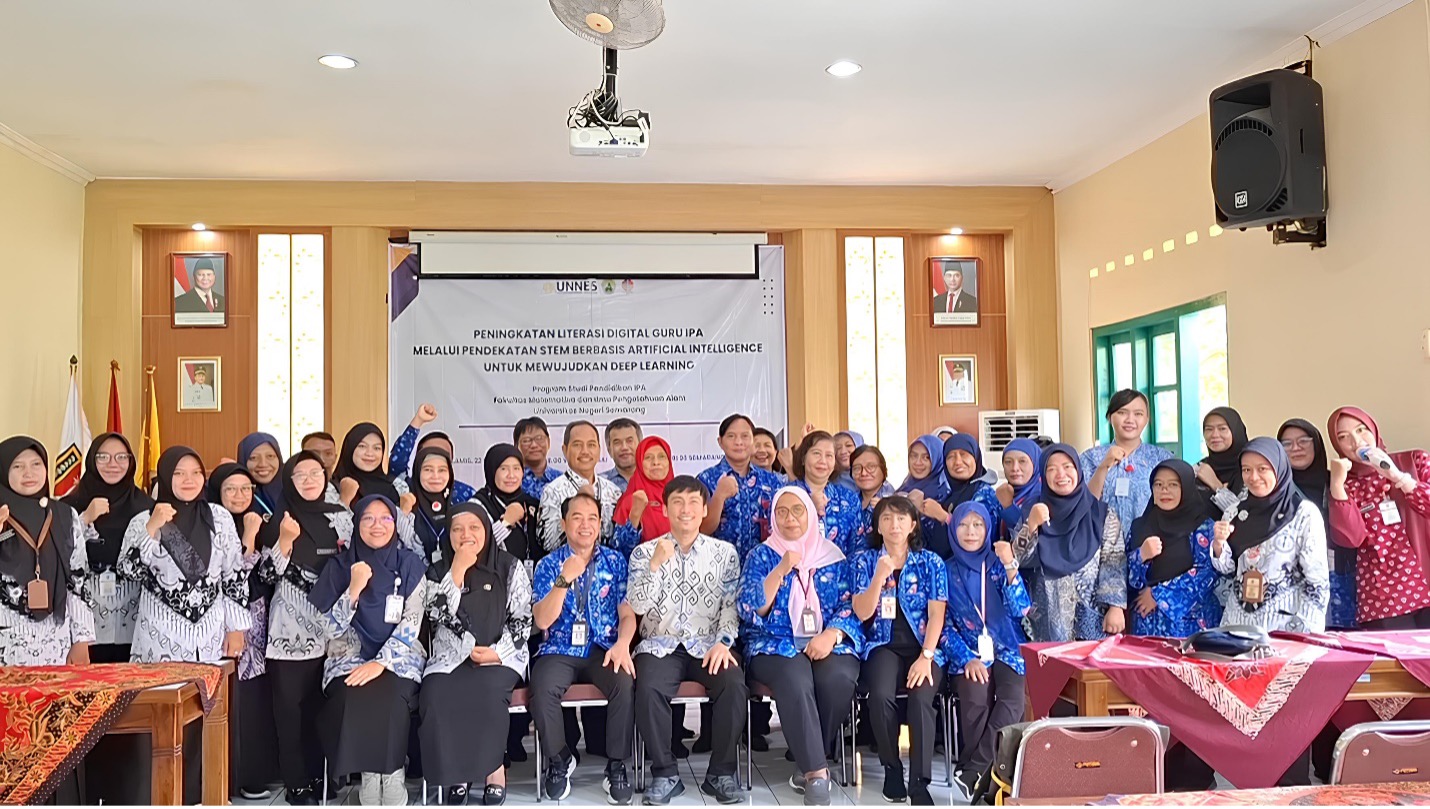
The FMIPA Community Service Team of Semarang State University successfully held a training to Improve Science Teacher Digital Literacy through a STEM approach based on Artificial Intelligence to Realize Deep Learning for Science Teachers in Semarang City. The activity carried out at SMP Negeri 36 Semarang was attended by 38 teachers from various SMPs in Semarang City, Thursday (22/5). The activity was opened by singing the song Indonesia Raya, remarks by the Principal of SMP Negeri 36 Semarang, Mrs. Nur Laily, S.Pd., M.Pd, Chairperson of MGMP IPA Semarang City, Mr. Sukimin, M.Pd., and Chairperson of Community Service, Mr. Arif Widiyatmoko, Ph.D., and ended with a prayer together.
The training organized by the Unnes FMIPA Community Service Team presented a number of competent speakers in their fields, namely Arif Widiyatmoko, Ph.D., Septico Aji, M.Pd., Fidia Fibriana, Ph.D., Tiara Dwi Wulandari, S.Pd., Siti Nursulistari, S.Pd., Alfiana Nur Rosita Mayanti, S.Pd., and Nadia Eka Ardhani. In this activity, participants received various materials relevant to the development of technology and education, including Digital Literacy for Science Teachers, the use of Artificial Intelligence in Science Learning including AI-based platforms that can be used by teachers to support science learning, as well as direct practice in determining acid and base indicators with the help of the AI Color Detector application. In addition, this training also includes materials on the STEM approach and an introduction to the concept of Deep Learning, which aims to improve participants’ understanding of the integration of technology in science learning in an innovative way. With various interactive and applicable sessions, this training provides new insights as well as practical skills that can be applied in the learning process, so that participants are better prepared to face the challenges of technology-based education in the digital era.
The Head of MGMP IPA Semarang City, Sukimin, M.Pd., expressed his appreciation for this training, which provided new insights into the implementation of the STEM-AI concept in science learning. “We are very grateful to the FMIPA UNNES service team for this training. With the materials and direct practice, our understanding of the application of artificial intelligence technology in learning has become clearer. In addition, the exploration of various innovative AI-based applications and discussions on data security amidst the widespread use of AI are very interesting and useful parts for us, besides this training also strengthens our understanding and becomes a reference for applying the Deep Learning concept to science learning,” he said. This training is expected to have a positive impact on educators in dealing with the development of digital technology and encourage the application of more interactive and effective learning methods and apply the Deep Learning concept.
Teacher Concerns
As a partner of FMIPA UNNES, MGMP IPA SMP Kota Semarang is not yet familiar with AI and utilizing AI-based features or platforms in detail. The Head of MGMP IPA said that teachers currently still have limited knowledge and experience in utilizing AI to support learning, while also facing concerns regarding the negative impacts of this technology on students, given the difficulty of curbing the use of AI in the digital era. To overcome these challenges, on Thursday (22/5/2024), a training was held to Improve Digital Literacy for Science Teachers through the AI-Based STEM Approach to Realize Deep Learning, which started at exactly 09.00 WIB. This activity received an enthusiastic response from the participants, because it provided new insights and skills in implementing AI effectively and innovatively in science learning as well as the application of the Deep Learning concept to science learning.
The presenters delivered material on the concept of Deep Learning, deep learning frameworks, and how to integrate it into science learning. In addition, the relationship between STEM in the application of Deep Learning learning and the use of artificial intelligence (AI) in STEM learning to support this approach was also explained. The resource person also introduced the form of the Science learning RPP which adopted the Deep Learning concept so that it could be implemented effectively.
After the delivery of the material, a practical session was continued where the teacher and group members analyzed the STEM elements in the LKPD that had been distributed. sequentially filling in the questions on the STEM-AI LKPD. Then continued with the practice of natural indicators of acids and bases according to the materials obtained, namely bougainvillea, butterfly pea flowers, and dragon fruit. The teacher was very enthusiastic in trying the AI color detector feature. When recognizing color changes using the color detector, there was an obstacle, namely that several groups downloaded the color detector application incorrectly, so that only the color code was detected. The FMIPA service team quickly helped in overcoming the difficulties
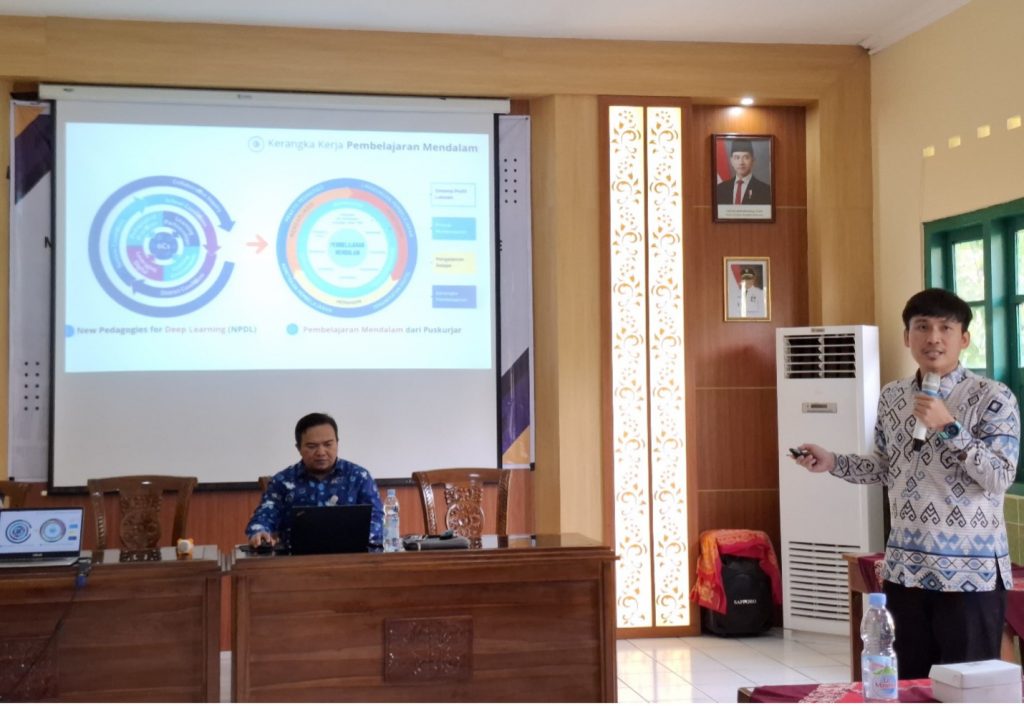
“The training activity to improve digital literacy for science teachers through the STEM approach based on Artificial Intelligence aims to equip educators with insight and skills in utilizing AI technology to support more innovative and interactive learning. This training is expected to help teachers in designing contextual and curriculum-relevant learning, while guiding students to participate in various competitions such as STEM, OPSI, coding, and robotics. In addition, teachers are also expected to be able to develop interesting and applicable AI-based learning models in various science topics, so as to improve student understanding and support the realization of Deep Learning,” said Arif Widiyatmoko, Ph.D as the head of the community service team.
As the closing activity, a discussion and question and answer session was held for community service participants related to the use of AI in science learning to support Deep Learning. Then several participants critically conveyed their ideas regarding the application of AI with Deep Learning learning to welcome the digital era. The training activity was closed with a group photo session. Hopefully this training activity will be useful for Science Teachers of Junior High Schools in Semarang City.