



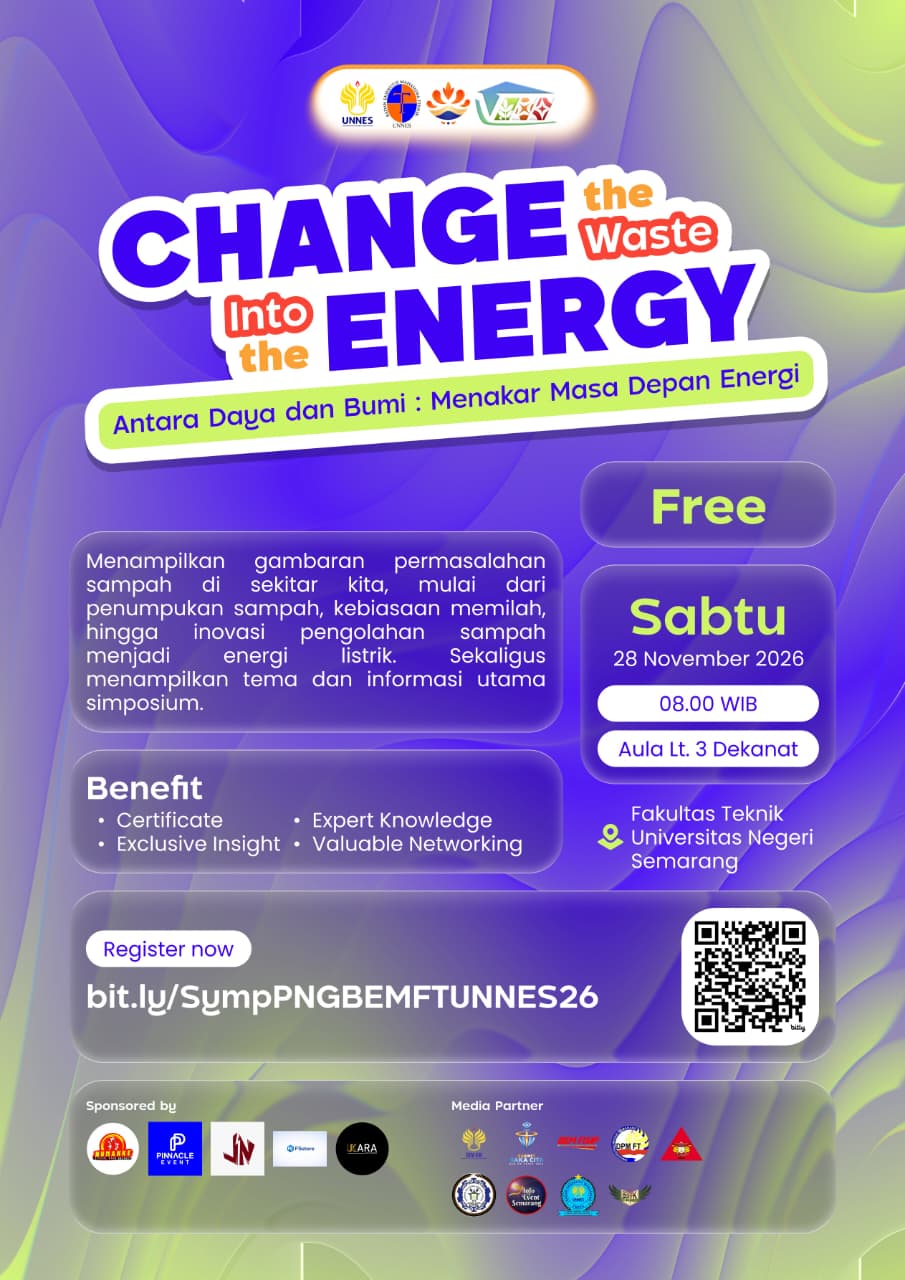
SEMARANG — The Student Executive Board of the Faculty of Engineering at Universitas Negeri Semarang (BEM FT UNNES) will organize a symposium titled Change The Waste Into The Energy on Saturday (November 28, 2026). The event serves as a cross-sector dialogue forum to examine waste management challenges in Central Java, particularly in Semarang City, while evaluating the implementation of Waste-to-Energy (Pengolahan Sampah menjadi Energi Listrik / PSEL) projects.
The symposium is set to bring together key stakeholders, including the Central Java Provincial Environmental and Forestry Agency (DLHK), the Semarang City Environmental Agency (DLH), WALHI Central Java, Team Recula of Universitas Diponegoro, UNNES academics, waste management practitioners, and community representatives. This multi-stakeholder lineup aims to connect technical feasibility, regulatory policy, and social-environmental realities.
Discussions will focus on integrating waste management systems from upstream to downstream, covering policy effectiveness, infrastructure readiness, technology deployment, social and environmental impacts, and community participation. PSEL initiatives will also be examined closely to assess how converting waste into electricity can address municipal waste challenges in a sustainable manner.
Moving beyond idea exchange, the symposium is designed to synthesize cross-sector perspectives into actionable recommendations that can inform policymakers.
Execution of the event is entrusted to NextGen BEM FT UNNES—first-year students participating in the organizational internship program at the close of the 2026 leadership term. Involving incoming members in this capacity acts as a regeneration measure that places students directly at the center of strategic public issues.
Exploring waste-to-energy conversion within this forum aligns with the United Nations Sustainable Development Goals (SDGs), particularly SDG 7 (Affordable and Clean Energy) by examining the potential of waste-derived renewable energy, energy system efficiency, and the sustainable deployment of energy conversion technologies. At the same time, an upstream-to-downstream waste governance approach connects with SDG 12 (Responsible Consumption and Production), SDG 11 (Sustainable Cities and Communities), and SDG 17 (Partnerships for the Goals) through multi-stakeholder collaboration across institutions and civil society.
Through Change The Waste Into The Energy, BEM FT UNNES seeks to highlight the role of engineering students in bridging technological innovation, public policy, and community interests while supporting sustainable development in Central Java.