



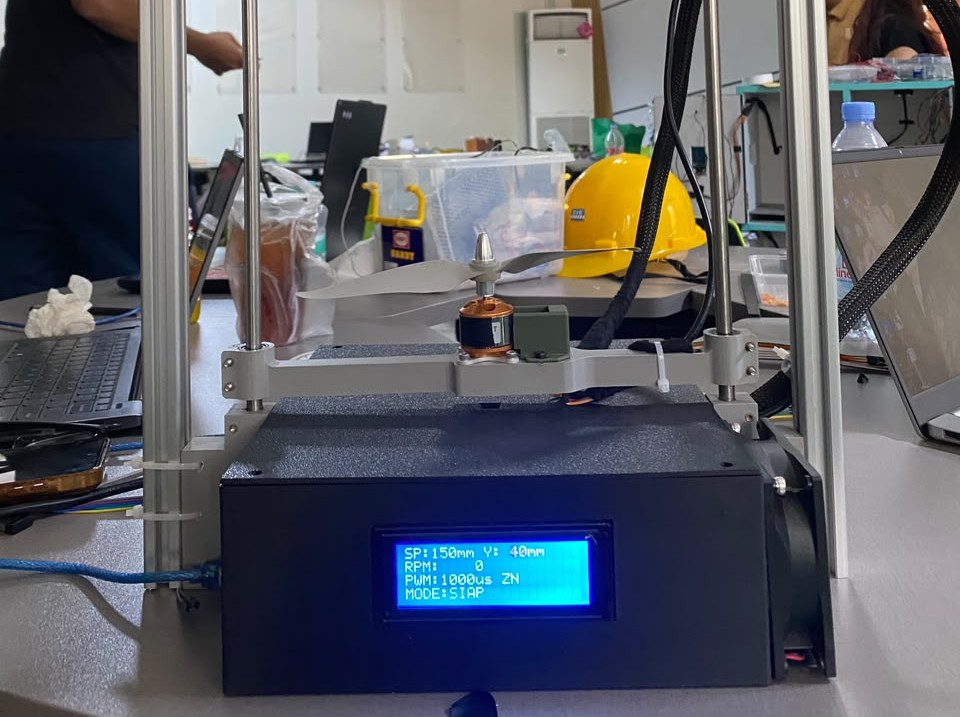
SEMARANG — A team of Computer Engineering students from the Faculty of Engineering, Universitas Negeri Semarang (FT UNNES), unveiled Tower Copter, an altitude control testbed integrating Internet of Things (IoT) telemetry and metaheuristic optimization algorithms, during the EXPO Capstone exhibition at Building E11, FT UNNES, on Wednesday (November 11, 2026). The system provides a safer, more controlled, and repeatable alternative to free-flight testing for unmanned aerial vehicles (UAVs).
The control engineering prototype was developed by Fahturomi Anjar Septian alongside team members Elya Syafa’atun Ni’mah and Nazli Rahmeisi. Recognizing that free-flight drone testing carries high risks of hardware damage and makes isolating aerodynamic disturbances difficult, the team engineered Tower Copter to constrain motion strictly along a single vertical axis—enabling researchers to evaluate flight-control stability safely and systematically.
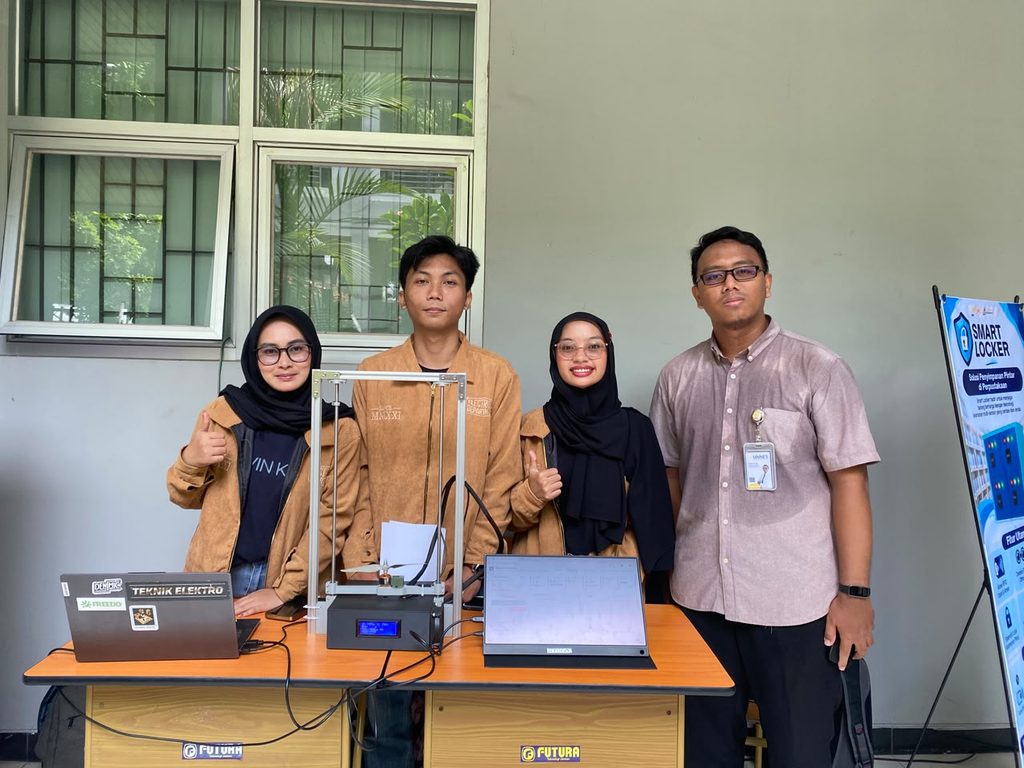
Tower Copter stands out by unifying three advanced engineering features into a single cohesive platform. First, rather than relying on manual trial-and-error tuning, the system determines Proportional-Integral-Derivative (PID) control parameters using modern optimization algorithms—specifically CPO, SO, and GJO—and benchmarks their performance directly against the classical Ziegler-Nichols method under identical hardware and test conditions.
Second, the testbed incorporates an IoT monitoring and remote operation architecture built on an ESP32 microcontroller and the MQTT messaging protocol. This setup streams real-time metrics—including altitude, motor RPM, and control signals—directly to a web dashboard, automatically logs experimental datasets, and allows operators to execute test commands remotely.
Third, to suppress sensor noise and measurement fluctuations, the team implemented adaptive signal smoothing using three Kalman Filter variants: the standard Kalman Filter (KF), Extended Kalman Filter (EKF), and Unscented Kalman Filter (UKF). The filter parameters are automatically tuned via Particle Swarm Optimization (PSO), allowing the best-performing estimator to be deployed directly on the hardware as the feedback input for the PID controller.
Built with a modular architecture, Tower Copter allows users to swap tuning algorithms, state estimators, and test scenarios purely through software configuration without modifying the physical hardware. This adaptability positions the device as an ideal standardized laboratory kit for undergraduate control systems practicums.
The team completed the prototype on August 1, 2026, following a 90-day development cycle encompassing mechanical fabrication, embedded programming, and control validation. Constructed on a total budget of IDR 1.5 million (Rp1,500,000), the project demonstrates that high-precision control engineering test rigs can be built domestically at a fraction of the cost of commercial laboratory equipment.
Showcased at FT UNNES’s EXPO Capstone, Tower Copter directly advances SDG 9 (Industry, Innovation, and Infrastructure) by democratizing access to resilient, modular engineering research infrastructure. Through cost-effective applied innovation, UNNES Computer Engineering students are strengthening domestic technological capabilities and preparing future engineers to drive advancements in industrial automation and autonomous flight systems.