
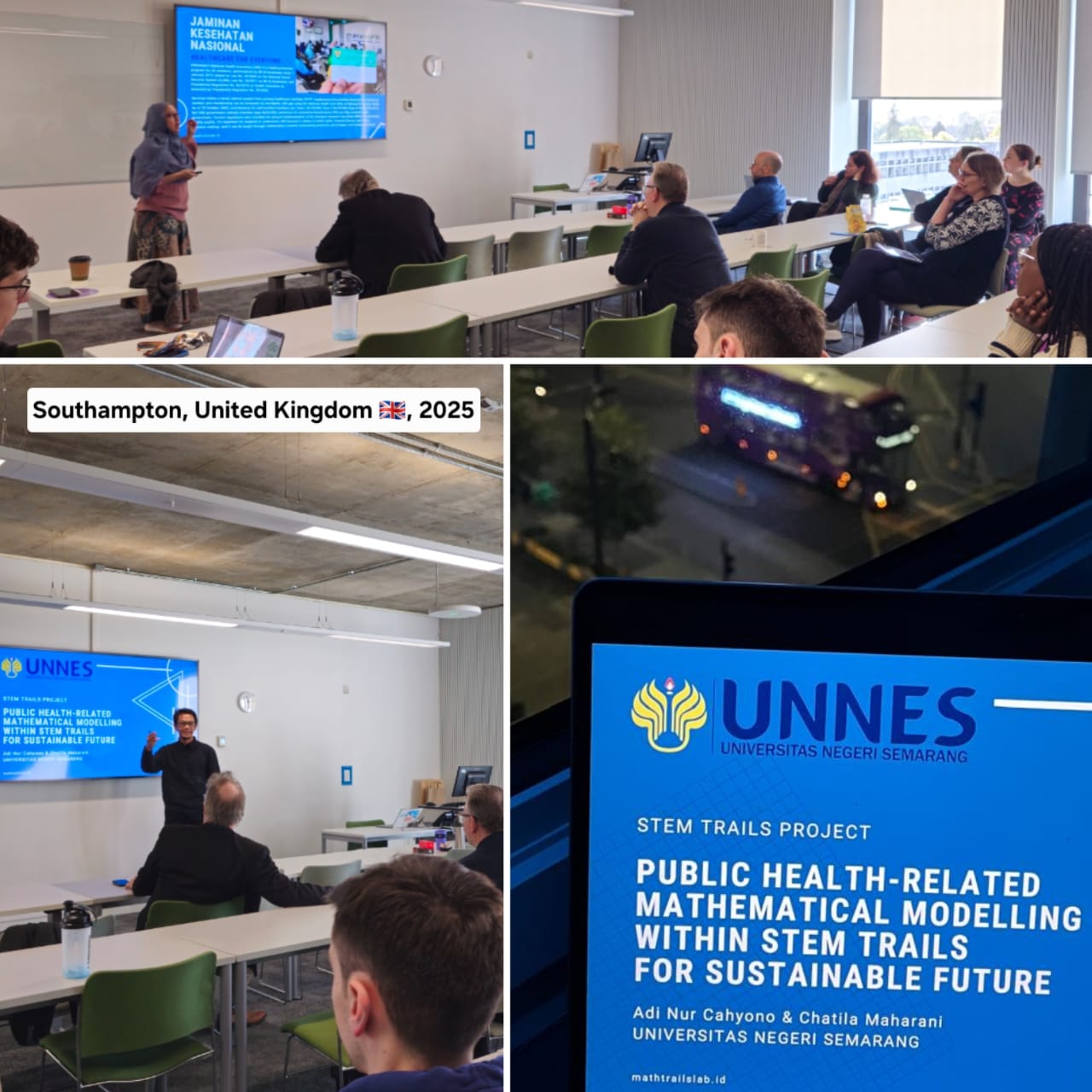
Dua dosen Universitas Negeri Semarang (UNNES), Dr. rer. nat. Adi Nur Cahyono, M.Pd. dari Fakultas Matematika dan Ilmu Pengetahuan Alam (FMIPA) dan Dr. sc. hum. Chatila Maharani, S.T., M.Kes. dari Fakultas Kedokteran (FK), menjadi pembicara dalam forum akademik internasional di University of Southampton, Inggris, Jumat (31/10/2025). Keduanya memaparkan hasil riset bertajuk “Public Health-related Mathematical Modelling within STEM Trails for Sustainable Future”, yang mengintegrasikan pendidikan matematika dan kesehatan masyarakat dalam konteks pembangunan berkelanjutan.
Forum yang dihadiri profesor, peneliti, dan mahasiswa dari berbagai negara ini menjadi bagian dari rangkaian kunjungan akademik UNNES ke Inggris dan Austria pada 26 Oktober–1 November 2025. Dalam kesempatan tersebut, UNNES menegaskan perannya sebagai universitas yang aktif berkontribusi dalam penyelesaian persoalan global melalui pendekatan riset lintas disiplin.
Dalam paparannya, Dr. Adi dan Dr. Chatila menyoroti pentingnya peran matematika dalam menjawab persoalan riil masyarakat. Melalui proyek kolaboratif Public Health-related STEM Trails, mereka mengembangkan model pembelajaran luar ruang berbasis Science, Technology, Engineering, and Mathematics (STEM) yang menggabungkan konteks matematika dengan isu-isu kesehatan publik.
Proyek ini menjadikan lingkungan sekitar dan landmark kota sebagai “laboratorium hidup” bagi siswa, guru, dan masyarakat. Beberapa lokasi yang telah menjadi rute math trail antara lain Tugu Ikan Belida (Palembang), Tugu Dawet Ayu (Banjarnegara), Kawasan Kota Lama (Semarang), dan Candi Borobudur.
Dalam setiap rute, peserta melakukan pengukuran, pengamatan, dan pemodelan matematika terhadap persoalan seperti Jaminan Kesehatan Nasional (JKN), Program Makan Bergizi Gratis (MBG), hingga kebijakan sanitasi lingkungan. “Kami ingin membuktikan bahwa matematika dapat menjadi media refleksi sosial, bukan sekadar hitungan di kelas,” ujar Dr. Adi.
Hasil penelitian yang dikembangkan oleh tim UNNES ini telah diimplementasikan secara luas dan dipublikasikan di jurnal internasional bereputasi Research in Science & Technological Education yang diterbitkan oleh Routledge Taylor & Francis Group.
Di forum tersebut, kedua akademisi UNNES juga mengangkat kisah John Snow dan Florence Nightingale sebagai contoh klasik keterkaitan antara data, pemodelan, dan kebijakan kesehatan berbasis bukti.
Kasus wabah kolera tahun 1854 di London yang diteliti John Snow dipaparkan sebagai titik awal lahirnya epidemiologi modern, sementara Florence Nightingale dikenalkan sebagai tokoh reformasi sosial dan pelopor visualisasi statistik untuk kebijakan publik.
“Melalui pendekatan historis ini, kami ingin menanamkan bahwa data dan pemodelan matematis berperan langsung dalam menyelamatkan nyawa dan memperbaiki sistem kesehatan,” terang Dr. Chatila Maharani.
Usai kegiatan di Inggris, kedua peneliti UNNES menghadiri forum “STEAM for Tomorrow” di Johannes Kepler University (JKU) Linz, Austria, yang diselenggarakan oleh Federal Ministry of Women, Science, and Research of Austria.
Forum ini mempertemukan kelompok riset dari berbagai negara yang menampilkan inovasi pembelajaran STEAM, mulai dari pengembangan kurikulum digital hingga integrasi teknologi baru dalam pendidikan.
JKU Linz merupakan mitra strategis UNNES. Dr. Adi diketahui secara rutin menjalin kolaborasi riset dan publikasi bersama, menjadi visiting professor, membimbing mahasiswa doktoral, serta terlibat dalam berbagai kegiatan akademik internasional.
Kegiatan akademik ini menegaskan komitmen UNNES sebagai universitas konservasi yang menjadikan riset dan kolaborasi internasional sebagai sarana menghadirkan solusi nyata bagi masyarakat dunia.
Melalui pendekatan lintas disiplin antara matematika dan kesehatan masyarakat, UNNES berkontribusi langsung terhadap Tujuan Pembangunan Berkelanjutan (SDGs), khususnya SDG 3 (Good Health and Well-Being) dan SDG 4 (Quality Education).