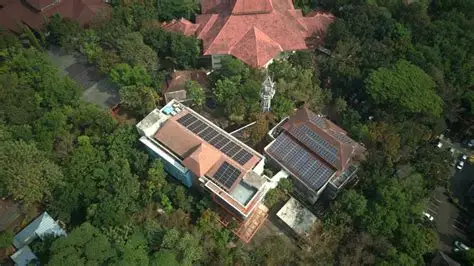
UNNES Systematically Measures Low-Carbon Energy Use, Records 705,236 kWh of Solar Electricity in 2025
Semarang — As a unified institution, Universitas Negeri Semarang (UNNES) actively and systematically measures the amount of low-carbon energy used across the university. This commitment is concretely demonstrated by the documented generation of 705,236 kilowatt-hours (kWh)—equivalent to 2,538.8496 gigajoules (GJ)—of solar electricity from January to December 2025.
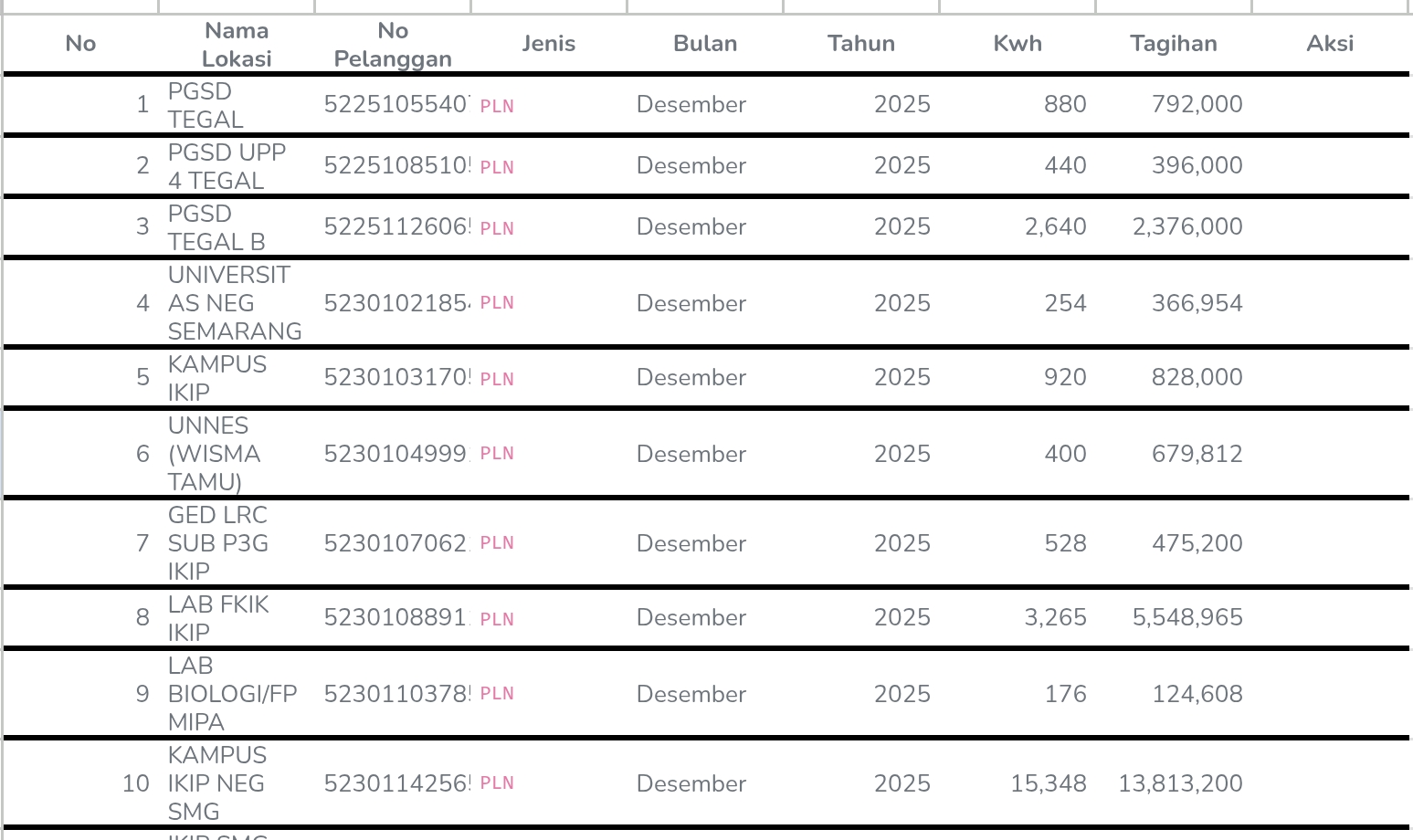
This low-carbon energy measurement is centrally tracked through the university’s myUNNES-office system. The platform recorded 239 detailed solar photovoltaic (PV) entries across 20 named locations within the campus, effectively separating solar electricity data from conventional PLN grid supply. Sixteen of these monitored locations recorded positive solar energy figures throughout the year.
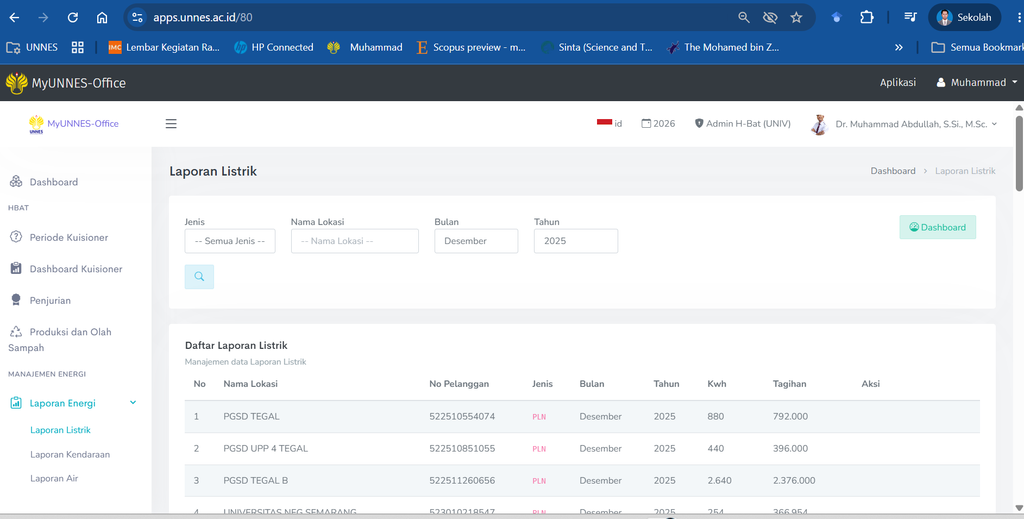
Based on this institutional tracking, the Digital Center recorded the highest renewable energy contribution at 190,829 kWh. This was followed by the Faculty of Economics and Business administration building with 87,532 kWh, and the Rumah Ilmu Building with 72,715 kWh. Tracking at the building level allows the university to evaluate the operational efficiency of individual facilities and plan future installations.
The university’s total energy use includes both electricity consumption and direct fuel consumption. Electricity supplied by the national grid (PLN) accounted for 22,016.996 GJ, equivalent to 8,893,610 kWh. On-campus solar photovoltaic systems across 20 monitored locations contributed a further 2,538.8496 GJ, equivalent to 705,236 kWh.
Beyond electricity, UNNES recorded an estimated 1,976.36 GJ from Pertamax fuel used by official university vehicles and 661.88 GJ from Pertamina Dex fuel used for backup generators. Together, these four categories amounted to 27,194.0856 GJ, reported as 27,194 GJ after rounding.
| Energy source | Operational use | Energy used in 2025 (GJ) |
|---|---|---|
| PLN grid electricity | Electricity for campus facilities | 22,016.996 |
| On-campus solar photovoltaics | Renewable electricity across 20 monitored locations | 2,538.8496 |
| Pertamax | Fuel for official university vehicles | 1,976.36 |
| Pertamina Dex | Fuel for backup generators | 661.88 |
| Total energy used | Combined electricity and fuel consumption | 27,194.0856 |
SEMARANG — Universitas Negeri Semarang (UNNES) recorded 705,236 kilowatt-hours (kWh) of solar electricity in 2025, equivalent to 2,538.85 gigajoules (GJ). This documented low-carbon energy source represents approximately 9.33% of the university’s estimated total annual energy use of 27,194.08 GJ, based on available electricity and fuel records.
The figures were compiled from the myUNNES-office system for January–December 2025. The report contains 239 monthly solar photovoltaic (PLTS) records across 20 named locations, enabling the university to trace reported energy figures by building and reporting period.
Solar Energy Supports Campus Activities
Reporting locations include the Rectorate, IT Building, Rumah Ilmu, Digital Center, faculty buildings and engineering department buildings. These facilities accommodate administration, teaching and learning, research, information technology and digital services.
The Digital Center recorded the largest annual solar electricity total, at 190,829 kWh. The Faculty of Economics and Business administration building followed with 87,532 kWh, while Rumah Ilmu recorded 72,715 kWh.
Monthly recorded solar electricity ranged from 39,044 kWh in February to 88,299 kWh in December. These variations provide information for further evaluation alongside installation capacity, operating conditions, maintenance records and monitoring completeness.
Measuring the Low-Carbon Energy Contribution
UNNES converted the recorded solar electricity using 1 kWh = 0.0036 GJ, resulting in an annual total of 2,538.8496 GJ.
| Energy measure | 2025 total |
|---|---|
| Recorded solar electricity | 705,236 kWh |
| Equivalent energy from solar PV | 2,538.85 GJ |
| Estimated total university energy use | 27,194.08 GJ |
| Recorded solar contribution relative to estimated total energy use | 9.33% |
The estimated total covers PLN grid electricity, recorded solar electricity and estimated energy from fuel purchased for official vehicles and generators. The reported low-carbon contribution covers solar PV and does not include an assumed low-carbon share of purchased grid electricity.
Building-level records enable UNNES to track the contribution of solar energy across campus facilities and identify priorities for further technical assessment. Continued monitoring can support system maintenance, improve reporting completeness and inform future renewable energy development.
The documented solar contribution provides a measurable foundation for UNNES’s efforts to increase low-carbon energy use and reduce the carbon intensity of campus operations.
By measuring and documenting its renewable energy utilization across all facilities, UNNES provides a data-driven foundation for reducing carbon emissions. This institutional initiative reflects the university’s commitment to advancing clean energy adoption and strengthening climate action as part of its broader sustainability efforts.