Universitas Negeri Semarang (UNNES) continues to implement sustainable development principles by prioritizing the reuse and redevelopment of previously developed land for new campus facilities. This approach reflects UNNES’s commitment to efficient land use, environmental conservation, and its identity as a Conservation University, while enabling the university to expand its academic infrastructure without unnecessarily converting undeveloped green areas.
The initiative is part of UNNES’s broader approach to sustainable campus planning, which emphasizes the optimal use of existing land and facilities. By prioritizing brownfield land areas previously occupied by buildings or other developed infrastructure the university seeks to balance the need for modern academic facilities with the protection of green open spaces and the surrounding environment.
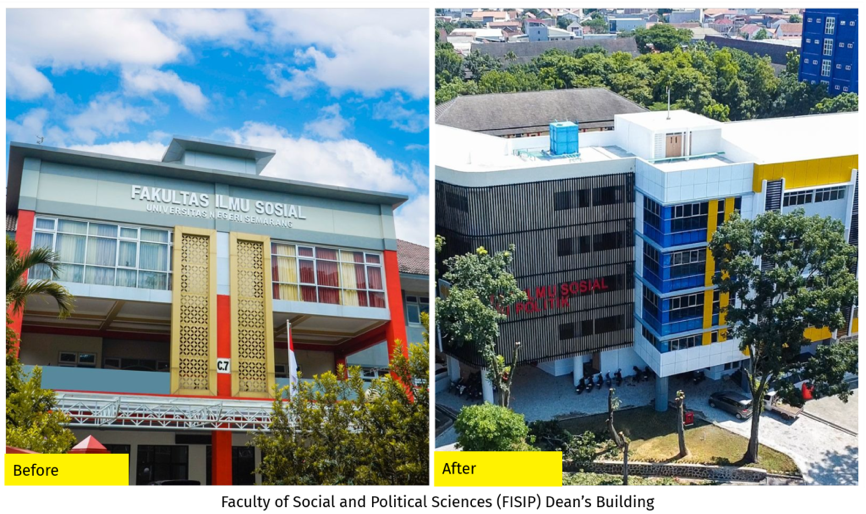
One example is the development of the new Faculty of Social and Political Sciences (FISIP) Dean’s Building. The project involved the redevelopment of the site previously occupied by the C7 Building and the Archives Building. The new five-storey FISIP building, inaugurated in November 2024, provides additional facilities for teaching, academic administration, and student services. Its development demonstrates how existing campus areas can be reorganized to accommodate evolving academic needs.
The same approach is reflected in the development of buildings for the Faculty of Mathematics and Natural Sciences (FMIPA) and the Faculty of Education and Psychology (FIPP), which utilize existing campus land. These projects form part of UNNES’s continuing efforts to improve educational infrastructure while making more effective use of land already within the university’s developed campus area.
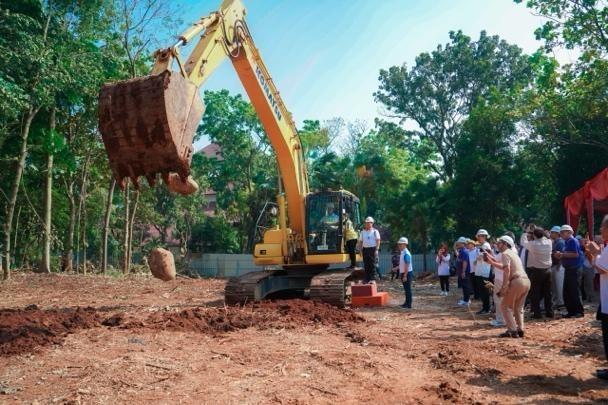
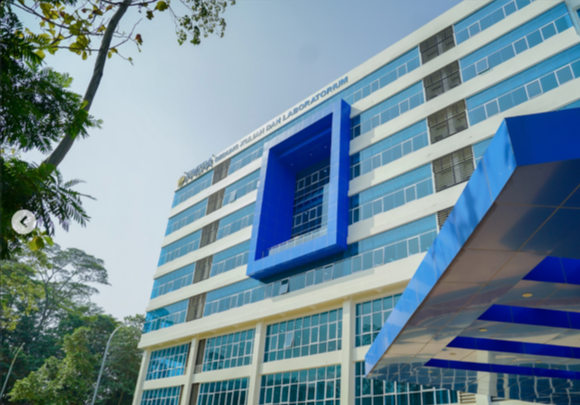
Through brownfield land utilization, UNNES seeks to minimize the need to open new greenfield areas, optimize the use of available space, and reduce pressure on surrounding green spaces. This approach also supports more integrated campus planning by directing infrastructure development toward areas that have already been developed, in line with the university’s environmental conservation principles.
By incorporating land-use efficiency into campus infrastructure development, UNNES reinforces its commitment to sustainable and responsible growth. The university’s brownfield approach contributes to Sustainable Development Goal 11 (Sustainable Cities and Communities) by promoting efficient land use and sustainable development, while supporting the preservation of green spaces as part of its Conservation University vision.