The rapid expansion of urban areas continues to pose significant challenges to the preservation of historic buildings and cultural heritage sites. Amid changing spatial planning demands and modern development pressures, the protection of cultural heritage has become an increasingly important issue that requires collaboration among various stakeholders, including higher education institutions.
As a university committed to the advancement of knowledge and the preservation of cultural values, Universitas Negeri Semarang (UNNES) continues to promote historical conservation through academic activities involving students, scholars, and heritage practitioners.
This commitment was reflected in the Historical Conservation Seminar titled “Revitalization of Cultural Heritage Buildings: Preservation Strategies amid the Challenges of Urbanization,” organized by the History Education Study Program, Faculty of Social and Political Sciences (FISIP), UNNES. The seminar was held at the C7 Auditorium of FISIP UNNES on Thursday, June 4.
Attended by around 150 students, the event provided a forum for discussing various strategies to preserve cultural heritage as an essential part of sustainable urban development.
Head of the History Education Study Program at FISIP UNNES, Andy Suryadi, S.Pd., M.Pd., emphasized that learning about historical conservation should not be limited to classroom theory. He stated that students need direct experience through field research and interaction with practitioners who are actively involved in preserving history and culture.
According to him, guidance from historians and field practitioners plays an important role in strengthening students’ competencies. For this reason, the History Education Study Program invited several speakers with extensive experience in local historical research and cultural heritage preservation.
“Students need to learn directly from those who have long worked with historical sources, archives, and preservation issues in the field. Such experiences cannot always be obtained from books,” he said.
The first speaker, Syamsul Nurhidayat, presented several student projects developed through the Historical Conservation course. Among the outputs were historical documentation and video projects highlighting historic buildings and cultural heritage sites in Semarang City.
He explained that digital media is a relevant approach to introducing history to younger generations. Through documentary video production, students not only learn research and field observation skills but also develop the ability to communicate their findings to a wider audience.
“When history is presented through media that is familiar to young people, the message of preservation becomes easier to understand and share,” he noted.
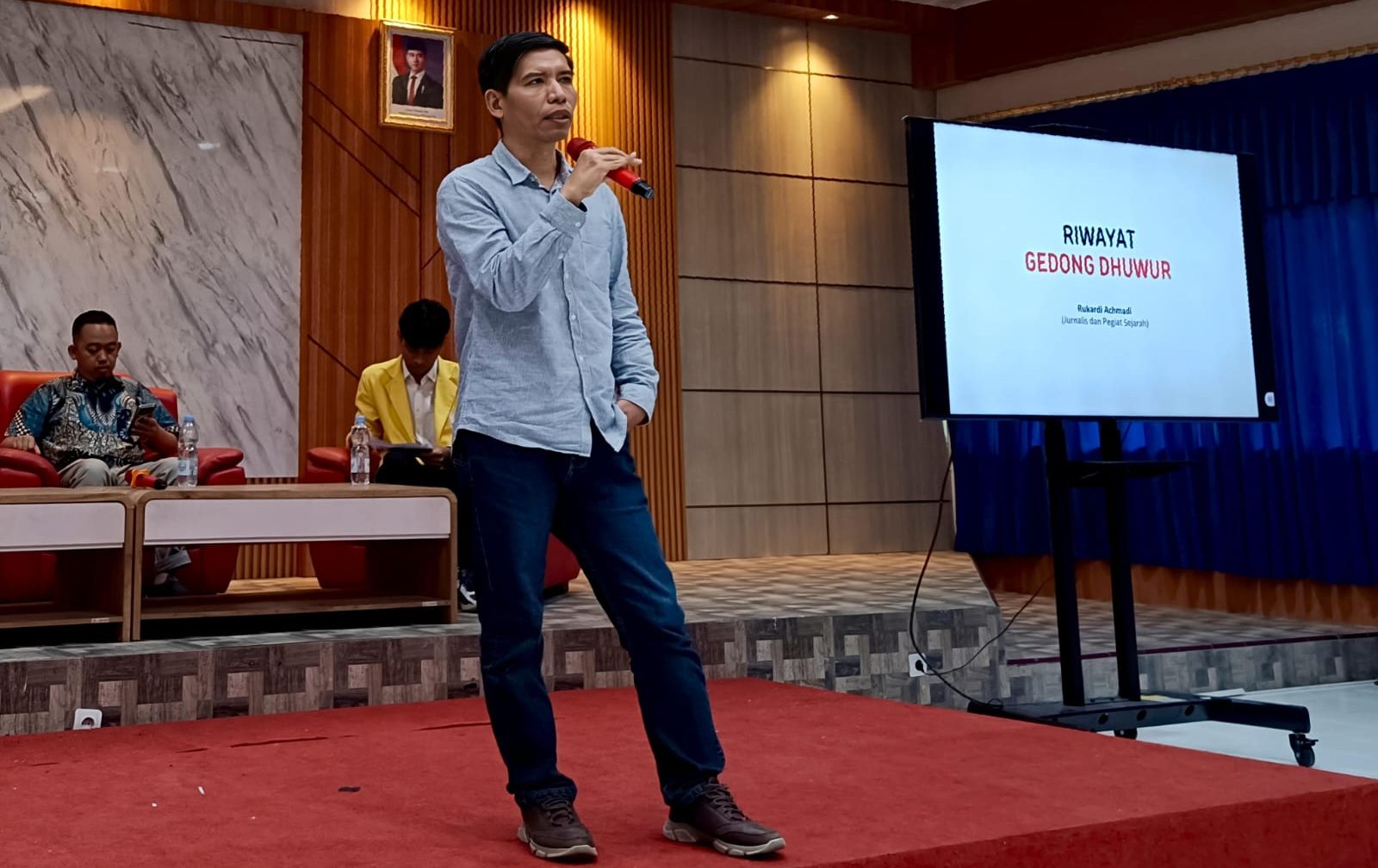
The discussion became even more engaging when senior Suara Merdeka journalist and Semarang history enthusiast Rukardi Achmadi invited participants to explore the historical traces of the Simongan and Gedong Dhuwur areas. In his presentation, he explained that Simongan holds layers of history dating back to the arrival of Admiral Cheng Ho’s fleet and continuing through the modern development of Semarang City.
Rukardi described the area as a witness to various social, economic, and cultural dynamics that have helped shape Semarang’s identity. He also discussed important figures and sites connected to the area, including historical land ownership in Simongan and the existence of Gedong Dhuwur, which was built in a hilly area as a retreat.
He further highlighted several assets once owned by prominent businessman Oei Tiong Ham, known as the Sugar King of Java, including his residential complex on Jalan Kyai Saleh, formerly known as Istana Gergaji. Through this explanation, participants were encouraged to understand that every historic building and area is closely connected to the social history that shapes the character of a city.
Meanwhile, History Education lecturer Dr. Syaiful Amin, S.Pd., M.Pd., stressed that historical conservation is not merely about maintaining the physical form of old buildings. More importantly, he said, conservation is an effort to preserve the collective memory embedded in historic buildings and spaces.
He added that cultural heritage revitalization should be carried out adaptively so that historic buildings can continue to serve meaningful functions in today’s context without losing their historical value.
“When a historic building disappears, what is lost is not only its physical structure, but also the traces of experience and collective memory of the people connected to it,” he said.
Throughout the seminar, students actively raised questions on various topics, including strategies for revitalizing historic buildings, the use of digital technology in conservation, and the challenges of preserving cultural heritage amid urban development. Their enthusiasm reflected the growing awareness among younger generations of the importance of protecting cultural heritage as part of national identity.
Through this seminar, FISIP UNNES reaffirmed its commitment to promoting the preservation of cultural and historical heritage as part of sustainable development. This effort is in line with Sustainable Development Goal 11, which emphasizes the creation of inclusive, safe, resilient, and sustainable cities and communities, including through the protection of cultural and historical heritage.
The seminar is expected to strengthen students’ awareness and participation in preserving and developing Indonesia’s cultural heritage, ensuring that historical values can continue to be passed on to future generations amid the ongoing dynamics of urban development.