
Law Faculty Promotes Restorative Justice Reform Through National FGD and Webinar

Universitas Negeri Semarang > Sustainable Development Goals Universitas Negeri Semarang > Unit > FH > Law Faculty Promotes Restorative Justice Reform Through National FGD and Webinar

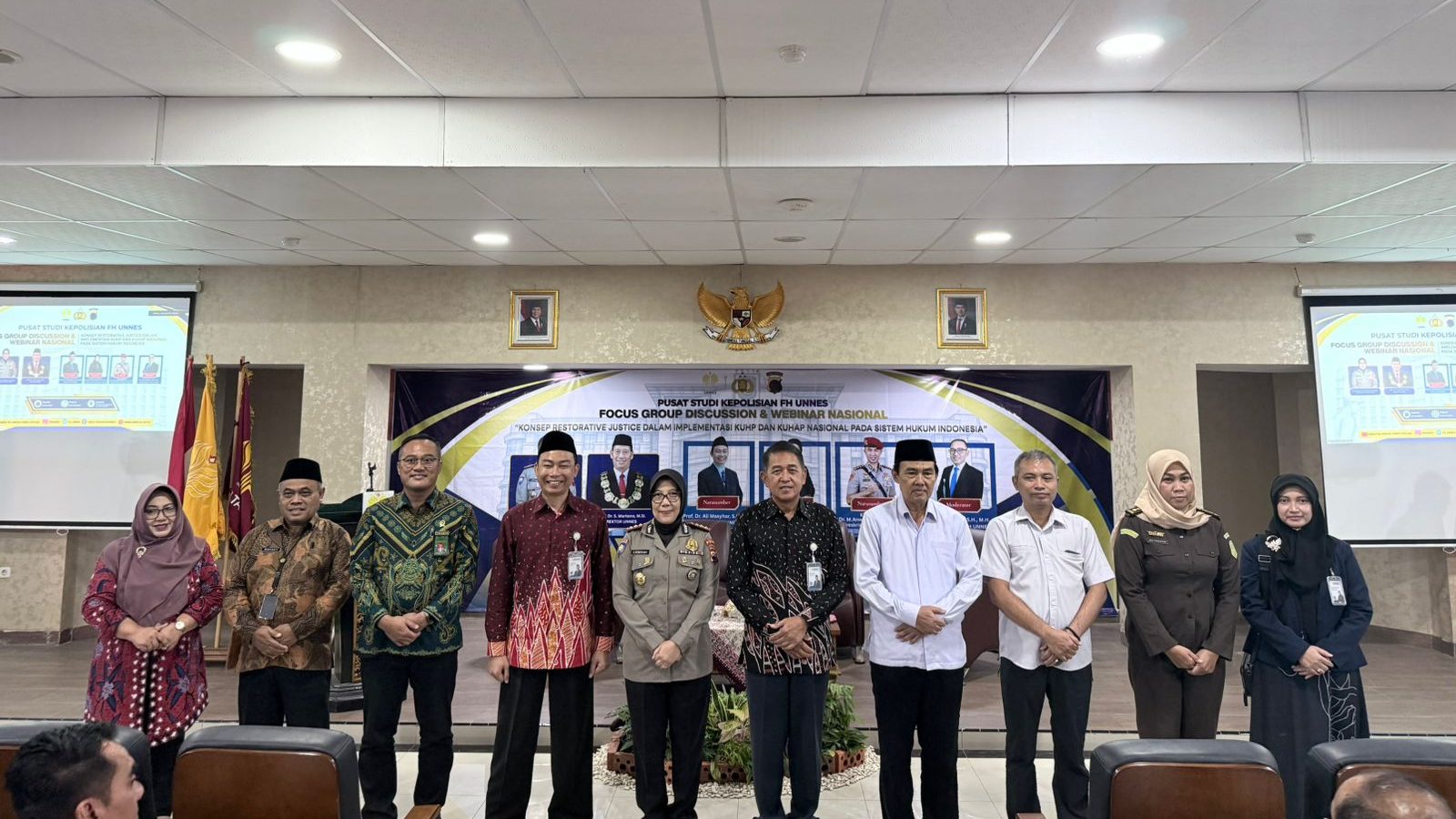
The Faculty of Law at Universitas Negeri Semarang (UNNES), through its Center for Police Studies, organized a Focus Group Discussion (FGD) and National Webinar titled “The Concept of Restorative Justice in the Implementation of the National Criminal Code and Criminal Procedure Code within Indonesia’s Legal System.”

Held on Thursday (May 7), the event served as a strategic discussion forum bringing together academics and law enforcement practitioners to examine the future direction of criminal law reform in Indonesia.

The program featured Senior Commissioner of Police Kombes Pol. Siti Rondhijah and UNNES Rector Prof. Dr. S. Martono, M.Si. as keynote speakers. In her remarks, Kombes Pol. Siti Rondhijah emphasized the importance of restorative justice as a humane approach to maintaining social order and as part of the police institution’s adaptation to the evolving paradigm of modern law.

The discussion was further enriched by presentations from academics and legal practitioners. Prof. Dr. Ali Masyhar, S.H., M.H. explored restorative justice from philosophical perspectives to the broader framework of national legal policy. He described restorative justice as a manifestation of Pancasila values and a reflection of substantive justice within Indonesia’s legal system.

Meanwhile, Dr. Cahya Wulandari, S.H., M.Hum. discussed the implementation of restorative justice within the criminal justice system, particularly highlighting the importance of victim protection during case resolution processes. She noted that practical implementation still faces challenges in ensuring that victims remain protected and empowered throughout legal proceedings.

A practical law enforcement perspective was presented by Kombes Pol. Dr. M. Anwar Nasir, S.I.K., M.H., who explained the strategic role of the police in implementing restorative justice, including the use of discretionary authority and penal mediation mechanisms during investigations. He also stressed the importance of ensuring that restorative justice practices remain within the boundaries of the law.

The entire discussion was moderated by M. Azil Maskur, S.H., M.H., who maintained a dynamic and interactive atmosphere throughout the forum. The discourse that emerged highlighted that restorative justice is not merely a legal concept, but also an approach that requires strong regulatory support, institutional capacity, and public awareness.

The high level of enthusiasm shown by participants—including academics, students, law enforcement officers, and legal practitioners—reflected growing public attention toward criminal law reform in Indonesia. Various opinions and questions raised during the forum illustrated a shared aspiration for a more humane legal system focused on recovery and reconciliation.

Through this event, the Faculty of Law UNNES reaffirmed its role as a center for legal thought that remains responsive to the dynamics of national legal reform. The FGD and National Webinar are expected to strengthen collaboration among academics, practitioners, and policymakers in advancing a more effective and equitable implementation of restorative justice in Indonesia.
Related Posts

Leave a Reply

* Kode Akses Komentar:

* Tuliskan kode akses komentar diatas:

GDPR

  • Privacy Policy

Privacy Policy

At unnes.ac.id, the privacy of our visitors is of extreme importance to us. This privacy policy document outlines the types of personal information that is received and collected by unnes.ac.id and how it is used.

Log Files

Like many other Web sites, unnes.ac.id makes use of log files. The information inside the log files includes internet protocol (IP) addresses, type of browser, Internet Service Provider (ISP), date/time stamp, referring/exit pages, and number of clicks to analyze trends, administer the site, track user’s movement around the site, and gather demographic information. IP addresses and other such information are not linked to any information that is personally identifiable.

Cookies

unnes.ac.id uses cookies to store information about visitors’ preferences, to record user-specific information on which pages the site visitor accesses or visits, and to personalize or customize our web page content based upon visitors’ browser type or other information that the visitor sends via their browser.

Third-party ad servers or ad networks use technology in their respective advertisements and links that appear on unnes.ac.id and which are sent directly to your browser. They automatically receive your IP address when this occurs. Other technologies (such as cookies, JavaScript, or Web Beacons) may also be used by our site’s third-party ad networks to measure the effectiveness of their advertising campaigns and/or to personalize the advertising content that you see on the site.

unnes.ac.id has no access to or control over these cookies that are used by third-party advertisers.

You should consult the respective privacy policies of these third-party ad servers for more detailed information on their practices as well as for instructions about how to opt-out of certain practices. unnes.ac.id’s privacy policy does not apply to, and we cannot control the activities of, such other advertisers or web sites.

If you wish to disable cookies, you may do so through your individual browser options. More detailed information about cookie management with specific web browsers can be found at the browsers’ respective websites.

Consent

By using our website, you hereby consent to our privacy policy and agree to its terms.

Update

This Privacy Policy was last updated on: 2023-02-14. Should we update, amend or make any changes to our privacy policy, those changes will be posted here.

Contact Us

If you have any questions, comments, or concerns about our Privacy Policy or our practices with regards to your personal information, please feel free to contact us through the contact form on our website or by emailing us at humas[at]mail.unnes.ac.id.

This Privacy Policy is intended as a general guide to our practices in collecting and using information. If there is any inconsistency between this Privacy Policy and the terms of the Service Agreement or any other terms that may apply to specific services you use, then those specific service terms shall apply.

Terms of Use

By using our website, you agree to abide by this Privacy Policy. If you do not agree with this Privacy Policy, please do not use our website. We reserve the right to update this Privacy Policy from time to time without prior notice. Please review our Privacy Policy periodically to check for changes. Your continued use of our website following the posting of changes to this Privacy Policy means that you accept the changes.

Thank you for reading our Privacy Policy. We are committed to protecting the privacy of our website visitors and will continue to update our Privacy Policy to ensure optimal protection.