


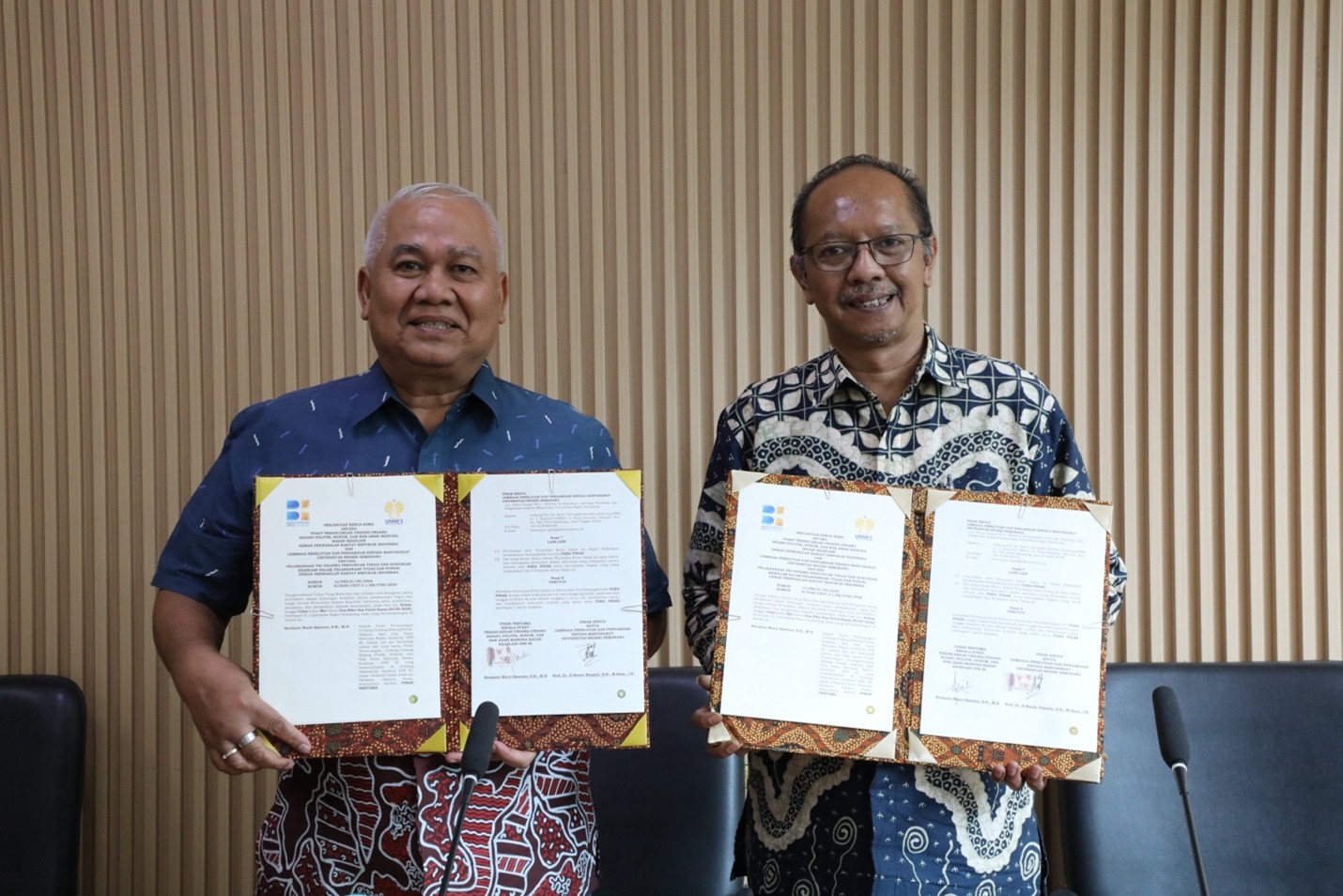
Focus Group Discussion on the Draft Amendment to the Population Administration Law and the Signing of a Cooperation Agreement between the Research and Community Service Institute of Universitas Negeri Semarang and the Center for Legislative Drafting on Political, Legal, and Human Rights Affairs, Agency for Parliamentary Expertise of the Dewan Perwakilan Rakyat Republik Indonesia

Universitas Negeri Semarang > LPPM UNNES - Lembaga Penelitian dan Pengabdian Kepada Masyarakat > berita > Focus Group Discussion on the Draft Amendment to the Population Administration Law and the Signing of a Cooperation Agreement between the Research and Community Service Institute of Universitas Negeri Semarang and the Center for Legislative Drafting on Political, Legal, and Human Rights Affairs, Agency for Parliamentary Expertise of the Dewan Perwakilan Rakyat Republik Indonesia

Tuesday, May 5, 2026 — Focus Group Discussion (FGD) between the Research and Community Service Institute of Universitas Negeri Semarang (LPPM UNNES) and the Secretariat General of the House of Representatives of the Republic of Indonesia (Setjen DPR RI) was held on Tuesday, May 5, 2026, as part of efforts to strengthen the substance of the Draft Law on the Second Amendment to Law Number 23 of 2006 concerning Population Administration. The activity reflected a collaborative initiative between academia and legislative institutions to formulate policies grounded in scientific research, public needs, and the rapid development of information technology.

The event began with opening remarks from Novianto Murti Hantoro, S.H., M.H., Head of the Center for Legislative Drafting on Political, Legal, and Human Rights Affairs, Agency for Parliamentary Expertise of the House of Representatives of the Republic of Indonesia. The FGD was officially opened by the Chair of LPPM UNNES, Prof. Dr. R. Benny Riyanto, S.H., M.Hum., CN. The event also featured the signing of a cooperation agreement between the Center for Legislative Drafting on Political, Legal, and Human Rights Affairs, Agency for Parliamentary Expertise of the House of Representatives of the Republic of Indonesia and LPPM UNNES as a concrete step toward strengthening institutional synergy in research, policy studies, and policy development. The agreement is expected to serve as a foundation for more structured and sustainable collaboration, particularly in supporting the preparation of academic papers, legislative studies, and policy recommendations.

The FGD featured two main speakers, Prof. Dr. R. Benny Riyanto, S.H., M.Hum., CN., and Prof. Dr. Rofi Wahanisa, S.H., M.H., alongside expert respondents from academia and various stakeholders specializing in law, information technology, and public governance. During the discussion session, participants highlighted several important issues, including the need to strengthen personal data protection, prevent the misuse of digital identities, and improve inter-agency coordination systems. Participants also emphasized the importance of harmonizing the proposed regulation with other related laws and regulations to ensure that the legal framework can be effectively implemented and aligned within the broader legal system.

The activity also demonstrated the significant role of higher education institutions in supporting a more transparent and research-based legislative process. Through academic research and expert contributions, universities help ensure that the resulting regulations are not only comprehensive and high-quality, but also capable of addressing real societal needs.

Through the implementation of the FGD and the signing of the cooperation agreement, it is expected that the partnership between the Center for Legislative Drafting on Political, Legal, and Human Rights Affairs, Agency for Parliamentary Expertise of the House of Representatives of the Republic of Indonesia and Universitas Negeri Semarang will continue to strengthen in support of a secure, reliable, and equitable national population identity system. The collaboration represents a shared commitment to advancing more effective public policies that are adaptive to technological developments and beneficial to society. (R)

Leave a Reply

* Kode Akses Komentar:

* Tuliskan kode akses komentar diatas:

We are using cookies to give you the best experience. You can find out more about which cookies we are using or switch them off in privacy settings.
AcceptPrivacy Settings

GDPR

  • Privacy Policy

Privacy Policy

At unnes.ac.id, the privacy of our visitors is of extreme importance to us. This privacy policy document outlines the types of personal information that is received and collected by unnes.ac.id and how it is used.

Log Files

Like many other Web sites, unnes.ac.id makes use of log files. The information inside the log files includes internet protocol (IP) addresses, type of browser, Internet Service Provider (ISP), date/time stamp, referring/exit pages, and number of clicks to analyze trends, administer the site, track user’s movement around the site, and gather demographic information. IP addresses and other such information are not linked to any information that is personally identifiable.

Cookies

unnes.ac.id uses cookies to store information about visitors’ preferences, to record user-specific information on which pages the site visitor accesses or visits, and to personalize or customize our web page content based upon visitors’ browser type or other information that the visitor sends via their browser.

Third-party ad servers or ad networks use technology in their respective advertisements and links that appear on unnes.ac.id and which are sent directly to your browser. They automatically receive your IP address when this occurs. Other technologies (such as cookies, JavaScript, or Web Beacons) may also be used by our site’s third-party ad networks to measure the effectiveness of their advertising campaigns and/or to personalize the advertising content that you see on the site.

unnes.ac.id has no access to or control over these cookies that are used by third-party advertisers.

You should consult the respective privacy policies of these third-party ad servers for more detailed information on their practices as well as for instructions about how to opt-out of certain practices. unnes.ac.id’s privacy policy does not apply to, and we cannot control the activities of, such other advertisers or web sites.

If you wish to disable cookies, you may do so through your individual browser options. More detailed information about cookie management with specific web browsers can be found at the browsers’ respective websites.

Consent

By using our website, you hereby consent to our privacy policy and agree to its terms.

Update

This Privacy Policy was last updated on: 2023-02-14. Should we update, amend or make any changes to our privacy policy, those changes will be posted here.

Contact Us

If you have any questions, comments, or concerns about our Privacy Policy or our practices with regards to your personal information, please feel free to contact us through the contact form on our website or by emailing us at humas[at]mail.unnes.ac.id.

This Privacy Policy is intended as a general guide to our practices in collecting and using information. If there is any inconsistency between this Privacy Policy and the terms of the Service Agreement or any other terms that may apply to specific services you use, then those specific service terms shall apply.

Terms of Use

By using our website, you agree to abide by this Privacy Policy. If you do not agree with this Privacy Policy, please do not use our website. We reserve the right to update this Privacy Policy from time to time without prior notice. Please review our Privacy Policy periodically to check for changes. Your continued use of our website following the posting of changes to this Privacy Policy means that you accept the changes.

Thank you for reading our Privacy Policy. We are committed to protecting the privacy of our website visitors and will continue to update our Privacy Policy to ensure optimal protection.