

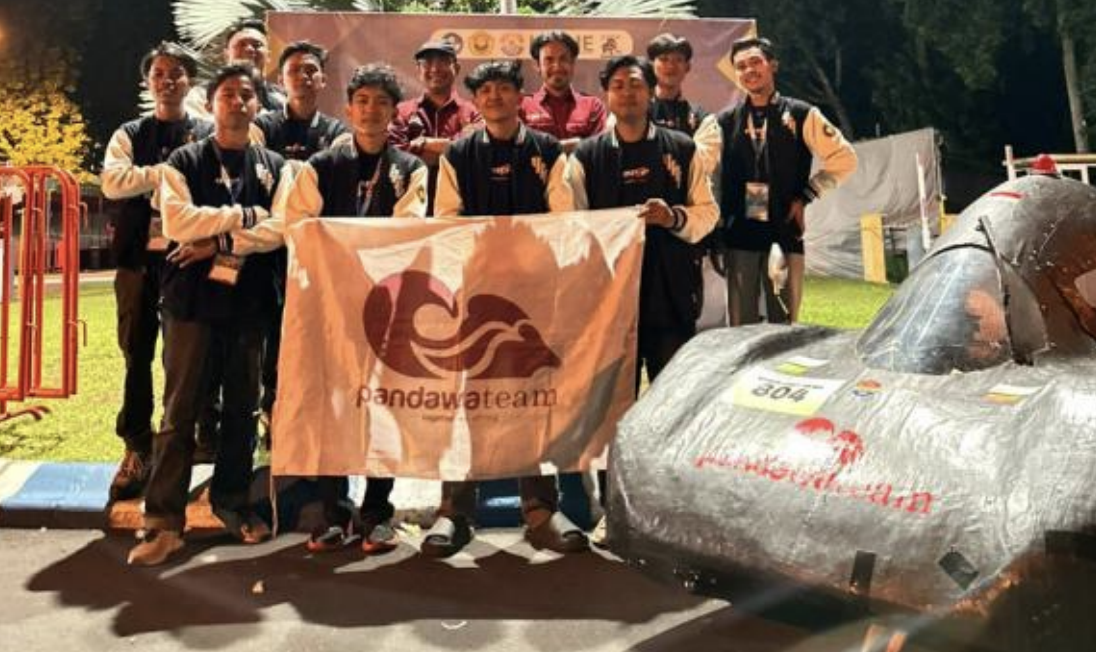
The Pandawa Team from Universitas Negeri Semarang (UNNES) placed fourth in the 2025 Energy-Efficient Car Contest (KMHE), organized by the Ministry of Education, Culture, Research, and Technology in collaboration with the University of Jember, from October 23–27, 2025.
The Pandawa Team competed in the Urban Ethanol Internal Combustion Engine category, achieving a fuel efficiency of 276.361 km/liter. This achievement places UNNES alongside several major universities focused on developing efficient and environmentally friendly vehicles.
Pandawa Team General Manager, Ahmad Khusom Kurniawan, stated that this competition is an important motivation for research development and improving vehicle efficiency.
“Through these results, we will use them as evaluation and learning materials to continue innovating, developing new ideas, and improving vehicle efficiency. We hope that in the next competition, the Pandawa Team can achieve even better results and take home the championship,” he said.
The KMHE Competition is a national event aimed at fostering student creativity, innovation, and collaboration in designing energy-efficient, efficient, and environmentally friendly vehicles. Through this activity, students are encouraged to contribute to the development of sustainable technology in the automotive and alternative energy sectors.
The competition begins with participant registration on the first day, followed by a Technical Inspection on the second day to ensure vehicles meet safety standards and technical regulations. After passing the roadworthiness test, teams proceed to the race sessions on the third and fourth days, which are the main stages of testing the vehicles’ performance and energy efficiency.
The vehicles are the result of student research, featuring aerodynamic designs, lightweight designs, and drivetrains optimized for fuel efficiency. This innovation was born from close collaboration between the supervising lecturers and students, who focus on sustainable vehicle technology and clean energy.
Furthermore, the Pandawa Team’s participation aligns with UNNES’s commitment to the Sustainable Development Goals (SDGs). Through this energy-efficient vehicle innovation, UNNES contributes to SDG 7 (Affordable and Clean Energy) by encouraging the use of alternative energy, SDG 9 (Industry, Innovation, and Infrastructure) by strengthening technology-based research, and SDG 13 (Addressing Climate Change) through low-carbon transportation solutions. Therefore, this team’s participation not only reflects achievement but also demonstrates UNNES’s concrete contribution to sustainable development.
These efforts further strengthen UNNES’s role as a Conservation Campus and an Impact Campus. The campus consistently fosters a culture of research and innovation oriented towards community welfare and environmental sustainability.