

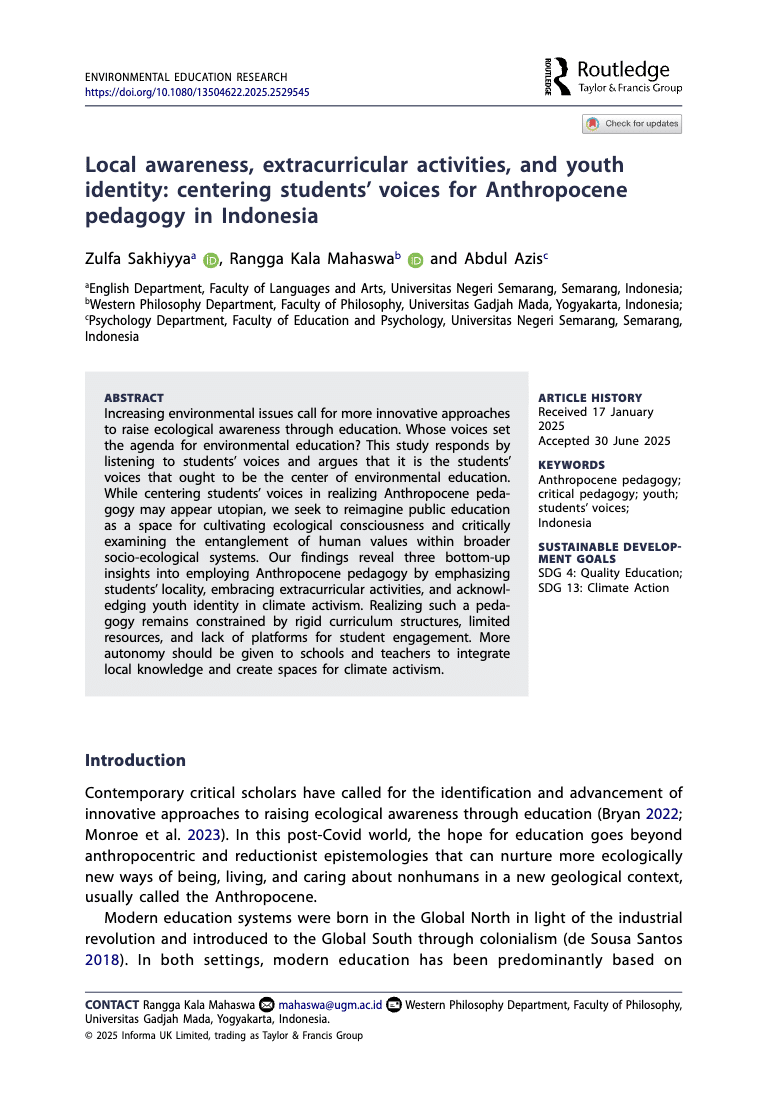
Environmental education is no longer simply delivered in a one-way fashion; it must actively involve students’ voices and ideas. This is the main finding of recent research conducted by Zulfa Sakhiyya, Ph.D., a lecturer at the Faculty of Languages and Arts (FBS) at Universitas Negeri Semarang (UNNES), along with Rangga Kala Mahaswa from Gadjah Mada University and Abdul Azis from the Faculty of Education and Psychology (FIPP) at UNNES.
The research, published in the journal Environmental Education Research and accepted on June 30, 2025, confirms that environmental education will have a greater impact if it is linked to local awareness, extracurricular activities, and the development of youth identity as agents of change.
“Student voices need to be positioned at the center of environmental learning. When students see a direct connection between learning materials and environmental issues in their communities, their empathy and concern will grow stronger,” said Zulfa Sakhiyya.
This research shows that student involvement in local environmental issues such as waste management, water pollution, and flooding can foster a more concrete sense of responsibility. Furthermore, extracurricular activities with environmental themes, arts, and performances provide strategic spaces for creatively expressing and practicing ecological awareness.
Furthermore, the identity of students as members of the younger generation is a key focus of this research. When students are empowered to speak, discuss, and act, they develop an identity as agents of environmental change. With this identity, students are better able to actively contribute to real solutions to environmental problems in their communities.
This research aligns with the Sustainable Development Goals (SDGs), specifically Goal 4 on quality education, Goal 13 on climate change action, and Goal 11 on sustainable communities. Education centered on local student voices is believed to shape a young generation that not only understands environmental issues but is also capable of taking concrete action.
The results of this research are expected to inspire schools in Indonesia to better listen to students’ voices when designing environmental education curricula, thereby creating a future generation that cares about and is responsible for the environment.