
UNNES Encourages Eco-Friendly Batik MSMEs to Introduce Impactful Innovations

Universitas Negeri Semarang > Konservasi UNNES > News > UNNES Encourages Eco-Friendly Batik MSMEs to Introduce Impactful Innovations

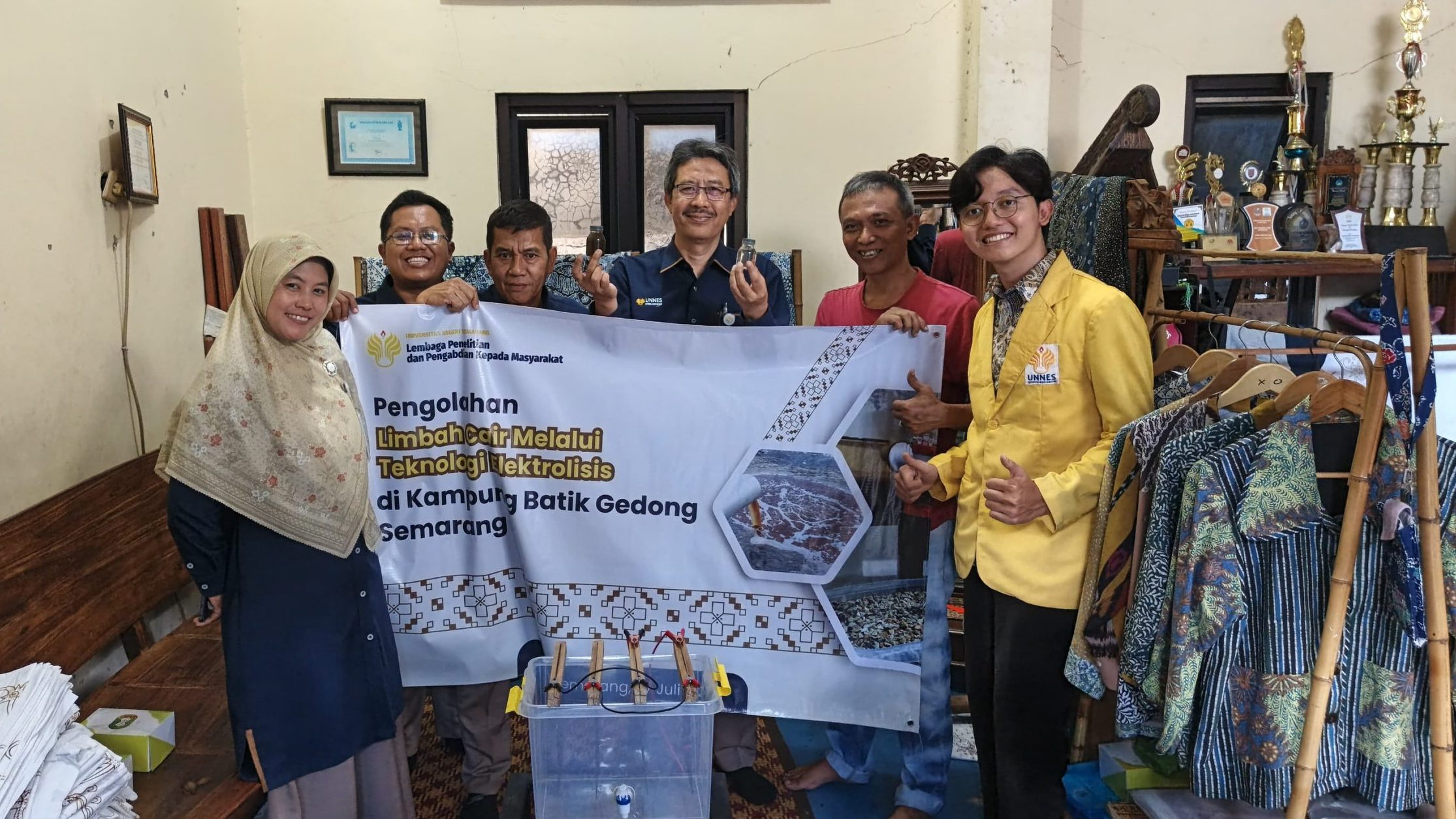
A community service team from Universitas Negeri Semarang (UNNES) conducted a community service activity in Kampung Batik, Semarang, on Monday, July 7, 2025. This activity was part of a lecturer community service program funded by the UNNES Institute for Research and Community Service (LPPM), which aimed to introduce appropriate technology for batik waste processing.

Held at the residence of Mr. Eko Haryanto, a hand-drawn batik artisan in the area, the activity featured an innovative household-scale electrolysis device. This device is designed to purify liquid batik waste through a particle separation process using electric current and electrodes, significantly reducing the color and turbidity of the wastewater.

The community service team was led by Prof. Dr. Nur Qudus, M.T., IPM., and involved several interdisciplinary lecturers, including Dr. Harianingsih, S.T., M.T. from Chemical Engineering, Drs. Bambang Sugiyarto, M.T. from the Department of Chemical Engineering, and Drs. from Civil Engineering, and Virgiawan Adi Kristianto, S.Pd., M.Ed. from Building Engineering Education. This activity was also supported by three students from the Chemical Engineering Department: Indra Sakti Pangestu, Isnina Noor Ubay, and Savira Rinda Erliana.

The activity began with an explanation of the concept and working principles of the electrolysis device, followed by hands-on practice using the device the team had designed. This one-gallon capacity device showed promising results in purifying batik waste, transforming it from a dark, tea-like color to a cleaner and clearer color. Due to its small scale and ease of operation, this device is highly suitable for use by home industries.

The evaluation of the partners revealed that Mr. Eko Haryanto’s knowledge of the waste treatment process increased from 60% to 80%, and his skill in operating the device increased from 50% to 75%. He also expressed strong interest in implementing the device into his existing batik waste processing process.

“I fully understand the concept of how this tool works. We will try to apply and develop it further, and we will collaborate with our existing waste processing techniques. We are very grateful for this activity,” said Eko.

On the same occasion, Prof. Dr. Nur Qudus also expressed his hope that this community service activity would not be merely a temporary academic activity, but could be continuously developed and applied in the field to address real environmental challenges.

“Innovations such as this electrolysis tool are expected to be a practical and affordable solution for batik MSMEs that currently lack adequate waste processing systems,” said Prof. Nur Qudus.

This activity also supports the achievement of the Sustainable Development Goals (SDGs), specifically SDGs 6 (clean water and sanitation), SDG 12 (responsible consumption and production), SDG 13 (addressing climate change), and SDG 14 (marine ecosystems).

As part of the Impactful Diktisaintek program, this activity reflects the concrete implementation of science and technology to address environmental issues in society. By presenting research-based innovations with direct impact, UNNES demonstrates its commitment to bridging academics and practice to promote inclusive and participatory sustainable development.
Related Posts

Leave a Reply

* Kode Akses Komentar:

* Tuliskan kode akses komentar diatas:

We are using cookies to give you the best experience. You can find out more about which cookies we are using or switch them off in privacy settings.
AcceptPrivacy Settings

GDPR

  • Privacy Policy

Privacy Policy

At unnes.ac.id, the privacy of our visitors is of extreme importance to us. This privacy policy document outlines the types of personal information that is received and collected by unnes.ac.id and how it is used.

Log Files

Like many other Web sites, unnes.ac.id makes use of log files. The information inside the log files includes internet protocol (IP) addresses, type of browser, Internet Service Provider (ISP), date/time stamp, referring/exit pages, and number of clicks to analyze trends, administer the site, track user’s movement around the site, and gather demographic information. IP addresses and other such information are not linked to any information that is personally identifiable.

Cookies

unnes.ac.id uses cookies to store information about visitors’ preferences, to record user-specific information on which pages the site visitor accesses or visits, and to personalize or customize our web page content based upon visitors’ browser type or other information that the visitor sends via their browser.

Third-party ad servers or ad networks use technology in their respective advertisements and links that appear on unnes.ac.id and which are sent directly to your browser. They automatically receive your IP address when this occurs. Other technologies (such as cookies, JavaScript, or Web Beacons) may also be used by our site’s third-party ad networks to measure the effectiveness of their advertising campaigns and/or to personalize the advertising content that you see on the site.

unnes.ac.id has no access to or control over these cookies that are used by third-party advertisers.

You should consult the respective privacy policies of these third-party ad servers for more detailed information on their practices as well as for instructions about how to opt-out of certain practices. unnes.ac.id’s privacy policy does not apply to, and we cannot control the activities of, such other advertisers or web sites.

If you wish to disable cookies, you may do so through your individual browser options. More detailed information about cookie management with specific web browsers can be found at the browsers’ respective websites.

Consent

By using our website, you hereby consent to our privacy policy and agree to its terms.

Update

This Privacy Policy was last updated on: 2023-02-14. Should we update, amend or make any changes to our privacy policy, those changes will be posted here.

Contact Us

If you have any questions, comments, or concerns about our Privacy Policy or our practices with regards to your personal information, please feel free to contact us through the contact form on our website or by emailing us at humas[at]mail.unnes.ac.id.

This Privacy Policy is intended as a general guide to our practices in collecting and using information. If there is any inconsistency between this Privacy Policy and the terms of the Service Agreement or any other terms that may apply to specific services you use, then those specific service terms shall apply.

Terms of Use

By using our website, you agree to abide by this Privacy Policy. If you do not agree with this Privacy Policy, please do not use our website. We reserve the right to update this Privacy Policy from time to time without prior notice. Please review our Privacy Policy periodically to check for changes. Your continued use of our website following the posting of changes to this Privacy Policy means that you accept the changes.

Thank you for reading our Privacy Policy. We are committed to protecting the privacy of our website visitors and will continue to update our Privacy Policy to ensure optimal protection.