

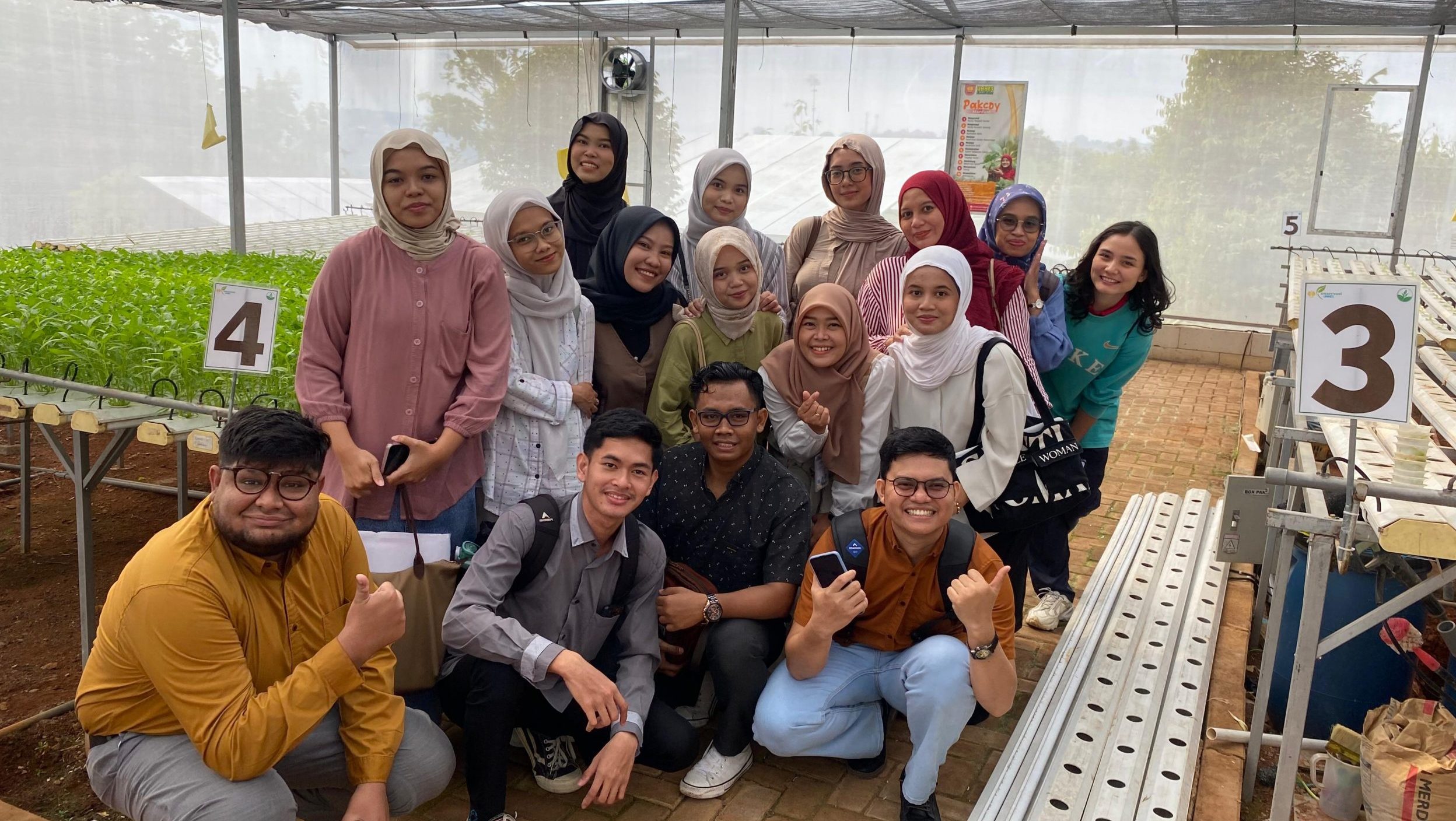
A total of 15 students of the Master of Economics Education Program, Universitas Negeri Semarang (UNNES) conducted an educational visit to the UNNES Ecofarm located behind the Faculty of Sports Science Building, on Friday (13/6). This activity lasted for approximately three hours and was accompanied by three accompanying lecturers: Prof. Dr. Amin Pujiati, S.E., M.Sc., Dr. Dyah Maya Nihayah, S.E., M.Sc., and Dr. Inaya Sari Melati, S.Pd., M.Pd.
The visit began with remarks from the Head of the UNNES Conservation Sub-Directorate, Prof. Dr. Nana Kariada Tri Martuti, M.Sc. In her remarks, she emphasized the importance of involving the younger generation in supporting the achievement of the Sustainable Development Goals (SDGs), especially Goal 12 (Responsible Consumption and Production) and Goal 13 (Addressing Climate Change).
The students then attended an introductory session on the maggot ecosystem, covering the life cycle, cultivation techniques, types of feed, and their benefits in managing organic waste. In her presentation, Dr. Inaya emphasized that maggots not only act as an ecological solution in waste processing, but also have potential economic value.
“This is a real form of a circular economy. From waste to blessing,” said Dr. Inaya.
After the maggot education session, the students continued their visit to the organic plant mini farm and hydroponic garden that are sustainably managed by Ecofarm UNNES. They had the opportunity to witness firsthand environmentally friendly agricultural practices and participate in the process of harvesting vegetables such as pak choy and mustard greens. The harvest can be purchased at affordable prices as part of an effort to introduce the concept of local agriculture to the surrounding community.
In the reflection session, Prof. Amin Pujiati said that the cradle to cradle concept applied at Ecofarm is a real implementation of the principle of sustainability in education.
“Nothing is wasted in nature. Everything returns to the cycle of life. This is what we hope students will understand as prospective educators and agents of change,” she said.
He also emphasized that this activity is in line with UNNES’ vision as a conservation campus that supports the achievement of SDGs through education, research, and real action in society.
This activity provides inspiration that the transformation towards a sustainable lifestyle can start from simple steps. Caring for the earth is a cross-generational responsibility. As the message conveyed in this activity: “The earth does not need us, but we cannot live without the earth. Let’s take care of the earth with real action starting from ourselves, starting from today.”