

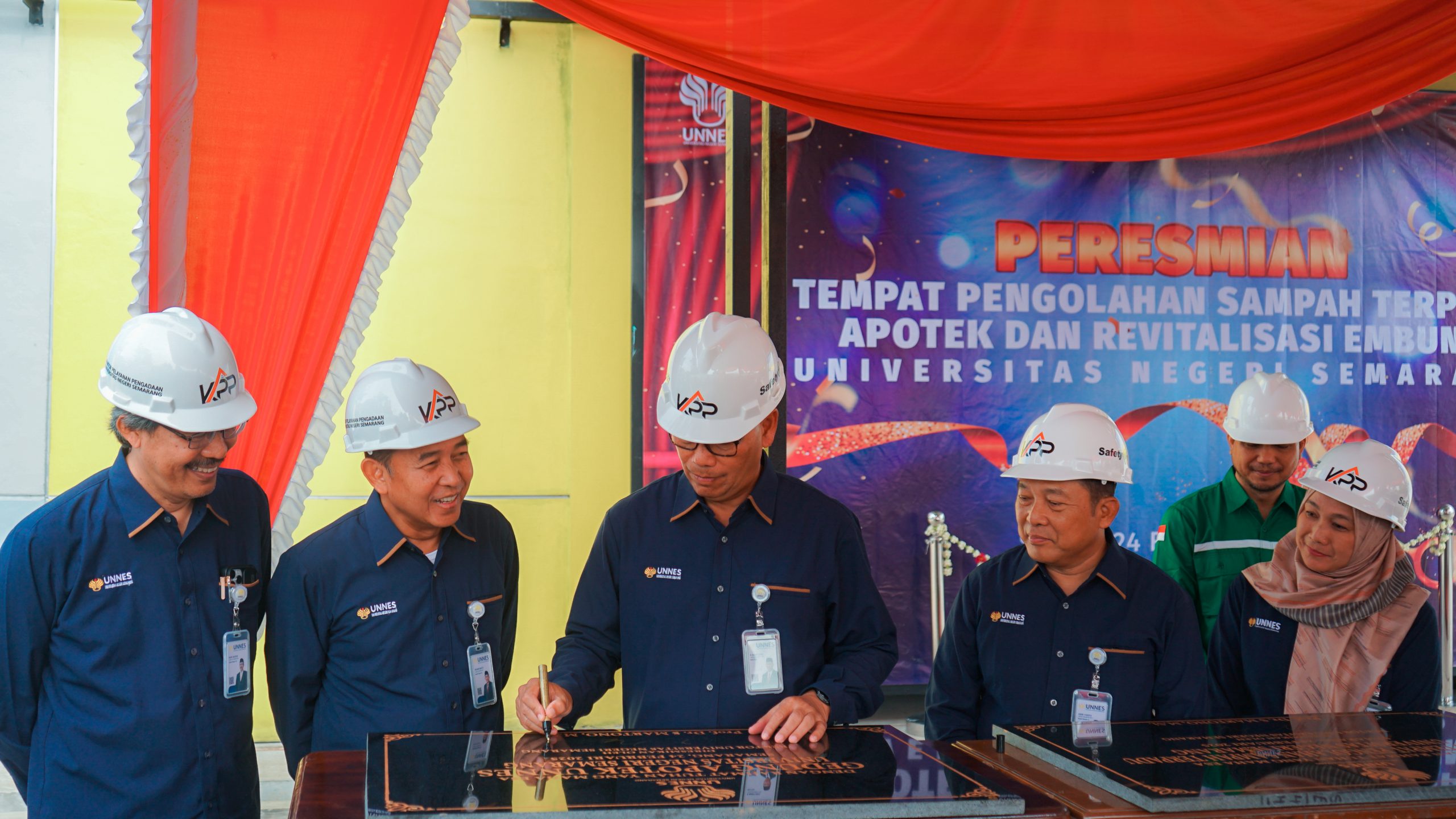
Universitas Negeri Semarang (UNNES) continues to demonstrate its commitment to conservation and education by inaugurating three strategic projects: the Integrated Waste Processing Facility (TPST), Pharmacy, and Revitalization of UNNES Reservoir. The inauguration, which took place on February 24, 2025 at the UNNES Campus, Sekaran, confirmed that the three facilities have the main objective of supporting learning, which is then followed by development in the health and business sectors.
In his report, the Head of the Procurement Service Office, Untoro Nugroho, S.T., M.T., explained that the construction of TPST is a concrete form of UNNES’ vision in realizing conservation insight. This TPST is a relocation from the old location which has the potential to conflict with community interests. With the land area increased from 940 square meters to 1540 square meters, UNNES continues to maintain its achievement as a zero waste campus for the past five years.
“For the past five years, UNNES has succeeded in implementing the zero waste concept without dumping waste into the TPA. With this new TPST, we are sure that the performance of waste processing will be increasingly optimal,” said Untoro.
In addition to TPST, the revitalization of UNNES reservoirs is an effort to optimize water management. Later, rainwater and water runoff in UNNES can stop in the campus environment without burdening the Semarang City drainage system. Revitalization of the reservoir also includes the installation of water wheels, fountains for aeration, and LG-sonic ultrasonic transmitters for algae control, all of which are supported by solar panels.
Meanwhile, the construction of the UNNES Pharmacy aims to improve health services for the academic community and the surrounding community. This pharmacy will be a one-stop service, where medical consultations can be directly followed by taking medicine. In the future, UNNES will also develop the concept of herbal assistance, so that the community has options for treatment.
In his remarks, UNNES Chancellor, Prof. Dr. S. Martono, M.Si emphasized that these three projects have the main priority as a means of learning.
“TPST will be a center for research and student internships, the reservoir will support learning for the Biology study program as well as being a recreational destination, and the pharmacy will support education in the Pharmacy and Medicine study programs and improve health services. Only then, these three facilities can be further developed in terms of business and health services,” said Prof. Martono.
With a larger waste processing capacity, a reservoir that is an educational and recreational area, and a pharmacy that serves health needs, it is hoped that these three facilities will not only be used by UNNES residents, but also the surrounding community. UNNES continues to strive to provide the best contribution to the environment and society.