

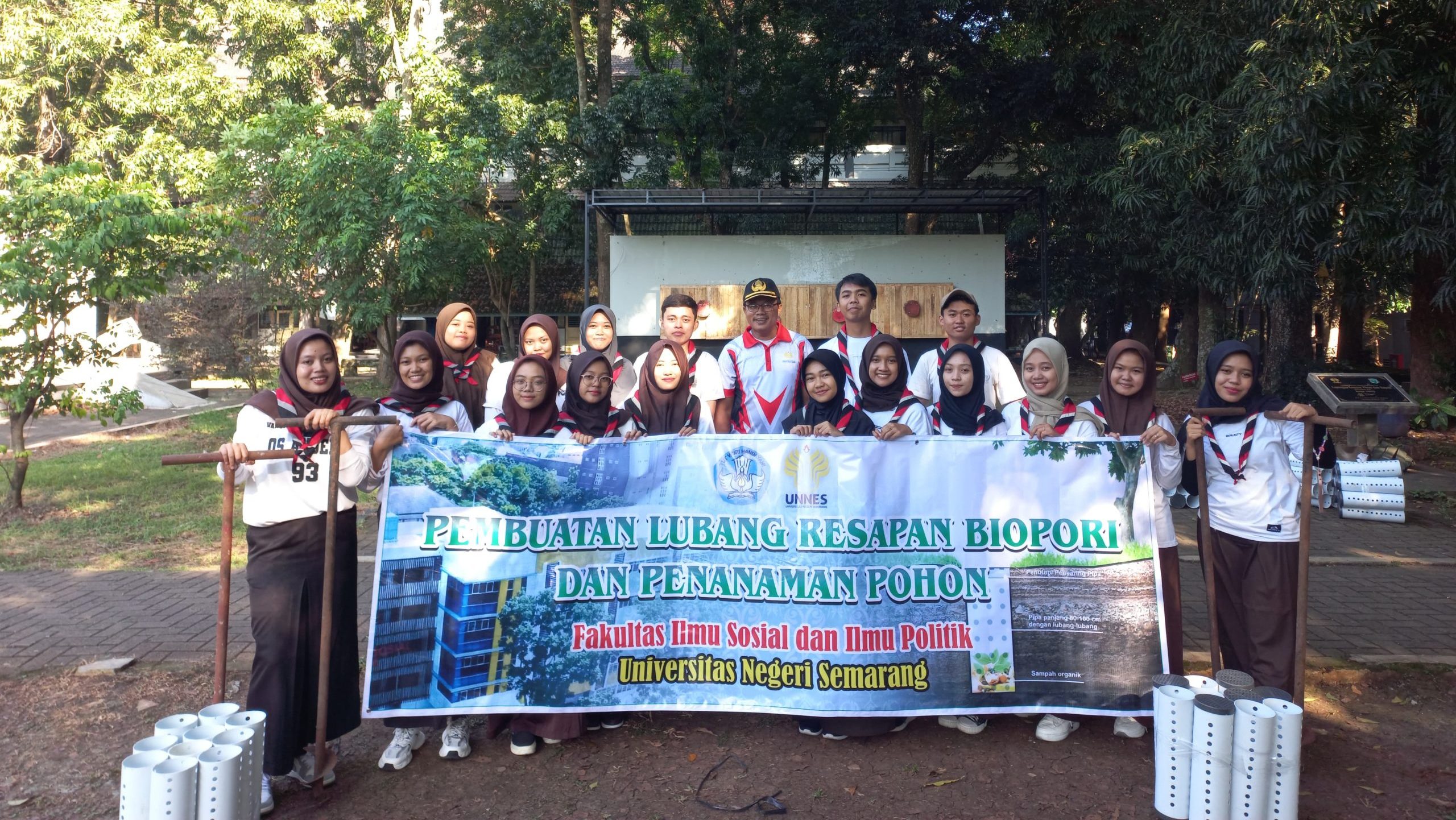
In order to support the achievement of the Sustainable Development Goals (SDGs), especially Goal 6 (Clean Water and Sanitation), the Faculty of Social and Political Sciences, Universitas Negeri Semarang (FISIP UNNES) through the Conservation Group in collaboration with Student Scouts Training Group 3 carried out the activity of making hundreds of biopore holes in the FISIP Sekaran campus environment, Gunungpati, on Saturday (14/6).
This activity is a real manifestation of the implementation of UNNES’ vision as a conservation university, as well as a form of FISIP UNNES’ active contribution to environmental preservation.
The Dean of FISIP UNNES, Prof. Dr. Arif Purnomo, S.Pd., S.S., M.Pd., who was directly involved in the activity, said that making biopore holes is a simple activity but has a big impact. Holes can be made at the bottom of channels, flooded areas, to the edges of parks and paving blocks.
“Although easy to do, not everyone understands the great benefits of biopores,” he said.
The head of the event, Rudi Salam, explained that the theme of environmental conservation was chosen because it is in line with one of UNNES’s main pillars.
“Previously, there was a program of one student, one tree. Now, we are adding a movement of one student, one biopore hole, to maintain the availability of groundwater and manage organic waste into compost,” said Rudi.
The head of the FISIP UNNES Scouts, Wazifun, added that biopore infiltration holes are an environmentally friendly, appropriate technology to overcome the problems of flooding and drought.
“During the rainy season, biopore holes help increase water absorption capacity, thereby reducing puddles. Meanwhile, in the dry season, biopores help maintain the availability of groundwater,” he explained.
This initiative not only supports Goal 6 (Clean Water and Sanitation), but also supports Goal 13 (Addressing Climate Change) and Goal 15 (Maintaining Terrestrial Ecosystems). Through this activity, FISIP UNNES confirms its commitment to integrating environmental conservation actions into campus life and forming the character of students who care about the sustainability of the earth.