

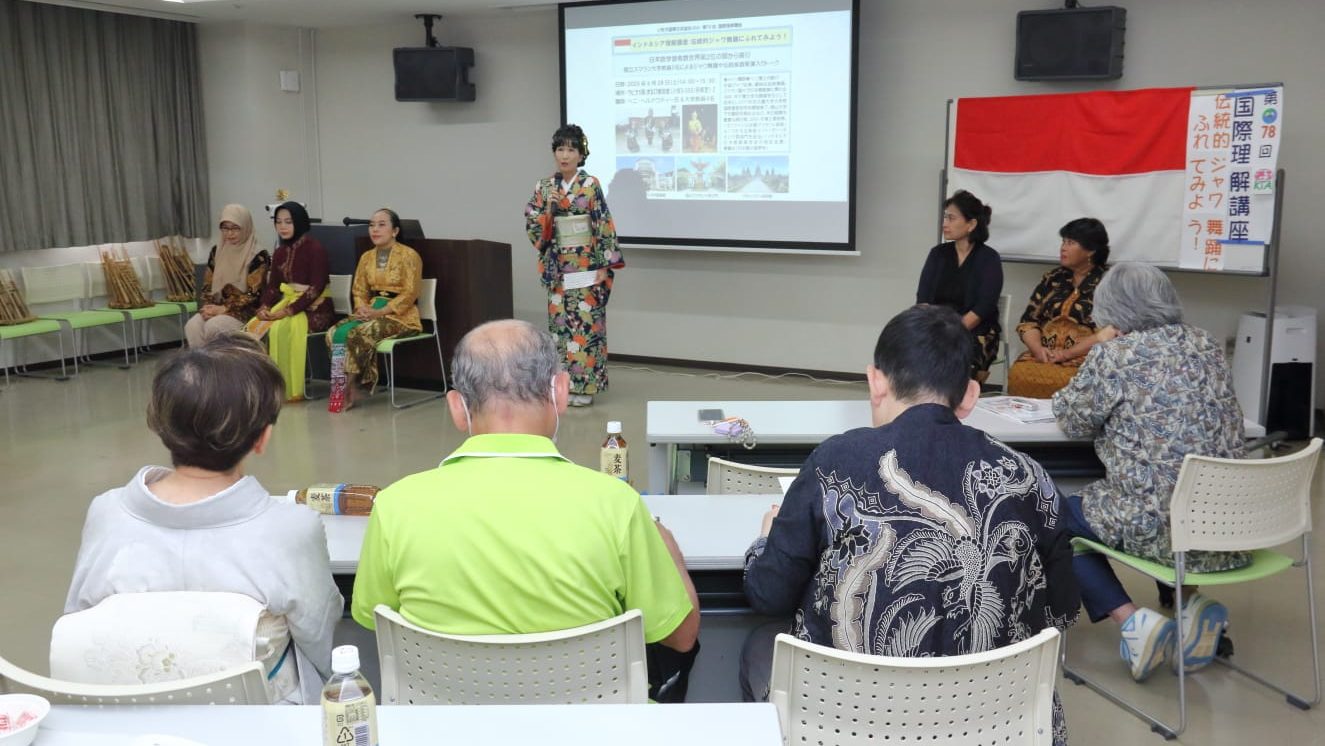
The Faculty of Languages and Arts of Universitas Negeri Semarang (UNNES) conducted an overseas community service activity themed “Local and Global Aesthetics: Integrating Traditional Japanese and Javanese Dance Elements” at the Komaki International Association (KIA), Japan, on Saturday (June 28, 2025).
The activity was led by Usrek Tani Utina, a lecturer in the Dance Education Study Program, along with a team consisting of Heni Hernawati, Setyani Wardhaningtyas, and Dwi Puji Asrini (Japanese Language Education), and Siti Aesijah (Music Education). They represented FBS UNNES based on an official assignment letter from the Dean, in an effort to strengthen cross-border cooperation through cultural and arts training.
This activity was implemented in response to the challenges of globalization, which encourage the preservation of local values amidst the flow of global culture. Through the training in Surakarta-style Javanese dance, the FBS UNNES team introduced the philosophy and aesthetics of traditional Indonesian dance movements, which are rich in spiritual values and character building.
The training was enthusiastically received by participants from various backgrounds. They were introduced to a variety of basic Javanese dance movements and their underlying philosophy. One of the main offerings was the Golek Mugirahayu dance performance, which was presented to strengthen participants’ understanding of the concepts of attitude and expression in Javanese dance.
Training participants noted the similarities between Javanese dance and the Japanese art of Kabuki, particularly in terms of the meaning of movement, depth of feeling, and discipline of practice. In a serious and engaged atmosphere, they imitated each movement meticulously.
The event was opened and closed by Tomiko Terakawa, a KIA member and Kabuki dancer. In her remarks, she stated that this activity significantly contributed to enriching cross-cultural perspectives through an artistic approach. She also highlighted three important values of the training:
- Harmony and Congruence (aesthetic feeling) – dance movements that teach balance between body, rhythm, and feeling, relevant as a medium for developing self-awareness (mindfulness).
- Symbolism and Philosophical Meaning – dance movements imbued with spiritual and ethical values can serve as a bridge for cultural understanding.
- Discipline and Perseverance (practice ethos) – a structured training method serves as the foundation for character education, in line with the principles of Kabuki.
This activity also supports the achievement of the Sustainable Development Goals (SDGs), specifically points 4 (Quality Education), 11 (Sustainable Cities and Communities), and 17 (Partnerships to Achieve the Goals).
The interactive discussion at the end of the activity further deepened the participants’ understanding of Javanese and Indonesian culture in general. Participants acknowledged gaining valuable experience that fueled their interest in studying Indonesian traditional arts in greater depth.
Receiving the participants’ enthusiasm, FBS UNNES hopes that this activity can be continued through ongoing collaborations, both in the arts and other areas of education and culture.